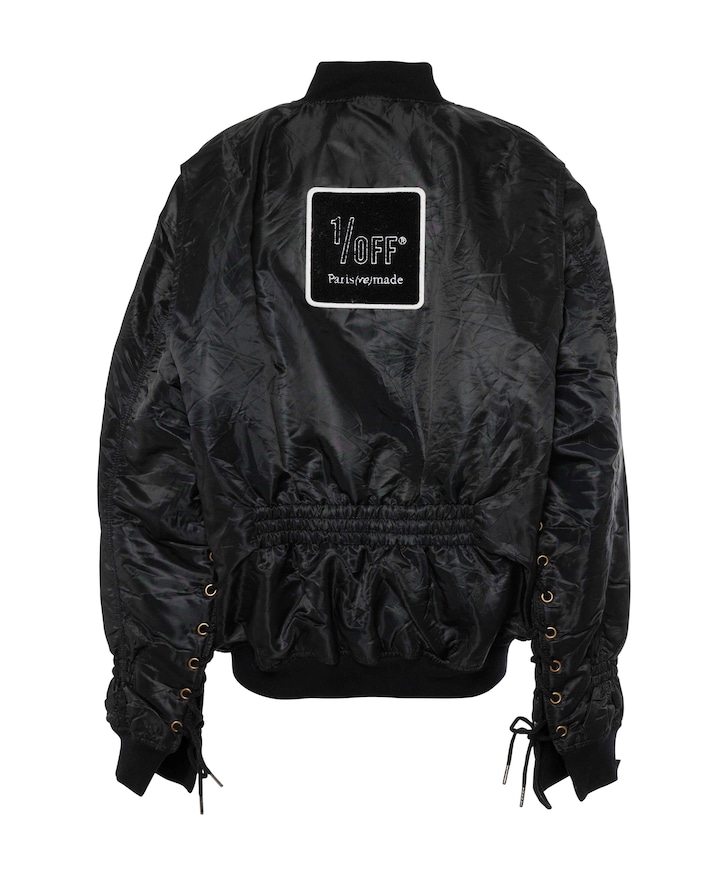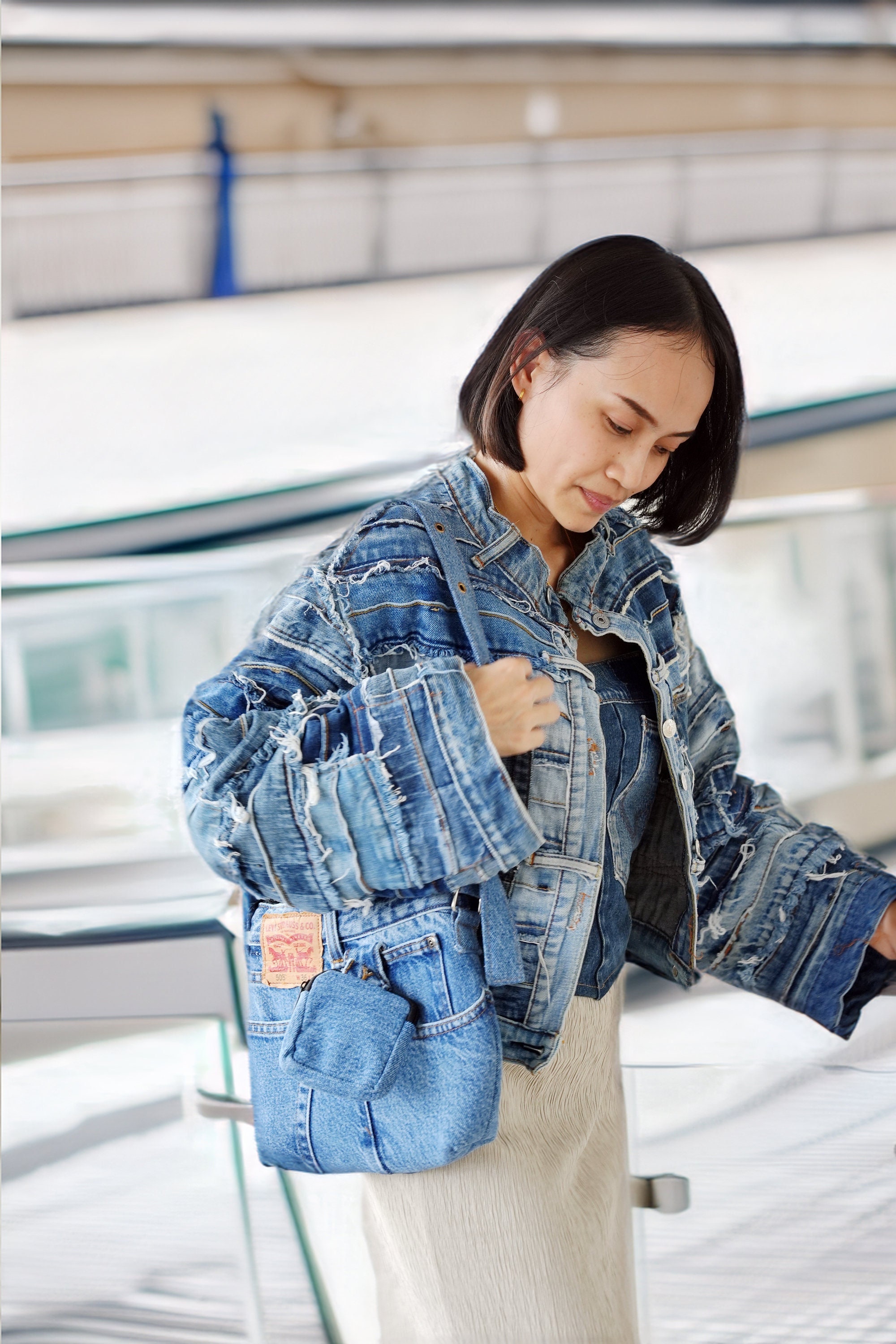
The most subversive garment in fashion right now isn't a couture gown or a limited-edition sneaker. It's a denim jacket — the 1/OFF Paris Upcycled Denim Jacket, assembled from dismantled vintage denim and re-cut into a silhouette that reads as deliberately, unmistakably luxury. The Amsterdam-based house built its entire proposition on a single provocation: the most sustainable garment is one already made, and the most interesting way to make it new is to take it apart. That proposition is now being validated at scale. Forbes recently reported 400% growth for 1/OFF Paris, framing the brand as the antidote to what it called luxury's "eco-apathy" — an industry that has spent a decade issuing sustainability reports while producing more clothes than ever.
The Argument, Made Tangible
Construction is where the thesis stops being a talking point. Each Upcycled Denim Jacket begins as multiple pairs of post-consumer jeans, sorted by wash, weight, and fade. The studio then deconstructs them — seams opened, panels flattened, hardware salvaged — before rebuilding the material into a single jacket. Because the source denim varies, no two jackets are identical in tone or patina.
The classic trucker architecture survives intact: pointed collar, button-front placket, chest flap pockets, adjustable waist tabs. What changes is the surface. Panels meet at unexpected angles. Indigo shifts register across the body in blocks of faded grey-blue and deep raw navy. Reclaimed buttons and rivets carry the small scars of their previous lives. The result sits somewhere between an heirloom and a collage — and it's precisely that refusal of uniformity that gives the piece its authority.
Denim Is the Right Battleground
This matters because denim is the most environmentally compromised fabric in the average wardrobe. Conventional cotton cultivation is water-intensive, indigo dyeing pollutes waterways, and the finishing processes that produce a lived-in fade involve sandblasting, chemical washes, and enormous energy expenditure. Upcycling sidesteps nearly all of it. The fibre already exists. The water has already been spent. The carbon has already been emitted.
What 1/OFF Paris adds is labour and design — the two inputs the luxury sector has always claimed to value most. In doing so, the brand reframes sustainability not as a concession to virtue but as a design constraint that produces better clothes. A jacket made from ten discarded pairs of jeans is, by any honest measure, more labour-intensive and more singular than one cut from a roll of freshly milled selvedge.
Amsterdam, and the Moment
The timing isn't incidental. Amsterdam Fashion Week has been aggressively repositioning itself as a platform for exactly this kind of practice, and Vogue's recent scrutiny of the city's fashion identity suggests the industry is looking to the Netherlands for a model. Meanwhile, the broader conversation has shifted. Vogue has catalogued the rise of recycled and upcycled denim as a legitimate category rather than a niche; HIGHXTAR has asked whether haute couture itself can be rebuilt for a sustainable future. 1/OFF Paris answers that question with denim rather than taffeta, which is arguably the smarter move — it puts the argument on the body of anyone who wears a jacket, not just the clients of a Paris atelier.
Who It's Actually For
Not the collector chasing a logo. Not the purist who insists on raw Japanese selvedge. The 1/OFF Paris Upcycled Denim Jacket is for the person who has grown suspicious of newness — who understands that a garment carrying visible history has more to say than one engineered to look untouched. It's for the buyer who wants luxury's cut and finish without luxury's extraction ledger. Worn over a slip dress, it reads as insouciant. Worn over tailoring, it reads as a rebuke. Either way, it's doing what fashion claims to do and so rarely does: making an idea wearable.
Strip away the buzzwords and 1/OFF Paris is making a fairly old-fashioned claim — that clothes get better when someone actually touches them. The house just happens to be proving it with other people's jeans, and turning the industry's most compromised fabric into its most convincing argument.