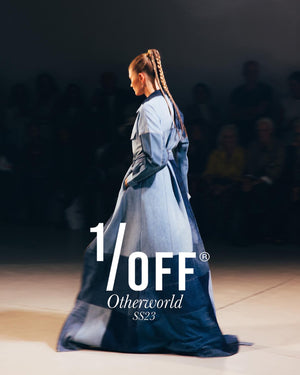
There is a particular silence that falls over a room when genuine couture enters it — the hush reserved for things made by hand, made once, made to last. 1/OFF Paris has built its entire identity on that silence, then broken it, brilliantly. The Amsterdam- and Paris-based label's Upcycled Couture Collection takes the rarest garments on earth — vintage Chanel, Dior, Yves Saint Laurent, archival designer pieces sourced from estates and auction houses — and deconstructs them into entirely new silhouettes. Not costume, not homage: couture, reimagined. The market has answered with a 400% growth surge, a story Forbes recently framed as upcycling's long-overdue conquest of luxury's "eco-apathetic" upper tier.
The mechanics are what make it extraordinary. Each piece begins as a finished, historically significant garment. 1/OFF's atelier then reverses, splices, and reconstructs it — a Chanel bouclé jacket becomes a cropped, raw-edged bolero; deadstock couture silk is re-cut into a single, sculptural dress. The house calls the process "upcycling couture," and the phrase is precise: the materials carry decades of craftsmanship inside them, and the design work is an act of translation rather than erasure. Hardware, linings, and label fragments are often left visible as deliberate artifacts — provenance becomes part of the new design language. Nothing is added that dilutes the original; everything is reconsidered.
The Anti-Aesthetic of Sustainability
What separates 1/OFF Paris from the broader upcycling movement is its refusal to treat sustainability as an aesthetic. There is no hemp, no earnest earth tones, no visual apology. The Upcycled Couture Collection looks like what it is: high fashion with a memory. Silhouettes are sharp and architectural, tailoring is precise, and the finish is unmistakably luxury — because the raw material already was. This is the brand's crucial argument to an industry still largely addicted to virgin resources: the most sustainable garment in the world is the one already made, and reworking it demands more skill, not less. It is a thesis that lands as the conversation around fashion's environmental cost shifts from marketing copy to boardroom imperative.
Perfectly Timed
The cultural timing is not accidental. 1/OFF's rise has coincided with a broader reappraisal of what couture means in the twenty-first century — questions raised everywhere from Amsterdam Fashion Week, where the brand's home city has become a genuine laboratory for responsible design, to critical debate over whether haute couture can be reinvented for a sustainable future at all. The label's recent fashion film, "Into the Unknown," extended that argument into moving image, positioning upcycled couture not as nostalgia but as forward motion. Meanwhile, the secondhand and archival market has never been more culturally central; vintage denim, resale platforms, and deadstock sourcing have moved from niche to mainstream. 1/OFF sits at the apex of that shift, operating where scarcity, craft, and conscience intersect.
One of One, By Definition
The collection is not for everyone, and it doesn't pretend to be. These are investment pieces for collectors who understand that a reconstructed couture jacket is, by definition, one of one — a garment that cannot be reproduced, only owned. It appeals to the client who has tired of logos and is looking for provenance, to the stylist hunting something no one else can pull, and to the conscious consumer who wants their luxury to survive scrutiny. It also speaks to a younger generation of buyers for whom sustainability is not a compromise but a criterion — and for whom the story behind a piece is as valuable as the piece itself.
The Commercial Proof
Why it matters now is simple: 1/OFF Paris has produced the evidence the luxury sector has been waiting for. Upcycling at the couture level is not a charitable gesture or a capsule PR exercise — it is a viable, scalable, and desirable business, one growing at a rate conventional luxury houses cannot ignore. The Upcycled Couture Collection is the clearest articulation of that idea yet: proof that the future of luxury may not be manufactured at all, but recovered, reconsidered, and reborn.
That, in the end, is the philosophy in its purest form — a house that takes what the past made precious and asks what it can still become. In a room full of new things, 1/OFF Paris offers something rarer: a second life, made by hand, made once, made to last.