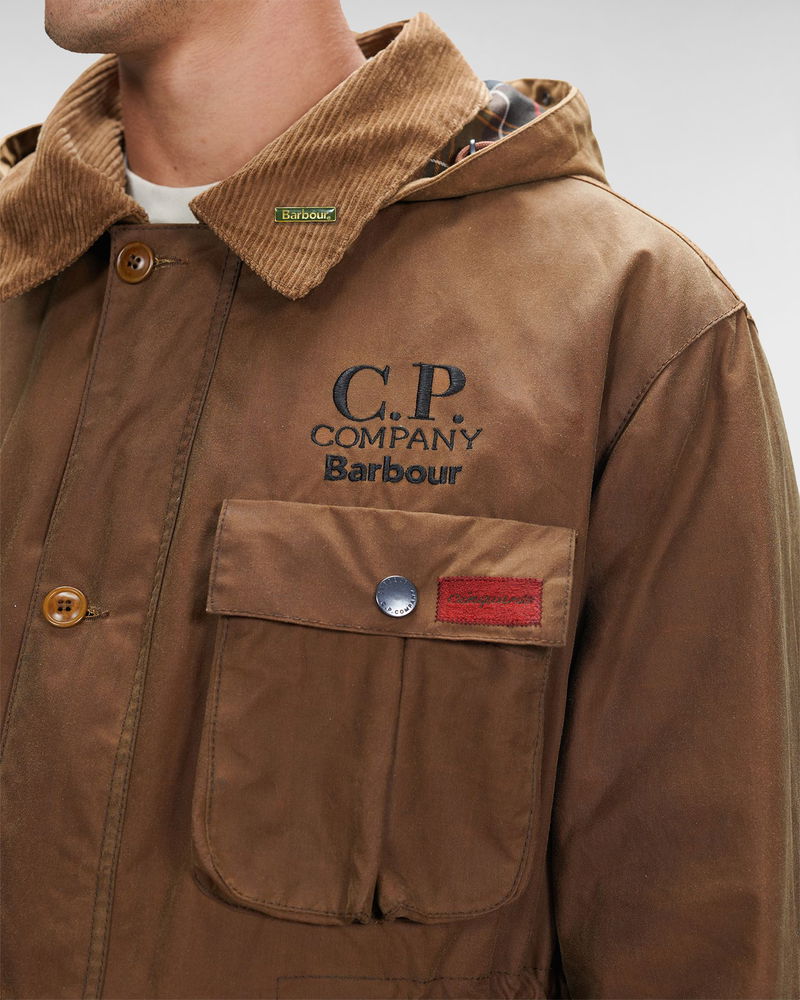
In an era when collaborations arrive with exhausting frequency and depart just as quickly, the ones that endure tend to share a certain restraint—a mutual respect between houses rather than a marketing marriage of convenience. The A.P.C. x Barbour Thornproof Wax Cotton Jacket, unveiled for Fall/Winter 2026, belongs firmly to that more considered tradition. Here, the Parisian label's quietly rigorous approach to wardrobe essentials meets the British heritage of Barbour, and the result is not a novelty but a garment with genuine lineage: a jacket pulled from the South Shields archive and reissued through A.P.C.'s exacting, understated lens.
The story begins with the fabric itself. Thornproof wax cotton is among Barbour's most storied materials, a densely woven cotton saturated with wax to repel weather and withstand the abrasions of field and hedgerow—hence the name. It is a textile with memory, softening and patinating with wear until the jacket becomes a record of its owner's movements. For FW26, A.P.C. and Barbour have drawn this archive material back into production, honoring its functional origins while refining the cut for a contemporary silhouette. The result reads as unmistakably Barbour in texture and unmistakably A.P.C. in proportion: clean lines, a measured fit, and an absence of superfluous detail that lets the cloth speak.
A Material With Memory
Thornproof wax cotton does not arrive asking to be noticed. It asks to be worn—through weather, through seasons, through the small abrasions of daily life. The wax finish gives the surface a quiet sheen that shifts with the light, deepening where the fabric creases and folding into a patina that no two owners will share. That quality of change over time is precisely what makes the material worth returning to: it resists the disposable logic of so much contemporary fashion, rewarding patience instead.
Two Houses, One Conviction
That restraint is the point. A.P.C.'s founder, Jean Touitou, built the house on a philosophy of durable, honest clothing—raw denim, crisp shirting, the kind of pieces meant to be worn hard and kept for years. Barbour's own heritage rests on a parallel conviction: garments engineered for the long haul, repaired rather than replaced. Bringing the two together is less a stylistic mash-up than a meeting of kindred values. The collaboration arrives as A.P.C. continues an unusually productive streak of partnerships, and it cements the label's instinct for choosing counterparts with genuine craft credentials rather than mere visibility.
From Field to City, Without Losing the Plot
Culturally, the waxed jacket occupies a singular place. Born of rural utility, it was adopted decades ago by a certain urban sensibility—the riding coat and the field jacket migrating from countryside to city, from function to signifier, without ever quite losing their practical soul. The A.P.C. x Barbour piece honors both lives. It is rugged enough for weather and wear, refined enough for the city, and free of the logo-heavy signaling that dates so many collaborations. This is a jacket for the person who buys few things and keeps them: the architect, the editor, the traveler who prefers one excellent coat to five forgettable ones.
Why It Lands Now
Why it matters now is partly a matter of timing and partly a matter of temperament. As fashion cycles ever faster toward novelty, the appetite for archive-driven, material-first clothing has sharpened—consumers increasingly want provenance and permanence over hype. A jacket resurrected from Barbour's own history, made in thornproof wax cotton, and shaped by A.P.C.'s disciplined eye answers that appetite precisely. It is a quiet statement in a loud season, and it rewards the wearer who understands that the best collaborations are conversations, not advertisements.
For the devoted follower of either house, the A.P.C. x Barbour Thornproof Wax Cotton Jacket is the rare crossover that feels inevitable rather than opportunistic—a garment that carries its history in the weave and its future in the wearing. It is, in the end, a distillation of what both labels have always believed: that good clothing is not designed to be noticed once, but to be lived in for years.