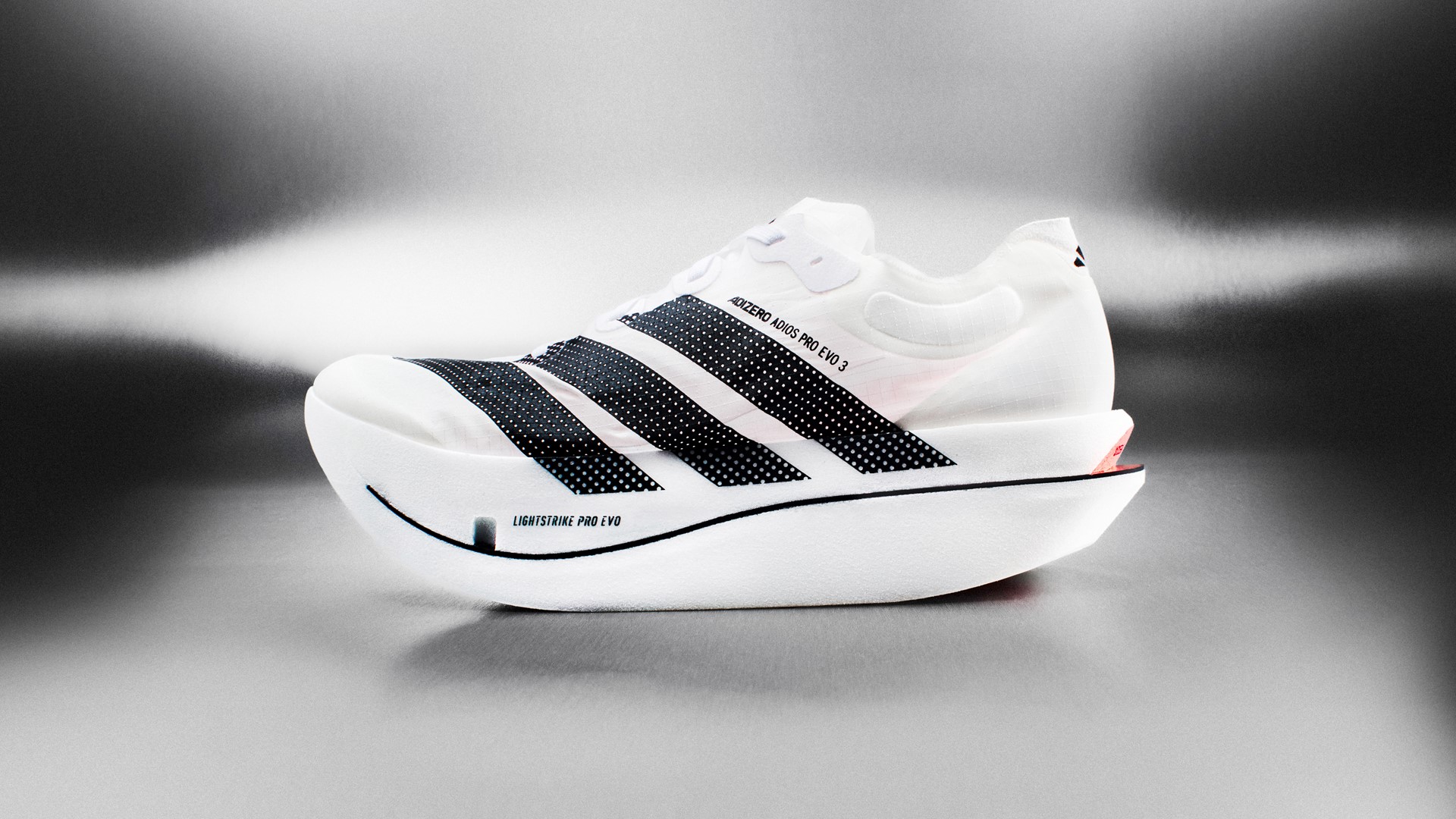
When Adidas released the first Adizero Adios Pro Evo, it did something the running world hadn't seen in years: it made a $500 racing shoe feel like a bargain. Now, with the Adizero Adios Pro Evo 3, the German sportswear giant has pushed the concept further, and the results are no longer a matter of marketing spin. Through the 2026 marathon season, the shoe has dominated the World Marathon Majors with a margin that has left competitors searching for answers, and TIME has recognized it as one of the Best Inventions of 2026. For a category that once measured progress in grams and millimeters, the Evo 3 represents something closer to a genuine leap.
There's a particular kind of obsession that lives at the intersection of engineering and endurance sports—where a few ounces and a fraction of a millimeter can mean the difference between a personal best and a season of wondering what went wrong. The Evo 3 sits squarely at that intersection, and it has become the rare piece of equipment that carries an almost mythical status among elite athletes and obsessive amateurs alike.
The Art of Subtraction
The story of the Evo 3 begins with restraint. Where most supershoes pile on foam, plate, and rubber in pursuit of stability, Adidas stripped the design to its essentials. The midsole is built from a remarkably light, highly resilient foam compound that returns energy with an almost springy immediacy, paired with a carbon-infused propulsion system that guides the foot through toe-off rather than forcing it.
The upper is gossamer-thin, a translucent mesh that feels closer to a second skin than a shoe, with minimal overlays and a heel counter so pared back it borders on the radical. Every element exists to reduce mass without sacrificing the geometry that makes fast running feel effortless. It's a philosophy of subtraction—the rare case where what's been removed tells you more about the design than what remains.
Refinement Over Revolution
What separates the Evo 3 from its predecessor is not simply weight—already astonishingly low—but the refinement of its ride. Adidas engineers have tuned the rocker profile so the transition from heel strike to toe-off feels continuous rather than segmented, a subtlety that matters enormously over 26.2 miles.
The outsole uses a sparse, strategic rubber layout that grips without bulk, and the fit has been widened slightly at the forefoot to accommodate the natural splay of a fatigued foot in the final miles. These are not headline-grabbing changes. They are the kind of details that separate a shoe that wins races from one that merely finishes them—the quiet work of engineers who understand that at mile 22, comfort and efficiency become the same thing.
The Weight of Dominance
The cultural context here is impossible to ignore. Marathon running has become a global spectacle, and the World Marathon Majors are its proving ground. When a single shoe model sweeps podium after podium, the running community notices—and so do the brands chasing it.
At $500, it is undeniably expensive, yet it sells out repeatedly, a testament to the fact that serious runners will pay for a genuine advantage. This is not a lifestyle sneaker dressed up in performance language; it is a tool, and it performs like one. In a sport where equipment has become increasingly democratized, the Evo 3 is a reminder that the bleeding edge still costs something—and that there are athletes willing to pay for it.
Who It's For—and Why It Matters Now
Who is the Adizero Adios Pro Evo 3 for? Certainly not the casual jogger. It is for the runner chasing a personal best, the age-group competitor hunting a podium, the athlete for whom seconds matter and ounces are the enemy. It is also, frankly, for anyone who wants to understand where running shoe design is heading.
Adidas has used this shoe as a laboratory, and the lessons learned here will trickle down into the models most of us actually buy. That is how innovation works in this sport: the extreme informs the everyday. Why does it matter now? Because the Evo 3 arrives at a moment when the supershoe wars have grown stale, with many brands iterating cautiously rather than innovating boldly. Adidas has chosen the opposite path, and the market has rewarded it.
In a season defined by its dominance, the Adizero Adios Pro Evo 3 is not just the fastest shoe on the course. It is the standard against which every other racing shoe will now be measured—and a reminder that in running, as in fashion, the most radical statement is sometimes the one made by taking everything away.