The stiletto has always been an engineering problem disguised as an accessory. For seventy years, its architecture has barely changed: a slender shaft of injection-molded ABS or carved wood, wrapped in leather, glued to a last, balanced on a steel or titanium rod driven through the heel like a nail through a plank. The form is elegant; the method is stubbornly analog. Alexander Wang's Griphoria stiletto dismantles that assumption entirely. Debuting as the first genuinely wearable 3D-printed heel, it arrives not as a concept-shop curiosity but as a finished product engineered for the pavement — and it may be the most consequential footwear release of the decade.
What separates Griphoria from the parade of 3D-printed shoes that came before it is the question of wearability. Previous attempts — the lattice-soled experiments, the resin-cured prototypes floated at design weeks — were architectural gestures that happened to fit a foot. They cracked. They were heavy. They were impossible to walk in for more than a runway's length. Wang's version inverts the equation.
The Geometry Carries the Force
The heel is printed as a single continuous structure, which means the load path from the wearer's weight to the ground is calculated rather than assembled. There are no glued joints to fail, no hidden shank to fatigue, no wrapped veneer to peel. The geometry itself carries the force. That is the quiet revolution: not that the shoe was printed, but that it was printed to be worn.
A Silhouette That Exposes Its Own Bones
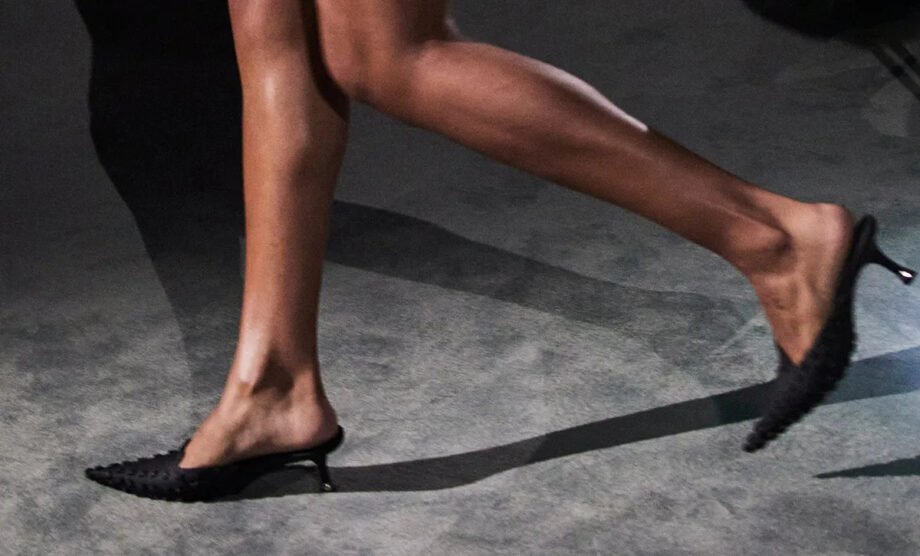
The design language is unmistakably Wang — sharp, urban, a little severe. The silhouette reads as a classic pump from the side, but the surface tells another story. Printed striations and organic ribbing run along the heel and arch, giving the shoe a skeletal, almost biomechanical texture that no traditional manufacturing method could produce. Where a conventional stiletto conceals its structure beneath leather, Griphoria exposes it, turning the mechanics of the heel into ornament. The result sits at the intersection of couture and computational design, and it aligns with a broader shift in Wang's practice: his recent Fall 2026 ready-to-wear collection doubled down on hard-edged tailoring and industrial finishes, and his new cross-disciplinary arts platform, the Wang Contemporary — which recently filled its Chinatown space with wax figures of pop icons — frames fashion as one medium among many. Griphoria belongs to that same instinct: treat the object as a piece of engineering you can exhibit and a piece of clothing you can actually use.
Why It Reads as Now
Culturally, the timing is pointed. The luxury market has spent several seasons chasing "quiet" product, and the results have grown indistinguishable. Meanwhile, the most-discussed footwear moments of the year have come from revivals and recontextualizations — Tyla stepping out in studded archival Wang sandals, North West and her friends turning a Wang boutique into a Valentine's Day event. Attention now rewards objects that look like nothing else. A 3D-printed stiletto is legible at twenty paces. It photographs as an object of its moment, not a reissue of a previous one, and it gives the brand a technological claim no heritage house can match by simply re-cutting an archive pattern.
Who It's For
Not the collector who buys heels to shelve them. It is for the woman who has already worn every silhouette — the one who owns the classic pumps, the strappy sandals, the sculptural mules — and now wants the pair that signals she is operating ahead of the room. It is for the client who reads the technical story and understands it as luxury rather than gimmick, the same way she once understood a carbon-fiber bicycle or a monobloc chair. And it is for anyone who has quietly resented that high heels, in 2026, are still built the way they were in 1956.
That is ultimately why Griphoria matters now. Fashion has spent years borrowing the vocabulary of technology — AI mood boards, digital twins, virtual showrooms — without letting it touch the physical product. Wang has skipped the theater and printed the shoe. If the heel holds, the implications ripple outward: footwear designed by algorithm, produced on demand, customized to individual gait and fit, manufactured without the waste of cutting and gluing. One stiletto is a product. A new method of making one is a door.