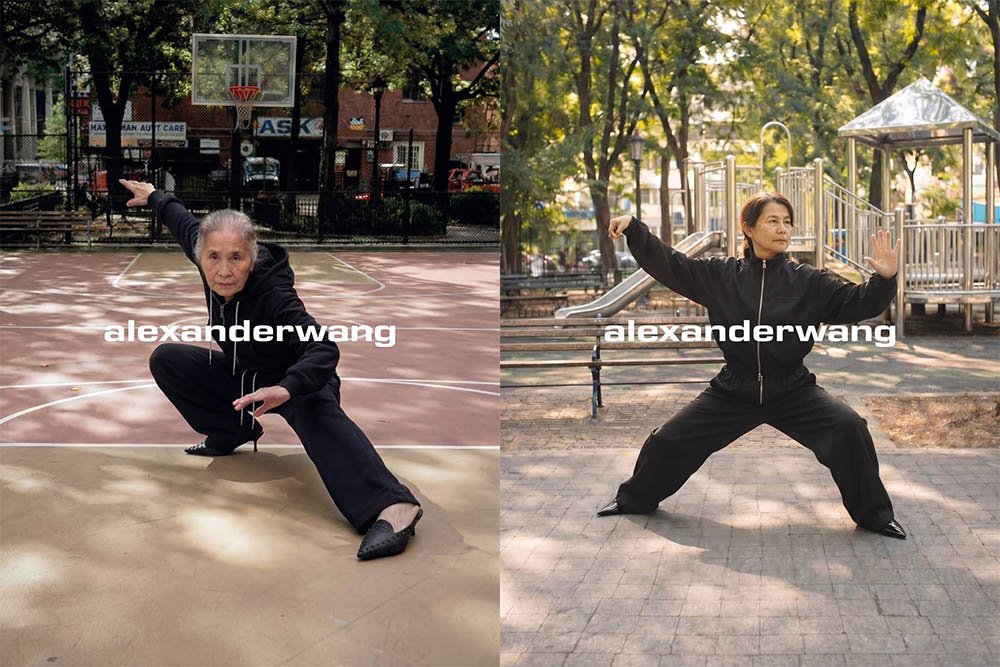
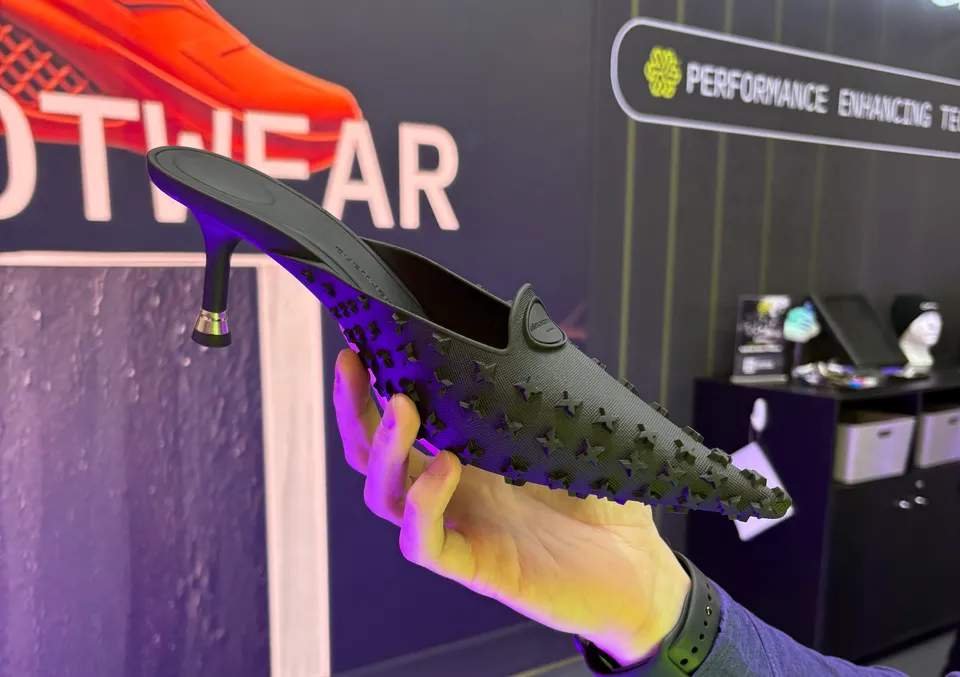
The stiletto has always been a feat of engineering disguised as an object of desire—a slender taper of steel and leather asked to bear the full weight of a body in motion. For most of its history, that engineering has been hidden, tucked inside the shank and masked by tradition. Alexander Wang's Griphoria Stiletto refuses the disguise entirely. This is a heel that wears its construction on the surface, a fully wearable 3D-printed shoe that turns the manufacturing process into the silhouette itself. Where couture footwear has long concealed its scaffolding, Wang exposes it—and in doing so, quietly redraws the boundary between what a shoe is and how it comes to be.
The design language is unmistakably Wang: lean, aggressive, and unsentimental. The Griphoria reads as a single continuous gesture rather than an assembly of parts, its form generated through additive manufacturing rather than cut from a last and stitched by hand. The result is a stiletto with an almost skeletal logic—lattice-like support structures, a sculpted heel that appears grown rather than carved, and a profile that feels at once futuristic and strangely inevitable.
A Shoe That Shows Its Bones
What distinguishes the Griphoria from the wave of 3D-printed concept shoes that have circulated as runway curiosities is the operative word Wang attaches to it: wearable. This is not a display object. It is a shoe intended to be walked in, and that distinction is the entire point. The lattice-like support structures and the sculpted heel aren't decoration layered over a hidden foundation—they are the foundation, exposed and made the whole of the design. The shoe's profile feels less carved than cultivated, as though the form grew into itself rather than being whittled down from a block.
The Material Argument
Materials tell the story of intent. Where traditional heels stack leather over a metal shank, the Griphoria is built from printed polymer systems engineered for flex, rebound, and structural integrity—formulations that allow the shoe to absorb impact while holding the geometry of the heel. The absence of conventional seams and adhesives is not merely an aesthetic choice; it is a manufacturing argument. By printing the shoe as an integrated whole, Wang sidesteps the labor-intensive, multi-stage assembly that has defined footwear production for more than a century. The Griphoria is, in effect, a thesis about what happens when a designer stops designing around the factory and starts designing the factory out of the equation.
The Wang Continuum
That argument lands with particular force right now. Wang's recent output has been defined by cross-disciplinary restlessness—the Resort 2027 and Fall 2026 collections, the opening of the Wang Contemporary arts platform in Chinatown with his mother, the "Real:ly" energy drink stunt staged with a humanoid robot at the Met Gala. The Griphoria belongs to the same instinct: a refusal to let any single discipline—fashion, art, technology—police its borders.
Culturally, the shoe also arrives at a moment when the industry is being forced to reckon with the sustainability and scalability of its own production models. Additive manufacturing promises less waste, fewer components, and the capacity to produce on demand rather than in speculative volume. Whether the Griphoria proves a template or a provocation, it positions Wang ahead of peers still debating the question.
Who It's For
This is not a shoe for the cautious. It rewards the wearer who treats footwear as a statement of technological literacy as much as taste—the client who understands that a 3D-printed stiletto is a different kind of luxury object, one whose value lies in its method as much as its finish. It speaks to the same audience that has followed Wang through his most experimental chapters, and to a newer generation for whom manufacturing transparency is a feature, not a footnote.
The Griphoria Stiletto matters because it collapses the distance between concept and closet. Plenty of designers have printed shoes; few have made the leap to a heel you can actually wear out of the house. Wang has done both—and in doing so has offered the clearest recent evidence that the future of footwear will not be stitched together, but built layer by layer.