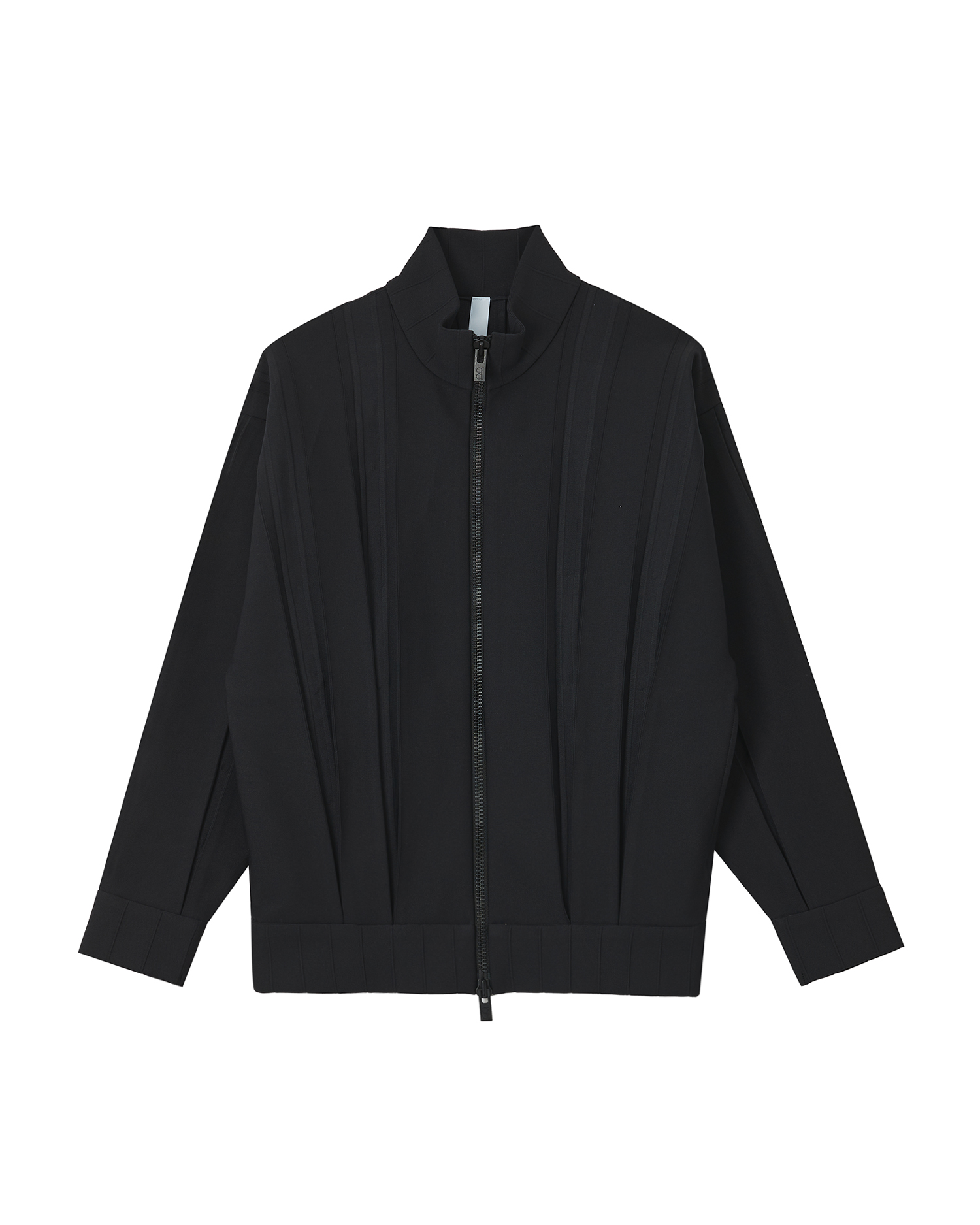
When CFCL brought its Spring 2027 collection to Paris, the label didn't simply add a runway to its resumé — it handed the broader fashion audience a new way of thinking about knitwear. The breakout of the season was the house's engineered knitwear: garments whose three-dimensional construction is computed rather than draped, knitted to shape rather than cut and sewn from bolts of cloth. WWD captured the mood with the phrase "In Good Form," and the description was apt. Form, in the CFCL sense, isn't a styling decision. It's the starting point.
The technical premise sets CFCL's engineered knitwear apart. Each piece is programmed at the yarn level, allowing the knit to build structure, volume, and ventilation directly into the fabric. The result is clothing that holds a sculptural line without the weight of traditional tailoring — crisp shoulders, clean planes, and a sense of deliberate geometry that reads as modern precisely because it isn't forced. This is knitwear as sculpture, a description the house has earned across recent seasons and one that reached its fullest expression in the Spring 2027 outing. The clothes look engineered because they are.
Knitwear as Architecture
What separates CFCL's approach from the familiar language of "sculptural knit" is that the structure isn't achieved after the fact. It's built into the yarn itself. Programming each piece at that level means the knit can construct volume and ventilation simultaneously — a garment that breathes in July and layers in September without ever losing its line. The tactile reality is what lingers: a collar that stands on its own, a sleeve that curves without a seam, the way a ribbed panel resolves into a clean hem. These are details you feel before you see them, and they reward close looking.
Rigor in Material and Method
That technical rigor extends to material and method. CFCL has long built its identity around responsible production and recycled yarns, and the Spring 2027 knitwear carries that commitment without announcing it loudly. The palette stays disciplined — quiet neutrals, softened tones, the occasional precise accent — so attention lands exactly where the house wants it: on the hand-feel of the knit, the behavior of a seam-free shoulder, the quiet intelligence of a garment that holds its shape season after season. For a brand that has also partnered with Veja on a minimalist sneaker made with responsible materials, the through-line is clear. Restraint is the aesthetic; responsibility is the infrastructure.
A Third Position for Knitwear
Culturally, the timing matters. Knitwear has spent years oscillating between comfort cliché and craft nostalgia, and CFCL's engineered knitwear proposes a third position: technical garment-making with an editorial sensibility. It speaks to a wearer who wants clothes that are intelligent rather than loud — the designer-adjacent professional, the architect, the person who reads a garment's construction before its label. The Spring 2027 collection extended this thinking to menswear as well, where WWD noted a "summertime sharpness" that translated the same engineered principles into a leaner register. The vocabulary scales.
Minimalism With a Spine
In practice, this is clothing for anyone who has grown tired of disposable trend cycles and wants a wardrobe built on pieces that hold their shape. CFCL's engineered knitwear isn't anonymous minimalism; it's minimalism with a spine. These are clothes for people who consider getting dressed a form of design literacy — who want the quiet confidence of a garment that does something rather than simply says something.
Why it matters now is simpler than all of this. Paris has plenty of spectacle; it has far less work that treats clothing as a problem to be solved elegantly. CFCL arrived on the runway with a proposition rather than a theme, and the three-dimensional knit construction did the talking. In a season that will be remembered for image, the breakout was a method — and the clothes that carry it are the ones worth keeping.