The most interesting thing about the current cycle of COMME des GARÇONS x Nike collaborations is how loudly everyone is talking about the wrong shoes. The COMME des GARÇONS Homme Plus x Air Jordan 11 has dominated headlines as the first-ever collaboration on that sacred model, and the CDG BLACK x Nike LD-1000 in "Spirit Pink" has generated its own share of noise, with the Field General 82 queued up behind it. Amid all that, the COMME des GARÇONS BLACK x Nike Air Zoom Talaria has slipped through with almost no fanfare — and that is precisely what makes it the sleeper hit of the entire run.
The Talaria is a deep cut, and that is its first virtue. Originally released in 1997 as a trail-leaning runner designed by Tinker Hatfield's team, it has never been a hype shoe; it has lived in the shadow of the Air Max lineage, admired by a certain kind of runner and a certain kind of sneaker obsessive but never canonized. Rei Kawakubo's BLACK line — the diffusion label built on the premise that a single garment, in a single color, can be endlessly reworked — is the ideal steward for a shoe with that kind of quiet history. Where the Homme Plus Jordan 11 is a headline, the Talaria is a footnote that rewards the reader who actually gets to the end of the page.
Almost Nothing, and Everything
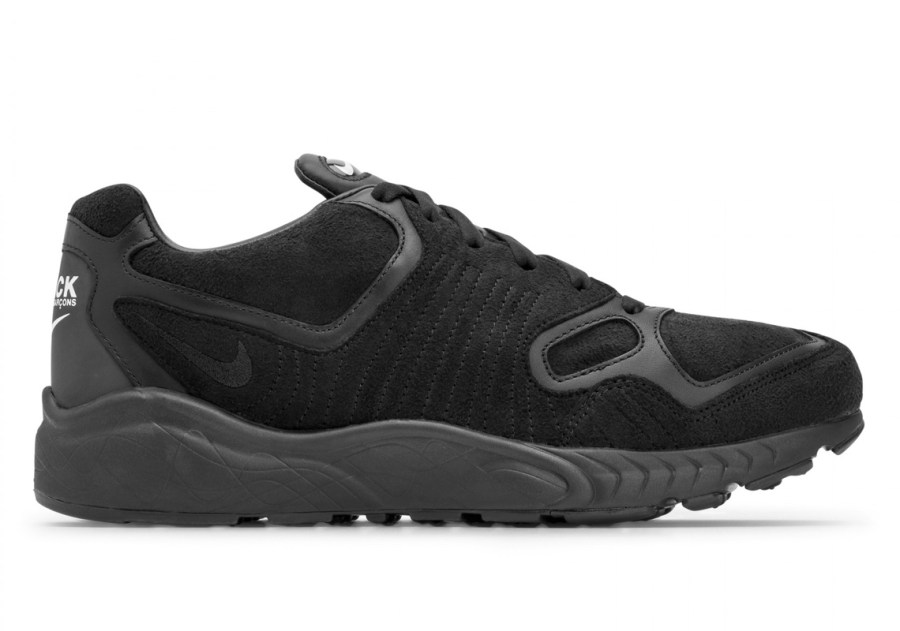
What BLACK has done with it is, characteristically, almost nothing — and everything. The silhouette is preserved nearly intact: the segmented midsole, the visible Zoom Air unit in the heel, the sculpted, slightly bulbous toe. The upper arrives in a monochrome wash of black and off-black, with the Swoosh rendered in tonal relief rather than contrast, and the co-branding reduced to a whisper at the heel and tongue. There is no oversized logo, no deconstructed panel, no ironic material swap. The design intelligence here is in the restraint — the way the shoe's original lines, which were always a little odd and a little beautiful, are allowed to speak for themselves once the colorway stops shouting over them.
Reduction as a Flex
Culturally, this places the Talaria squarely within the BLACK ethos rather than the broader CDG collaboration machine. BLACK was conceived as an exercise in reduction: one color, many forms, a proposition that a wardrobe — or a sneaker rotation — can be built on discipline rather than novelty. In a moment when the CDG x Nike pipeline is producing Jordans and LD-1000s and Field Generals at a pace that borders on saturation, a shoe that asks you to notice it rather than announces itself feels almost radical. It is minimalism as a flex — the confidence to wear something that only the right people will recognize.
For the People Who Read the Footnotes
Who is it for? Not the collector chasing the next drop-day frenzy, and not the casual buyer who wants the logo to do the talking. The Talaria is for the person who already owns the obvious collaborations and has started looking for the ones that got away — the runner-adjacent, the archival, the slightly strange. It is for someone who understands that a tonal black upper and a 1997 trail tooling package is a more sophisticated proposition than another high-contrast Swoosh. It is, in the best sense, a sneaker for people who read the footnotes.
Why It Matters Now
And why does it matter now? Because the current news cycle around COMME des GARÇONS is a study in scale — new flagship stores, archive sales, fragrance experiments, a relentless cadence of Nike link-ups — and within that noise, the Air Zoom Talaria represents the brand's original argument in its purest form. One shoe, one color, one idea, executed without compromise. In a collaboration landscape that increasingly mistakes volume for vision, the quietest release in the pack may well be the one still being worn — and still being discussed — long after the Jordans have gone back in the box.