In a season where Rei Kawakubo’s archival masterpieces are being auctioned for astronomical sums and her runway provocations dominate the discourse, the announcement of the COMME des GARÇONS x Air Jordan 11 feels like a quiet, calculated subversion. Slated for a September release, this monochromatic iteration of Michael Jordan’s most hallowed silhouette is not merely another collaboration; it is a philosophical statement dressed in the guise of a sneaker. The genius of this release lies not in its scarcity but in its pricing, which sits at a level notably more accessible than the typical high-fashion crossover. In an era where the industry’s most coveted drops often carry triple-digit resale premiums that alienate the very subcultures that birthed them, this partnership flips the script. By democratizing the iconic AJ11, Kawakubo and her team are offering a masterclass in cultural currency—proving that true avant-garde thinking can exist within the framework of the mainstream without losing its edge.
There’s something almost subversive about restraint in 2025. While the rest of the market screams in neon gradients and chunky hardware, this collaboration whispers. And that whisper is deafening.
The Architecture of Silence
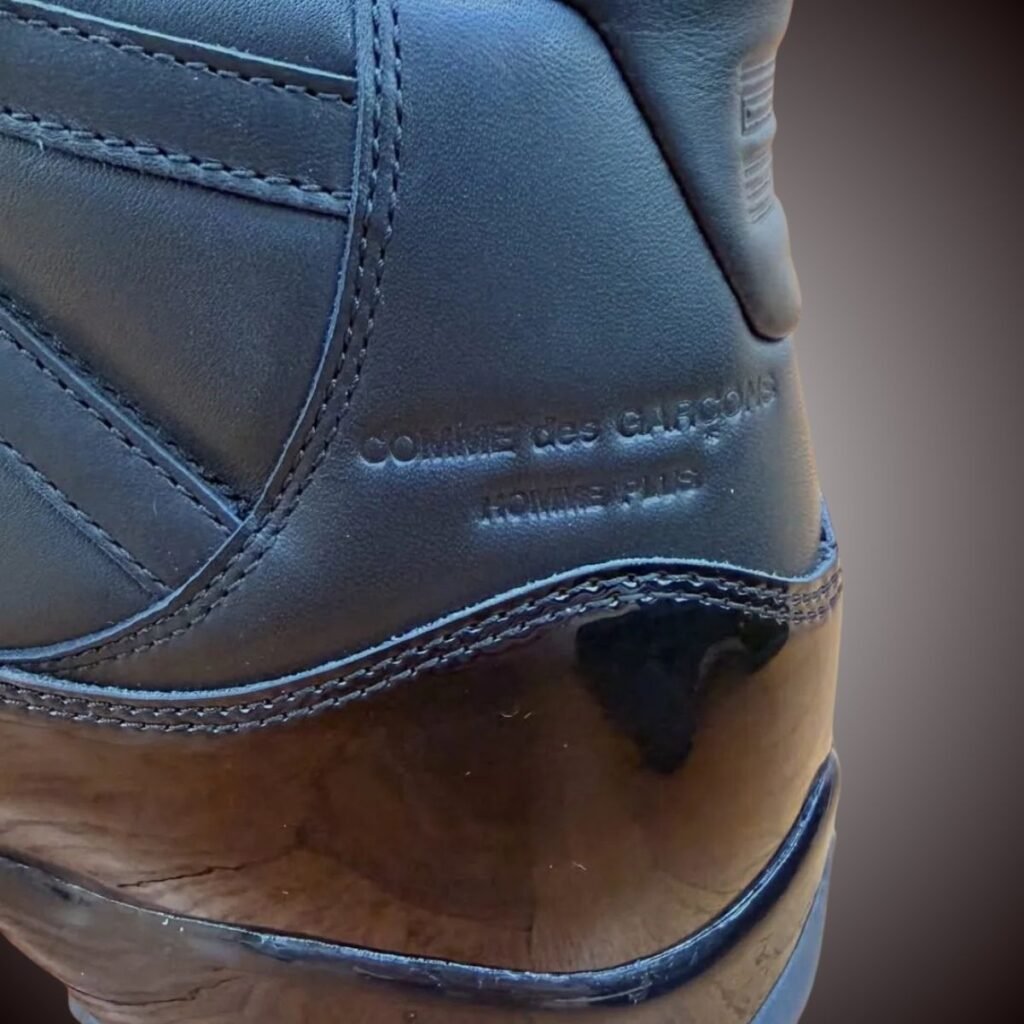
The design itself is a study in reduction, a hallmark of the Comme des Garçons ethos. The Air Jordan 11 is a sneaker historically defined by its glossy patent leather mudguard and aggressive, performance-driven lines. Here, that inherent flash is muted, stripped back to a single, seamless tone. Whether rendered in an off-white akin to bone or a deep, obsidian black, the monochromatic treatment erases the visual noise, forcing the eye to appreciate the silhouette’s architecture. The patent leather remains, but it no longer screams; it whispers. The mesh upper, typically a contrasting panel, is rendered in the same hue, creating a tonal block that feels both futuristic and monastic. This is not a sneaker that begs for attention; it commands respect through its restraint. The subtle co-branding, likely a discreet debossed logo or a tonal Jumpman, serves as a quiet signature, a nod for those in the know rather than a billboard for the uninitiated.
Run your fingers over that patent mudguard—it still has the signature sheen, but it’s been tamed, almost matte in its confidence. The mesh is softer than you remember, the proportions slightly elongated. This is the AJ11 as you’ve never seen it: not stripped of its heritage, but stripped of its noise.
Two Brands, One Pivot
This collaboration arrives at a pivotal moment for both brands. For Jordan Brand, it represents a continued foray into the rarefied air of luxury streetwear, a space where the silhouettes are treated as canvases for high-concept design. For Comme des Garçons, it is a strategic move that bridges the gap between the atelier and the asphalt. The recent news cycle has been dominated by the auctioning of rare, vintage Comme des Garçons pieces—garments that are museum artifacts, untouchable for the average enthusiast. In contrast, this sneaker becomes the entry point, a tangible piece of the Kawakubo universe that does not require a collector’s budget. It aligns perfectly with the ongoing narrative of modern street fashion, where the lines between Tokyo’s Harajuku and New York’s SoHo have blurred into a global, borderless aesthetic. The sneaker is the universal language, and here, Kawakubo speaks it fluently, infusing her deconstructive philosophy into a product that is inherently functional.
The timing is deliberate. As vintage CdG pieces become trophies locked behind glass cases, this release offers a counter-narrative—one where the brand’s radical spirit remains within reach.
The Wearer and the Worn
Who is this for? It is for the devotee who reveres the history of the AJ11 but craves a version that feels intellectually elevated. It is for the minimalist whose wardrobe is built on texture and shade rather than logo saturation. It is for the collector who understands that accessibility does not diminish value, but rather, redefines it. In a culture obsessed with gatekeeping, the COMME des GARÇONS x Air Jordan 11 is a radical act of inclusion. It suggests that high fashion’s most rebellious spirit can be worn by anyone willing to appreciate the power of a perfectly considered monochrome palette.
This is a sneaker that works as hard in a gallery as it does on the street. Pair it with raw denim and a boxy white tee, or let it anchor a full black-on-black tailoring moment. It doesn’t ask for permission; it simply exists, impeccably.
As the industry watches the auction prices for Kawakubo’s past work soar, this September release serves as a grounding counterpoint—a reminder that the future of fashion is not just about the rare and the unreachable, but about the profound impact of something beautifully, deliberately simple. In a world that equates luxury with exclusivity, Kawakubo reminds us that the most radical statement is often the one that says: this is for everyone.