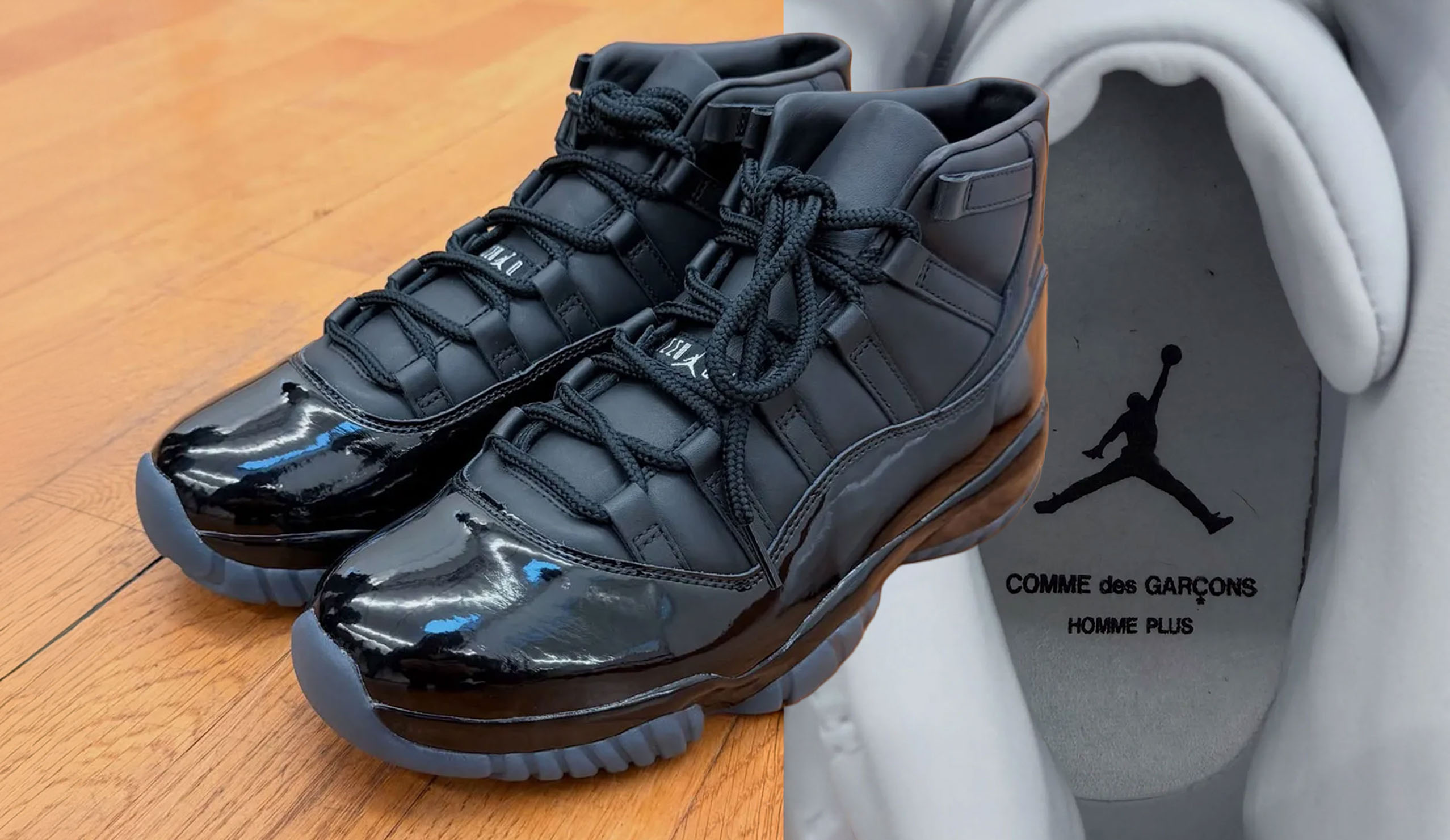
The sneaker collaboration has become luxury's most exhausted gesture — a ritual of logo-swapping that rarely produces anything worth remembering. Which is precisely what makes the Comme des Garçons Homme Plus x Air Jordan 11 "Triple Black" so startling. Here is a partnership that doesn't decorate a sneaker with a designer's name. It drags the most ceremonial silhouette in the Jordan archive into the tailoring atelier and lets it sit there — uncomfortably, brilliantly.
The Air Jordan 11 was never an ordinary basketball shoe. When Tinker Hatfield designed it in 1995, he reached for patent leather — a material borrowed from dress oxfords and tuxedo pumps — and wrapped it around a performance midsole. Michael Jordan wore them with a suit on the night of his return to the league, and a strange dual identity was born: the sneaker that belonged equally on the hardwood and under a dinner jacket. Rei Kawakubo's Homme Plus line, the menswear arm of Comme des Garçons dedicated to dismantling the conventions of the suit, was the only logical place for that duality to reach its conclusion.
A Colorway That Reads Like a Mood
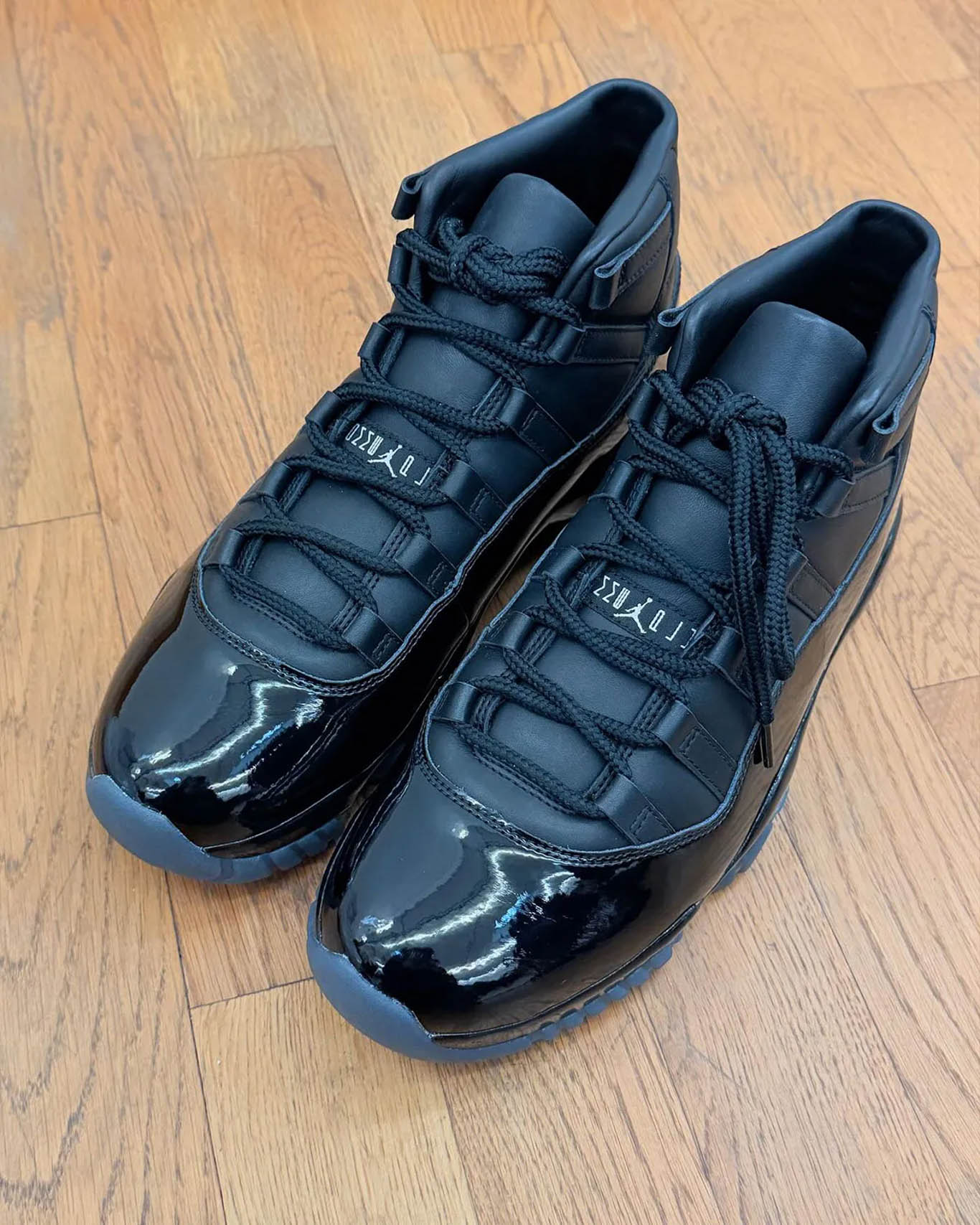
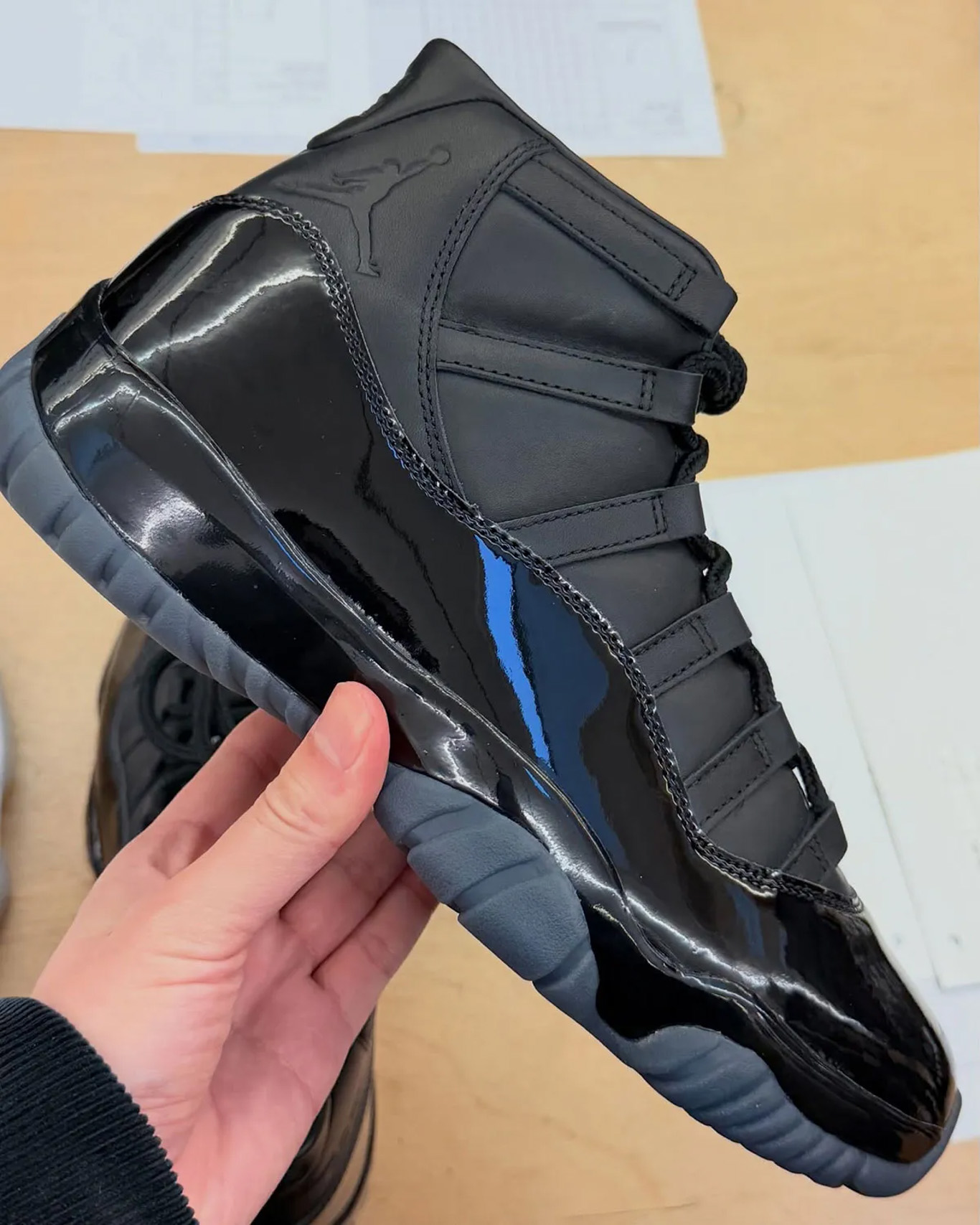
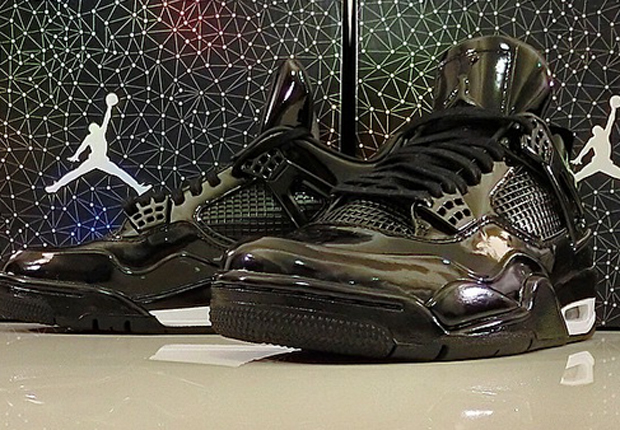
What arrives is the "Triple Black" execution: the shoe rendered almost entirely in matte and glossy black, stripped of the white midsole, the icy translucent outsole, the contrasting patent panels that normally define the model. Instead, the patent leather mudguard blends into the nubuck and ballistic mesh upper in a single, near-monolithic darkness.
The result reads less like a colorway than a mood — a shoe that seems to absorb light, closer to a piece of eveningwear than a piece of athletic equipment. Even the Jumpman logo, that most recognizable of corporate marks, is rendered in tonal black, half-hidden, as if embarrassed by its own visibility.
Where Formality Meets Engineering
Materials carry the argument. The patent leather — traditionally the signal of black-tie formality — is here doing structural work on a shoe built for ankle support and cushioning. The upper's ballistic mesh and nubuck overlays speak to performance heritage, while the full-length Air cushioning and carbon-fiber spring plate remain fully intact beneath the surface.
Nothing about the shoe's engineering has been compromised; only its legibility has been rewritten. On foot, it is a high-top that behaves like a dress shoe and performs like a 1990s basketball sneaker — a contradiction Kawakubo has spent four decades perfecting.
The Opposite of Stealth Wealth
Culturally, the timing is exact. Luxury houses have spent years trying to legitimize sneakers within tailoring, usually by making them smaller, cleaner, and more anonymous — the so-called quiet luxury sneaker that disappears beneath a trouser hem.
The Comme des Garçons Homme Plus x Air Jordan 11 refuses that erasure. It is loud in its silhouette and silent in its palette, a full-volume high-top rendered in total black, demanding to be seen while refusing to announce itself. It is the opposite of a stealth wealth shoe: it is a stealth provocation.
This is footwear for the person who already owns the tailoring and no longer needs the sneaker to apologize for it. It suits the collector who understands the Air Jordan 11 as a design object rather than a grail, and the Comme des Garçons devotee who has followed Kawakubo's menswear through its most abstract seasons. It is not a shoe for the office. It is a shoe for the dinner after, worn with a black wool suit and nothing else competing for attention.
An Idea, Not Just a Product
Why it matters now is simple: the collaboration market has grown cynical, and this release is not. It takes two institutions — one sporting, one conceptual — and produces a shoe that neither could have made alone. The Air Jordan 11 gains a gravity it has rarely been allowed. Comme des Garçons Homme Plus gains a piece of wearable cultural history that extends its argument about the suit into the world of sport.
And the rest of us get a reminder that a sneaker can still be an idea, not just a product — provided someone with actual conviction is holding the patent leather.