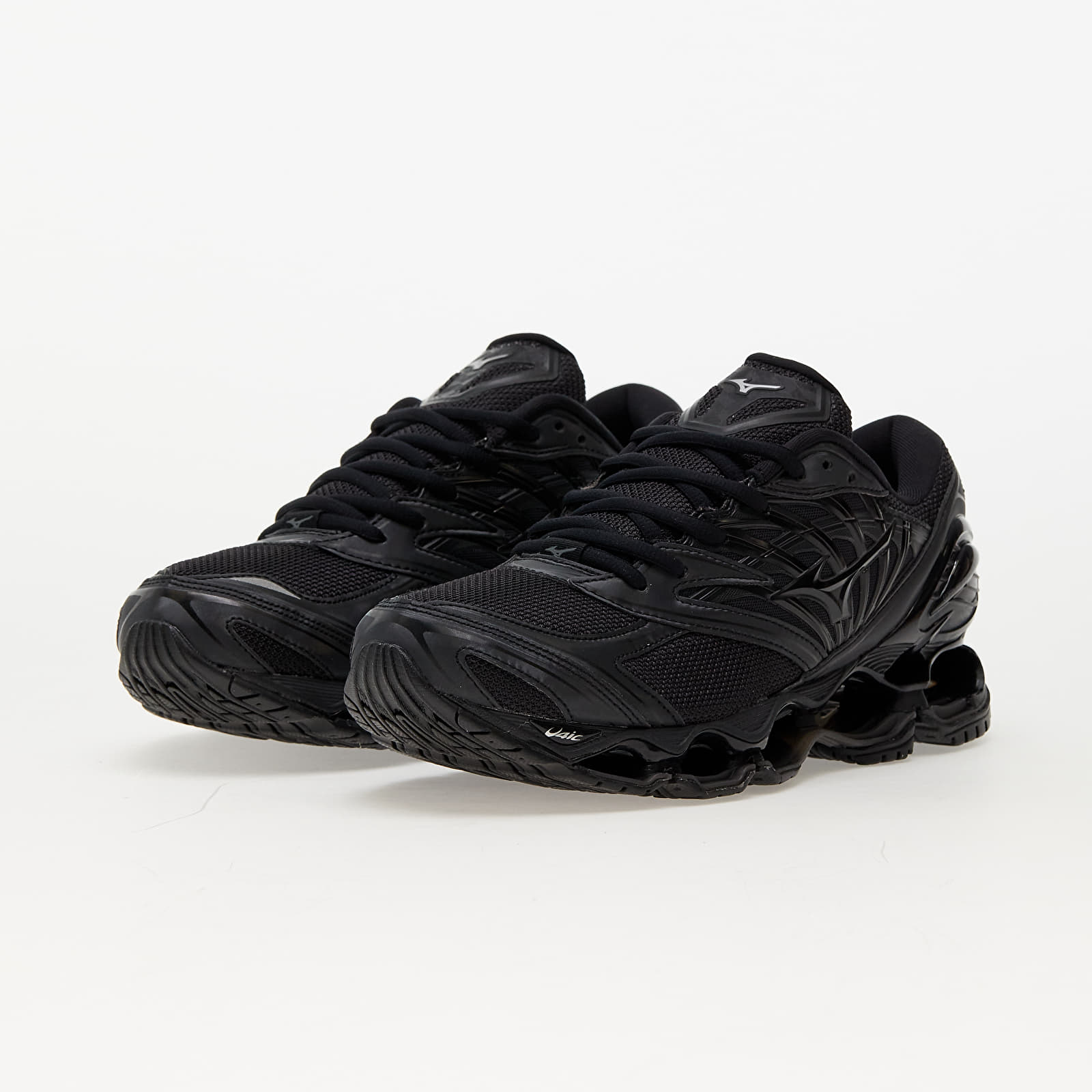
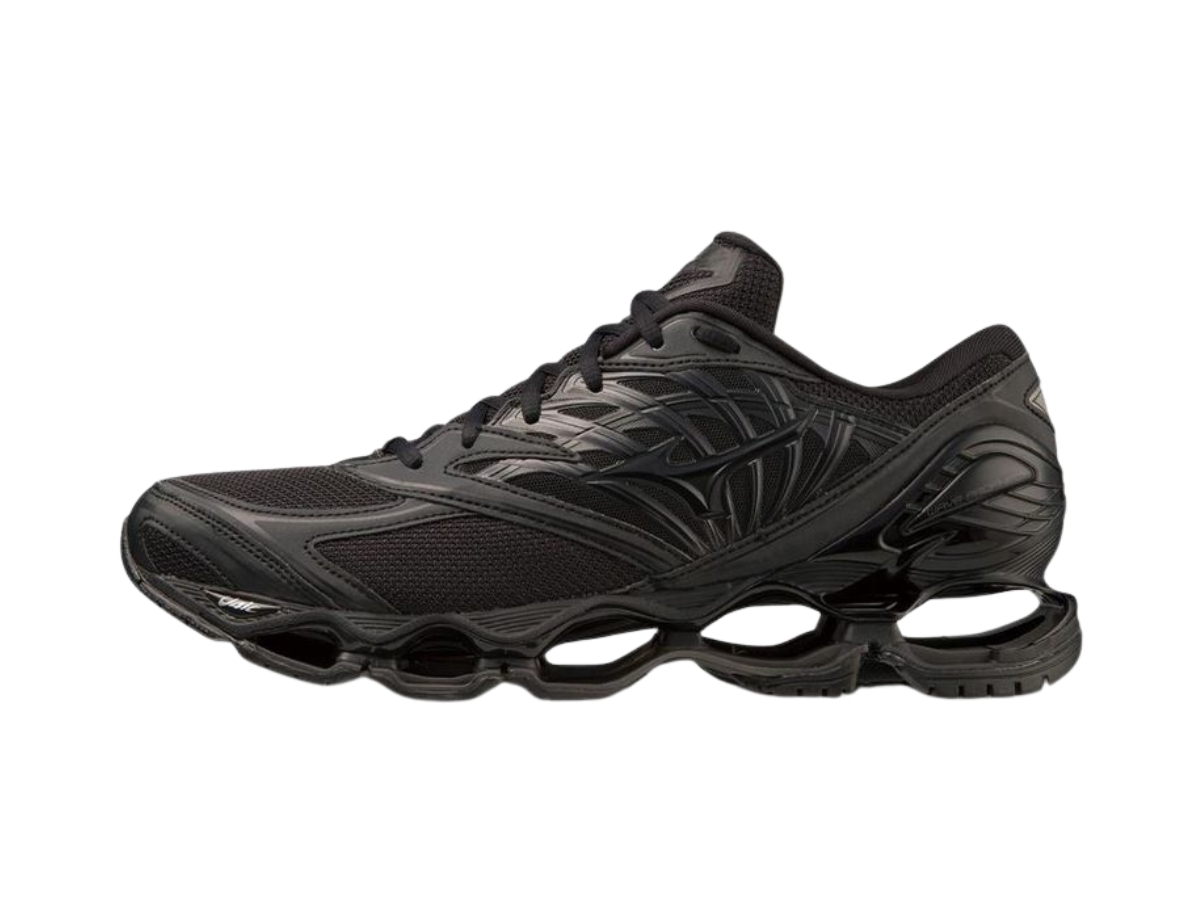
Some sneakers chase the algorithm. The Mizuno Wave Prophecy 1 never had to. When it first landed in 2010, it arrived looking like nothing else on the wall — a skeletal, honeycomb-boned sole unit suspended beneath a mesh upper, equal parts running shoe and structural model. Now it's back in a stealth all-black reissue that feels less like nostalgia and more like a correction of the timeline.
Because while the rest of the industry spent the following decade escalating the arms race — taller foam stacks, stiffer plates, louder colorways — Mizuno had already made its argument. The Wave Prophecy wasn't a response to maximalism. It was the blueprint.
The Sole as the Entire Thesis
Everything about the Wave Prophecy 1 begins and ends with the Infinity Wave sole unit. A full-length, dual-plate construction, it remains one of the most audacious pieces of footwear engineering ever brought to market — and crucially, Mizuno refused to hide it. Where other brands bury their cushioning inside foam, the Wave Prophecy puts the structure on the outside, a skeletal lattice running the length of the shoe, suspending the foot above empty space and flexing independently with every stride.
It looks like architecture. It performs like a suspension bridge. In this monochrome black execution, it reads as something closer to an industrial design object than a running shoe — which is precisely the point.
Texture Does the Talking
The upper is just as considered. A layered mesh base is reinforced with synthetic overlays and a sculpted heel counter, all rendered in tonal black so that texture — not color — carries the story. Run your eye along the midfoot and you'll catch the signature RunBird logo, embossed subtly, present but never shouting.
A padded collar and a traditional lace system keep the shoe anchored to its performance origins, while the overall silhouette carries a chunky, almost orthopedic confidence — one that predates, and arguably predicted, the maximalist wave that would go on to define the next decade of sneaker culture.
A Quiet Grail, Finally Answered
Culturally, the Wave Prophecy has always occupied a strange and enviable position. It was never a mainstream hit the way an Air Max or a Boost silhouette was — and that's exactly what made it a talisman for a certain kind of wearer. The techwear obsessive. The Japanese design purist. The runner who wanted something that felt engineered rather than marketed.
In the years since its debut, the shoe became a quiet grail: spotted on the feet of fashion editors in Tokyo and Berlin, pinned to archive-heavy mood boards, cited by designers who understood that Mizuno had solved a problem nobody else was even asking. The reissue lands at a moment when sneaker culture has tired of hype cycles and is actively hunting for objects with genuine design provenance. The Wave Prophecy 1 answers that search with authority.
Built, Not Branded
Materials-wise, this isn't a shoe chasing sustainability headlines or recycled-content checkboxes. It's built the way Mizuno has always built: durable mesh, high-abrasion synthetics, and a Wave plate constructed from a proprietary Pebax-based material that balances responsiveness with longevity.
The all-black colorway does the silhouette a considerable favor. It strips away the loud, tech-forward color blocking of the original 2010 release and lets the form speak entirely for itself. It's the difference between a prototype and a finished thought.
So who is this shoe for? The runner who remembers when running shoes were allowed to look strange. The collector weary of reissues that sand down the edges of their source material. The person who understands that the Wave Prophecy was never really about winning races — it was about demonstrating what a shoe could be if you refused to accept the conventional answer. In black, it becomes something more: a statement of restraint, a piece of wearable engineering, a reminder that the most interesting sneakers are rarely the loudest ones.
In a market saturated with retreads, the Mizuno Wave Prophecy 1 "Black" stands apart because it isn't trying to be anything other than what it always was: a singular idea, executed with conviction. Fifteen years later, that idea still has no equal — and Mizuno, as ever, isn't chasing anyone.