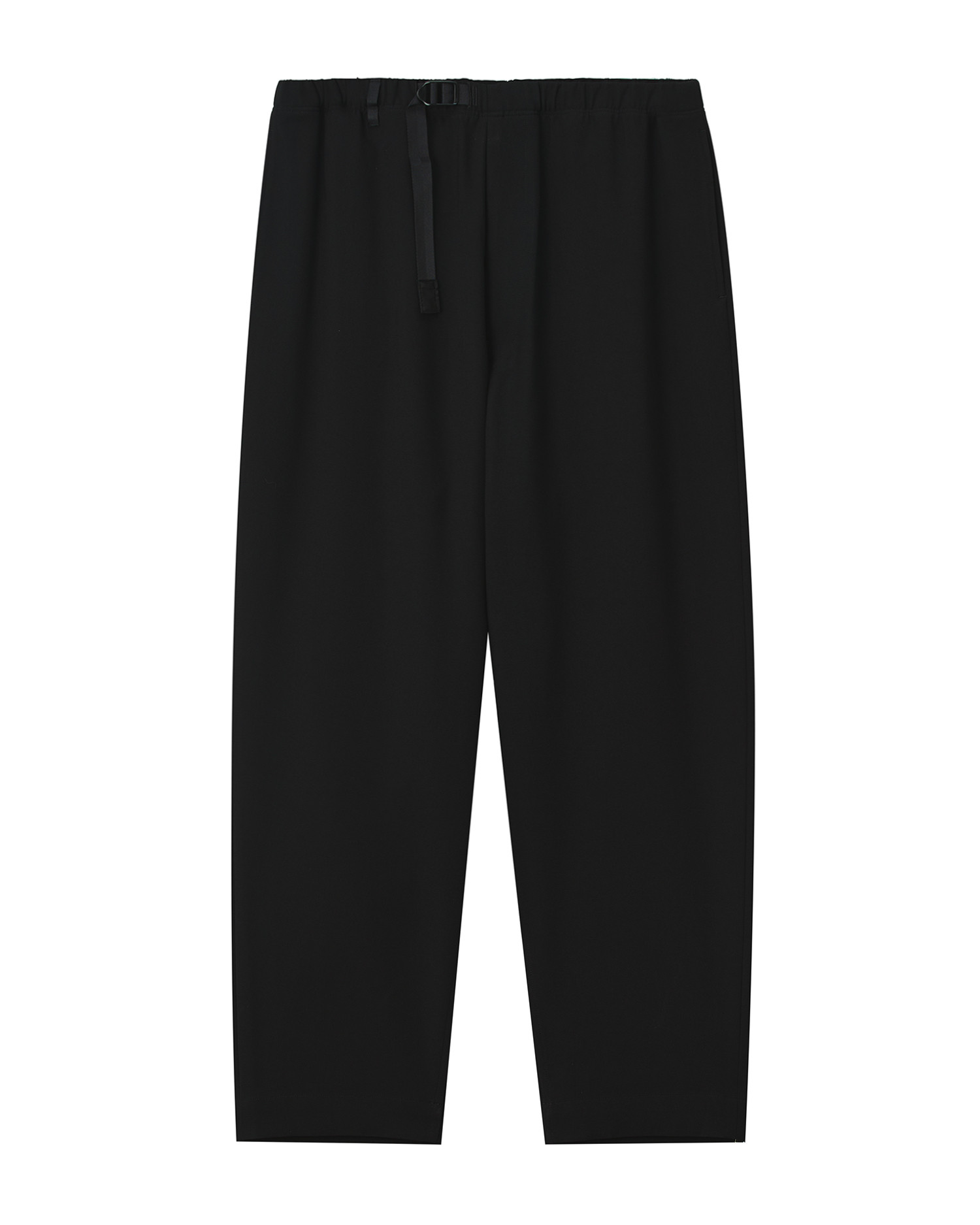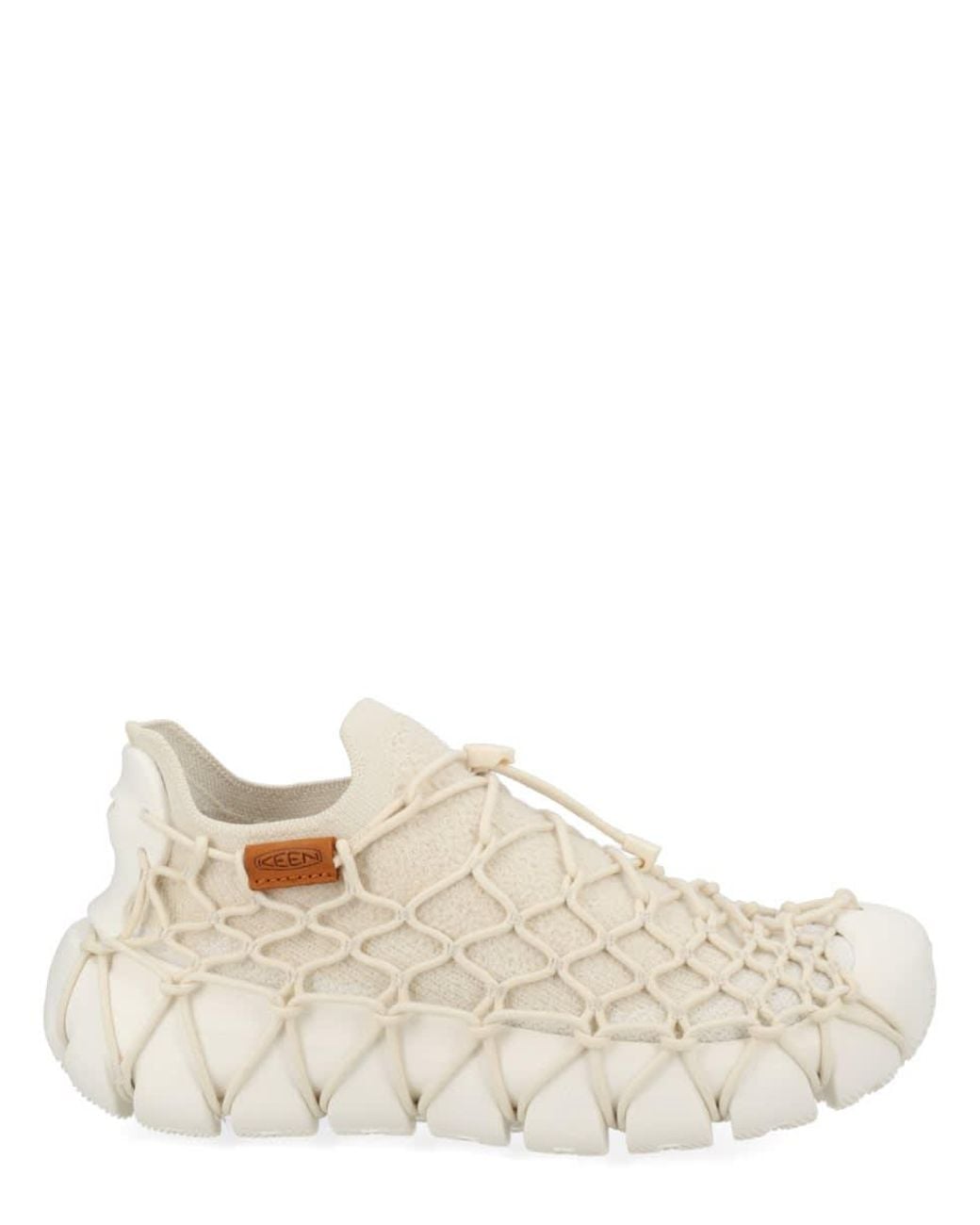
Most sneaker collaborations are exercises in addition. More colorways, more co-branding, more noise. Daisuke Obana went the other way. For his latest project under the N.Hoolywood COMPILE banner, the Japanese designer took KEEN's strangest silhouette and removed the one thing nobody thought to question: the glue.
The KEEN UNEEK 360 x N.HOOLYWOOD COMPILE, released September 12th, isn't a loud shoe. It doesn't need to be. Its argument is structural — and it's one the rest of the industry would do well to study.
Two Cords, One Sole, No Compromise
The original UNEEK, introduced by KEEN in 2014, was always an outlier. An open-air silhouette built from just two lengths of cord threaded through a sole, with no panels, no stitching, no traditional upper. Eccentric, functional, beloved by a very specific kind of wearer.
For the 360 iteration, Obana and KEEN pushed the concept further by addressing the element that had always quietly contradicted the shoe's minimalist premise — adhesive. Conventional footwear, even the most stripped-down designs, relies on glue to bond the upper to the midsole. It's a petroleum-based dependency that makes recycling notoriously difficult and accounts for a significant share of the industry's environmental footprint. The UNEEK 360 eliminates it entirely. The cord construction mechanically locks the upper to the sole in a glue-free build that can, in theory, be disassembled rather than discarded.
That's the whole idea: two cords, one sole, and no glue at all.
Obana's Method
This is the kind of engineering Obana has made his signature. N.Hoolywood's recent output reads like a survey of heritage objects under the knife: the Danner Postman Shoe reconstructed with work-boot attitude, the Teva Hurricane XLT3 CT rebuilt as an all-black military sandal, the first-ever Baracuta collaboration from a Japanese label, an ongoing New Balance partnership with Invincible, a ninth Champion "NEW WEAVE" capsule. Each project treats an established form as raw material rather than sacred text.
The UNEEK 360 fits that program precisely. It takes a mass-market performance shoe and asks what remains when you remove everything that isn't structurally necessary. The answer, apparently, is plenty.
What's Left When You Strip It Back
What remains is remarkably elegant. The UNEEK 360 reads as a lattice of cords across the foot, adjusting to the wearer's anatomy in a way stitched uppers cannot. The sole unit grounds all that airiness in genuine trail-ready traction. The aesthetic sits at the intersection of technical outdoor gear and Obana's austere, almost uniform-like sensibility — closer to a piece of equipment than a fashion statement, which is exactly the point.
It's a shoe for people who think about how things are made. Who notice when a design decision has been made for reasons other than cost. The tactile experience matters here: cords that move with you rather than against you, a fit that feels less manufactured and more assembled. Because it is.
Why the Timing Is Right
The broader industry is wrestling with greenwashing accusations and circularity pledges that rarely survive contact with manufacturing reality. Against that backdrop, a glue-free, cord-based shoe from a major American outdoor brand and a respected Japanese designer is a meaningful proof of concept. It demonstrates that sustainability need not arrive as compromise or penance. It can be expressed as formal refinement — as a better-designed object, full stop.
The KEEN UNEEK 360 x N.HOOLYWOOD COMPILE is not asking for credit. It's asking you to look at how it's built. And if you do, you'll see a shoe that says more with two cords than most sneakers manage with an entire upper.