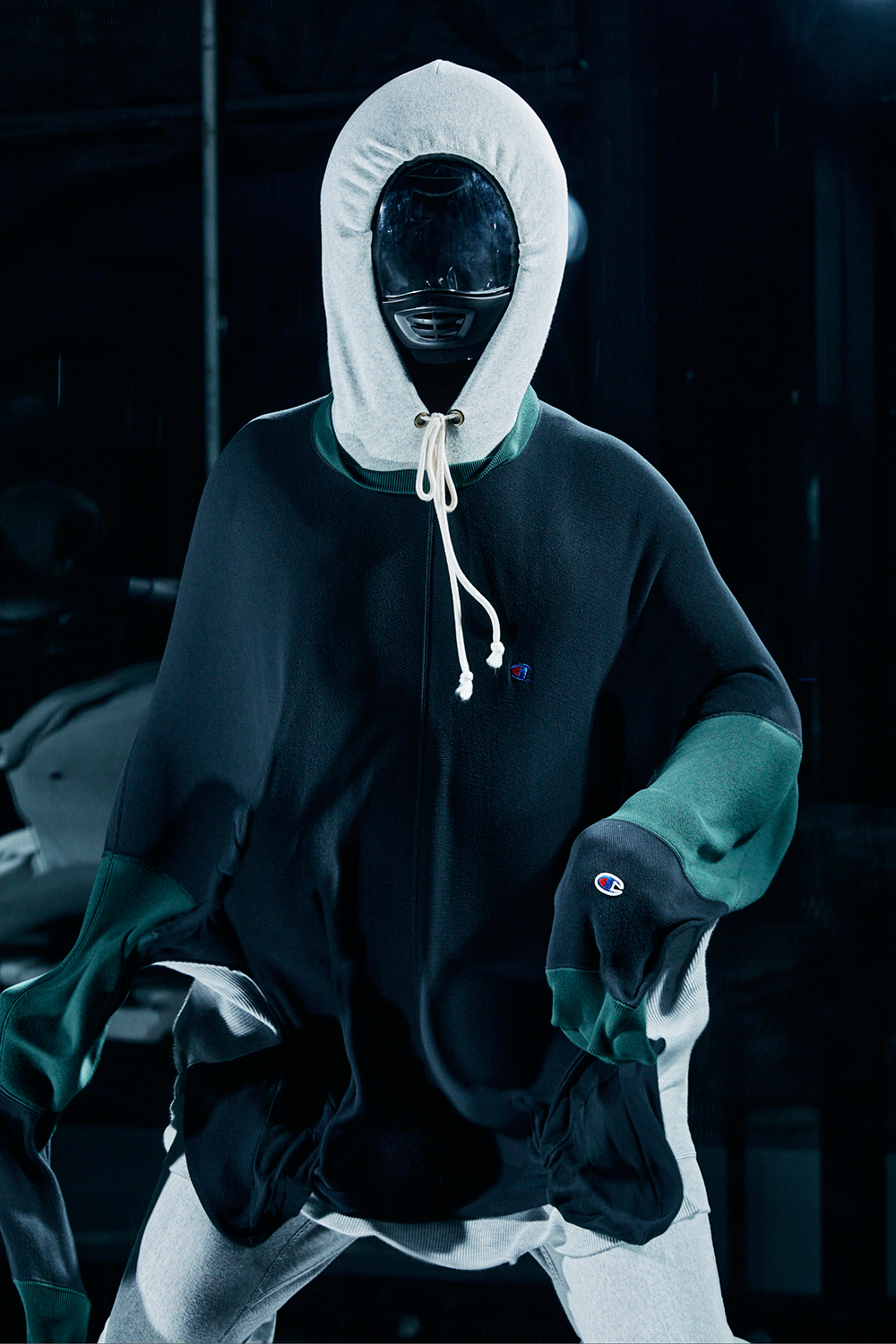
Some garments don't need an introduction. The Champion Reverse Weave sweatshirt is one of them — a piece so embedded in the collective wardrobe that we rarely stop to consider how it was built, or why it still holds. Introduced in 1938 as a fix for the shrinkage that plagued heavy cotton fleece, its fabric is cut across the grain rather than with it, a vertical orientation that became the technical backbone of collegiate athletics and, eventually, a global shorthand for authentic American casualwear.
What's interesting is that a Japanese label, not an American one, is the party meaningfully reconstructing it rather than simply reissuing it. That's the quiet provocation at the heart of the N.HOOLYWOOD x Champion "NEW WEAVE" Reverse Weave, now arriving in its ninth consecutive capsule.
The Designer Who Read the Racks
N.HOOLYWOOD is the project of Daisuke Obana, a former vintage buyer whose eye was trained not in fashion school but in the resale archives of Tokyo. That biography matters. Obana approaches Americana not as a tourist borrowing signifiers but as a scholar who has handled the artifacts — the wartime chinos, the Ivy League oxfords, the institutional fleece — and knows exactly which seams hold the meaning.
His label has spent two decades working the intersection of archive and invention, and the press has noticed. The Spring 2027 menswear collection drew coverage from Vogue and WWD, the latter framing it as "Ivy Style Reinvented," while Fall 2026 was read as a reinterpretation of cold-weather classics. The through-line holds: Obana doesn't design nostalgia. He designs its correction.
Where the Correction Turns Literal
The "NEW WEAVE" concept is where that correction becomes physical. Rather than reproducing Reverse Weave's fabric construction verbatim, the capsule re-engineers the weave itself — adjusting the knit's structure, hand, and drape while preserving the low-stretch, cross-grain logic that made the original resistant to distortion.
The result reads immediately as Reverse Weave but behaves differently on the body. Cleaner through the shoulder. More deliberate in its volume. The side gussets and ribbed panels are recalibrated to Obana's proportions rather than Champion's mid-century athletic fit. Champion's "C" patch remains, but it sits inside a garment whose silhouette has been quietly authored elsewhere — a familiar logo on unfamiliar architecture.
Nine Capsules Deep
This is the ninth iteration of the partnership, a duration that places it among the more durable cross-cultural collaborations in contemporary menswear. Long enough that the capsule has effectively become its own recurring institution — anticipated rather than merely announced. Hypebeast and stupidDOPE both covered this latest release, and the attention is earned. Nine capsules in, the project has accumulated the kind of internal continuity that lets each new entry refine rather than repeat.
A Garment That Already Belongs to Both
The cultural context is hard to overstate. Reverse Weave occupies a peculiar position in the global wardrobe — simultaneously a piece of American collegiate heritage and, through decades of adoption by Japanese collectors and stylists, a cornerstone of Tokyo's vintage canon. Obana sits at the exact intersection of those two histories. He isn't importing an American garment into a Japanese aesthetic, nor the reverse. He's working on a garment that already belongs to both, treating its construction as an open question rather than fixed scripture.
So who is this for? Not the buyer after a straightforward Champion sweatshirt, and not the collector chasing a pristine vintage example. The "NEW WEAVE" Reverse Weave speaks to the wearer who understands that a garment's history is material to be worked, not a plaque to be preserved — someone who wants the icon's legibility without its compromises, who values a shoulder line as much as a logo. It's a piece for people who read clothing the way Obana once read the racks: closely, and with the assumption that the best version of a classic hasn't been made yet.
That assumption, sustained across nine capsules and a broader practice that now extends into footwear projects with KEEN and Teva, is what makes N.HOOLYWOOD more than a collaboration machine. The brand matters now because it treats the archive as a living workshop — not a museum, not a mood board, but a place where things are still being made. And in the "NEW WEAVE" Reverse Weave, the most American of sweatshirts emerges, nine times over, as something unmistakably — and better — itself.