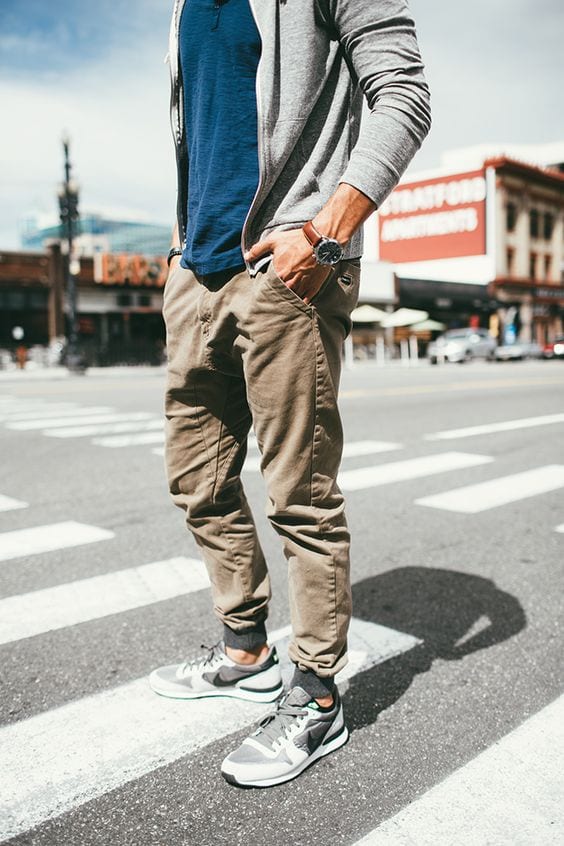
There is a particular kind of garment that earns its place not through spectacle but through quiet, repeated use—the piece you reach for without thinking, the one that solves a problem so elegantly you forget it was ever a problem. The Rag & Bone Miramar Walking Jogger is that garment, and its ascent from a clever design experiment to a full-blown cultural talking point is one of the more instructive stories in contemporary ready-to-wear.
At its heart, the Miramar is a trompe l'oeil proposition: a jogger cut from a soft, knit fabric, printed and finished to read unmistakably as a five-pocket jean. The waistband, the fly, the rivets, the faint whiskering at the hip—all of it is rendered with a fidelity that holds up at conversational distance and, crucially, in photographs. It is denim as costume, and yet the pleasure of the thing is that it never feels like a costume at all. Pull them on and the illusion holds. Live in them for a day of airports, errands, or a long train ride, and the illusion becomes a kind of private luxury—the look of denim with none of its obligations.
The Architecture of the Illusion
The design details are where the Miramar Walking Jogger distinguishes itself from the broader Miramar family. The silhouette is relaxed through the thigh and tapered gently toward a gathered ankle, the kind of easy, slouch-adjacent line that reads as intentional rather than sloppy. The fabrication is the real engineering feat—a stretch knit that moves with the body, resists the telltale sag of lesser printed bottoms, and delivers the drape of a broken-in jean without a single rigid seam to break in.
The trompe l'oeil finish is applied with a subtlety that rewards close inspection: the shading is soft rather than graphic, the faux hardware convincing without being cartoonish. There is no winking irony here, no graphic-print shortcut. The print does the work of a full denim wardrobe while the knit underneath does something denim never could—it gives.
Why the Fashion Press Paid Attention
Culturally, the Miramar arrives at a moment when the boundary between loungewear and streetwear has all but dissolved, and when travelers have grown weary of choosing between looking pulled-together and being genuinely comfortable in transit. The product has been taken up with unusual enthusiasm across the travel and style press—Condé Nast Traveler and Travel + Leisure have both sung its praises as a packing cheat code, Who What Wear documented the social-media-to-doorstep pipeline, and InStyle framed it as the comfort hack the modern closet was missing.
That broad, cross-category attention is telling. This is not a niche novelty; it is a solution garment that happens to be fashionable, and the distinction matters. When a piece migrates from the fashion desk to the travel desk, it has passed a test most trend items never face: it has been worn, packed, folded, and worn again—and it still looks good in the photo.
Who It's Actually For
Who is the Miramar Walking Jogger for? It is for the frequent flyer who refuses to board in athletic wear but has no patience for stiff denim at altitude. It is for the weekend errand-runner, the school-drop-off veteran, the creative who wants polish without structure. And it is for anyone who has quietly resented the false choice between comfort and composure that mainstream fashion has long insisted upon.
The timing is not incidental. Rag & Bone's broader momentum—a Pre-Fall 2027 menswear showing that drew Vogue's eye, a Cara Delevingne collaboration, a steady retail expansion into markets from Kansas City's Country Club Plaza to Birmingham—suggests a house in confident motion, and the Miramar sits at the center of that story as its most accessible, most shareable, most genuinely useful idea.
What elevates the Miramar Walking Jogger above a clever gimmick is its honesty about what it is. It does not pretend to be heritage denim; it offers the visual language of denim with the physical reality of your softest knit. In a market saturated with garments that ask the wearer to suffer for the silhouette, that trade feels less like a compromise and more like a correction. The illusion is the point, but the comfort is the reason you will keep reaching for them—and in the end, that is the most persuasive argument a piece of clothing can make.


