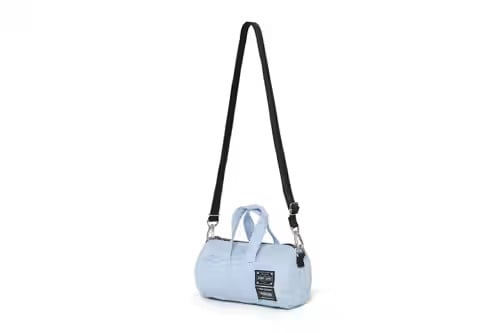
There's a specific alchemy to the way Sandy Liang designs—a refusal to pick between the sweet and the subversive, between the precious and the practical—and it has rarely been as legible as it is in the Sandy Liang x PORTER Jacquard Bag Collection. As the designer's first significant foray into a full accessories expansion, the collaboration pairs the downtown New York label's bow-festooned whimsy with the unimpeachable bag-making heritage of PORTER, the house Yoshida Kaban has been refining since 1935. The result is a capsule of jacquard-woven bags that read at once like a childhood keepsake and a genuinely serious piece of carry hardware—a neat lesson in the tension Liang has spent a decade perfecting.
What holds the collection together is the jacquard itself: a densely woven textile that carries Liang's motifs with a softness and depth flat print could never achieve. Her ready-to-wear has long trafficked in delicate florals, ribbon ties, and the recurring bow that has become her signature; here those codes are translated into a textile with real body and durability. The bags are finished with PORTER's characteristic hardware and construction discipline—the reinforced stitching, the considered interior organization, the quiet bombproof-ness that has made the brand a cult object among people who actually use their bags. It's a meeting of sensibilities that could easily have tipped into gimmick and instead reads as deliberate: the whimsy lives in the weave, the rigor in the build.
Where Whimsy Meets Hardware
Look closely and the two signatures start to converse. Liang's world is one of ribbon ties and delicate florals; PORTER's is one of reinforced stitching and interiors mapped with the same care as the exterior. Neither gets flattened in the exchange. The bow—that recurring Liang motif—turns up woven rather than appliquéd, given weight by the textile instead of floating on top of it. And the construction beneath all that softness is pure PORTER: hardware you can trust, organization you didn't know you needed, a bag built to be used rather than admired from a shelf. The tension between the two is the whole point, and it's handled with a light touch.
The Timing Is the Story
Culturally, the timing lands sharp. Liang has spent the past several seasons being anointed by the very institutions that once overlooked her—a Rizzoli monograph that reconstructs her archive, a New Yorker profile, a Spring 2027 collection that Vogue and WWD have both framed around a "sporty princess" thesis of precious practicality. The accessories line arrives as a natural extension of that narrative: a designer who has always treated the everyday as worthy of dressing up, now offering the bag you actually carry to the bodega and the dinner. The jacquard bags sit precisely at that intersection of the mundane and the ceremonial that Liang's work has always insisted upon.
Who It's For
Certainly the longtime acolyte who has followed the label from its earliest Lower East Side days—but equally the newcomer drawn in by the collaboration's crossover appeal. Picture the PORTER loyalist curious about a more playful silhouette, or the accessories collector who understands that a bag is the most intimate daily object one owns. The pieces skew wearable rather than precious, sized for real life and finished to withstand it. And in a market saturated with logo-driven status bags, there's something quietly radical about a jacquard carryall that asks to be touched rather than merely identified.
Why It Matters Now
The short answer: Sandy Liang has reached the moment where her vocabulary is expansive enough to travel beyond clothing, and PORTER is the ideal partner to give that vocabulary structural integrity. The collection has been widely covered not because it's a novelty but because it's coherent—a genuine expression of a designer's world, executed by a collaborator who refuses to compromise on craft. In an accessories landscape of endless remixes, that's a rare thing: a bag that feels like it could only have come from one imagination, made by hands that know exactly how to build it.
Which is, in the end, the whole Sandy Liang proposition in object form. The everyday deserves dressing up; the precious and the practical were never actually opposites. Woven into jacquard and buckled with PORTER's quiet rigor, that philosophy finally has a bag to carry it around in—soft to the touch, serious at the seams, and unmistakably hers.