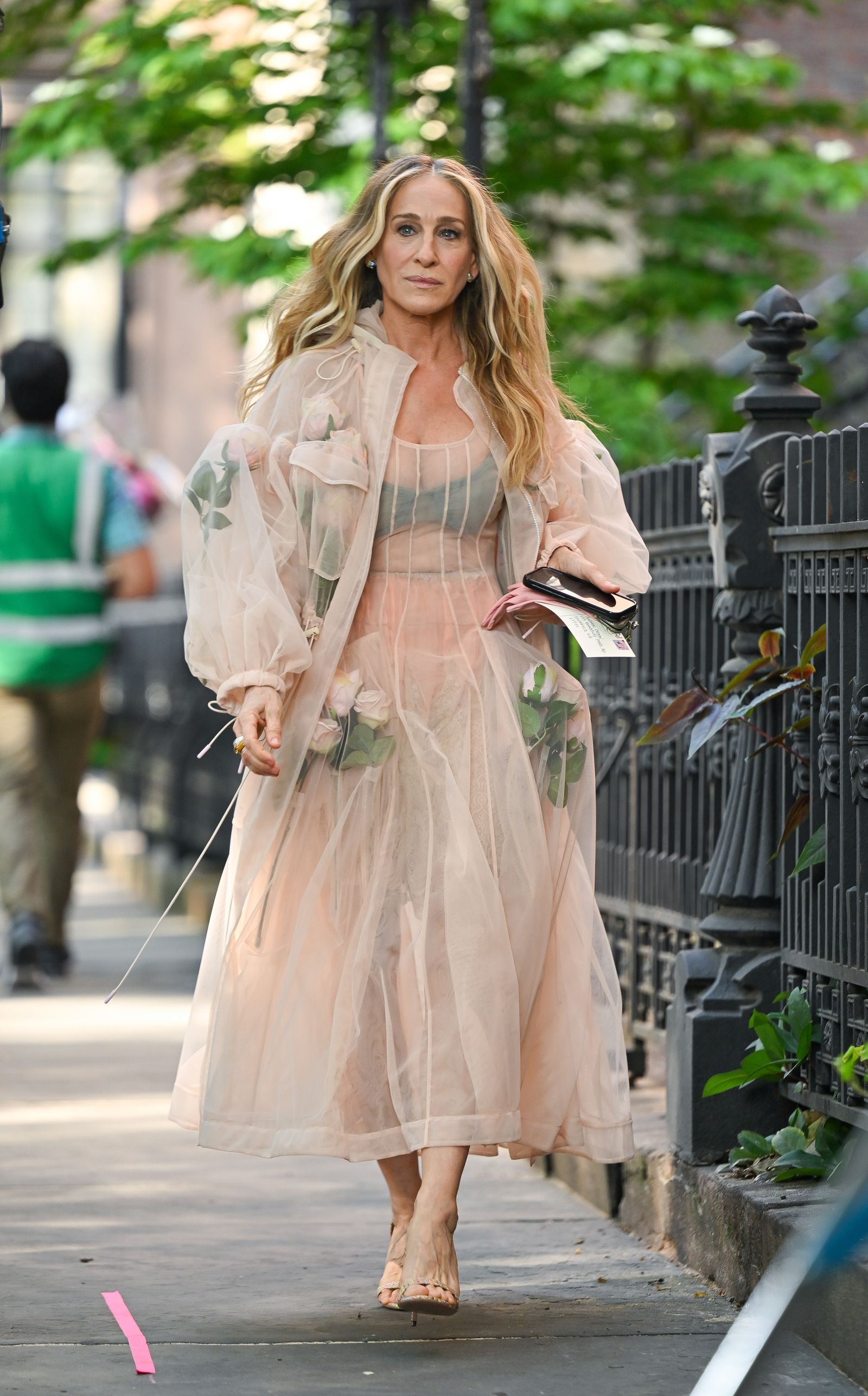
When Sarah Jessica Parker stepped onto the carpet at the New York City Ballet Fall Fashion Gala in a custom Simone Rocha sheer ballerina ballgown, the internet did what it does best: it saw Carrie Bradshaw. The reflex is flattering, and it is not wrong. But it undersells what was actually happening. This was not costume, and it was not nostalgia. It was a meeting of two sensibilities — the designer's romantic, subversive femininity and the actress's near-encyclopedic knowledge of fashion history — converging on the one night of the year when New York's cultural and sartorial establishments formally overlap.
The gown itself is a study in Rocha's signature tensions. Sheer tulle layers the body without quite concealing it, gathered into a voluminous, soft-edged ballgown skirt that reads as much rehearsal studio as red carpet. The bodice carries the designer's recurring vocabulary — delicate embellishment, ribbon-like detailing, a whisper of corsetry — while the silhouette nods unmistakably to the classical ballet tutu, exaggerated to gala scale. Nothing about it is accidental: the sheerness, the volume, the pale romance of it all are in direct conversation with the ballet's own aesthetic language.
A Designer Who Thinks in Movement
That conversation is precisely why Rocha was the right designer for this commission. Few working designers understand the ballet as both discipline and fantasy the way she does. Her collections have long drawn on pearls, tulle, broderie anglaise, and the architecture of dancewear, elevating them into garments that feel simultaneously innocent and knowing. Rocha has spent her career interrogating girlishness as a site of strength rather than fragility, and this commission is that thesis rendered in fabric.
The New York City Ballet's Fall Fashion Gala exists to pair choreography with couture, and Rocha's practice — which has extended into celebrated collaborations and a Spring 2027 collection that critics received as a masterstroke — is essentially choreographic already. Her clothes move. They are built for bodies in motion, even when those bodies are merely walking a carpet. The house's "hardcore femininity," as her work has been described, is not a paradox but a method.
The Right Woman for the Room
Then there is Parker herself. Her presence at the ballet gala is not incidental; she has long been one of the event's most committed patrons, and her red-carpet choices there tend toward the theatrical and the historically literate. The Carrie Bradshaw comparison surfaced instantly — Vogue, Page Six, W Magazine and Yahoo all reached for it — and again, it is not wrong, exactly. Bradshaw was a character who treated fashion as autobiography, and Parker has carried that instinct into her own public life.
But the deeper resonance is that Parker understands what a ballet gala asks of its guests: not a gown that shouts, but one that performs. She gave the dress the room it needed, styling it with a dramatic high ponytail that elongated the line and kept the whole look from tipping into period cosplay. The hair did quiet, structural work. It let the tulle breathe.
Romance With a Spine
Why does this matter now? Because the sheer ballerina ballgown arrives at a moment when fashion is rediscovering romance with a spine. The register Rocha has been working in for years — soft on the surface, rigorous underneath — is suddenly the one the culture wants. Her influence is visible everywhere from the runway to mass-market collaborations, and her Spring 2027 outing confirmed that she is not chasing the mood but defining it.
A custom gown like this one functions as a kind of proof of concept: here is what happens when a designer with a genuine point of view dresses a woman with a genuine point of view, for an occasion that actually means something. The sheerness is not a bid for attention. The volume is not a gimmick. Each decision is legible, and each one is in service of the other.
The Case Against the Endless Replica
Who is this for? Ostensibly, one woman on one night. In practice, it is for anyone who has grown tired of red carpets that mistake expense for imagination. The Simone Rocha ballerina ballgown is not a dress that will be replicated endlessly, and that is the point. It is a specific garment made for a specific body and a specific evening — a one-off in a culture that has learned to churn everything into content.
What lingers is the philosophy underneath it. Rocha's work has always argued that softness and strength are not opposites, and Parker has always treated fashion as a form of literacy rather than a form of display. Put the two together on the steps of the ballet, and you get the rare red-carpet moment that rewards a second look more than a first scroll — one that managed, in a single appearance, to remind an industry obsessed with virality that the most shareable thing a dress can do is be genuinely, intelligently beautiful.
:max_bytes(150000):strip_icc()/GettyImages-2177678003-2a48c69059ab48a2b06865e7b114b4b4.jpg)