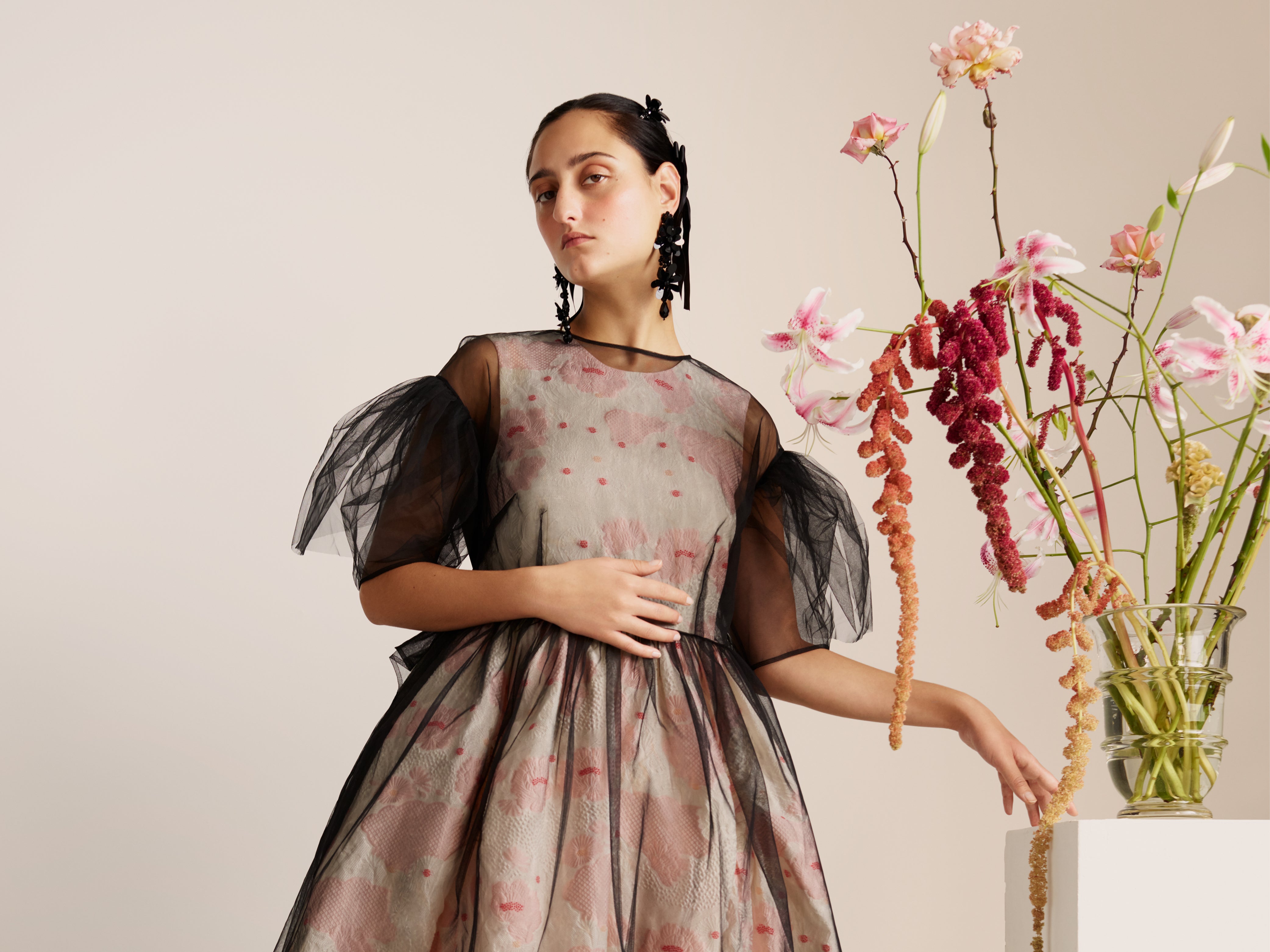
Some garments vanish the moment they leave the rail. Others refuse to. The Simone Rocha x H&M tulle midi dress belongs firmly to the second category — a piece that sold out almost instantly on its 2021 release and still commands multiples of its original price on resale, years after the collaboration itself receded into fashion history. Few high-street tie-ups produce a garment with genuine staying power; fewer still produce one that functions as a gateway drug. This dress does both.
What makes its afterlife so telling is what it carries. Conceived as the centrepiece of Rocha's collaboration with the Swedish giant, it distilled everything the designer had spent a decade building — the voluminous tulle, the ceremonial layering, the pearl embellishment, the faintly ecclesiastical romance — and placed it, briefly and tantalisingly, within reach of a far wider audience. The result was less a diffusion line than a translation, and the tulle midi became its emblem.
The Anatomy of a Sellout
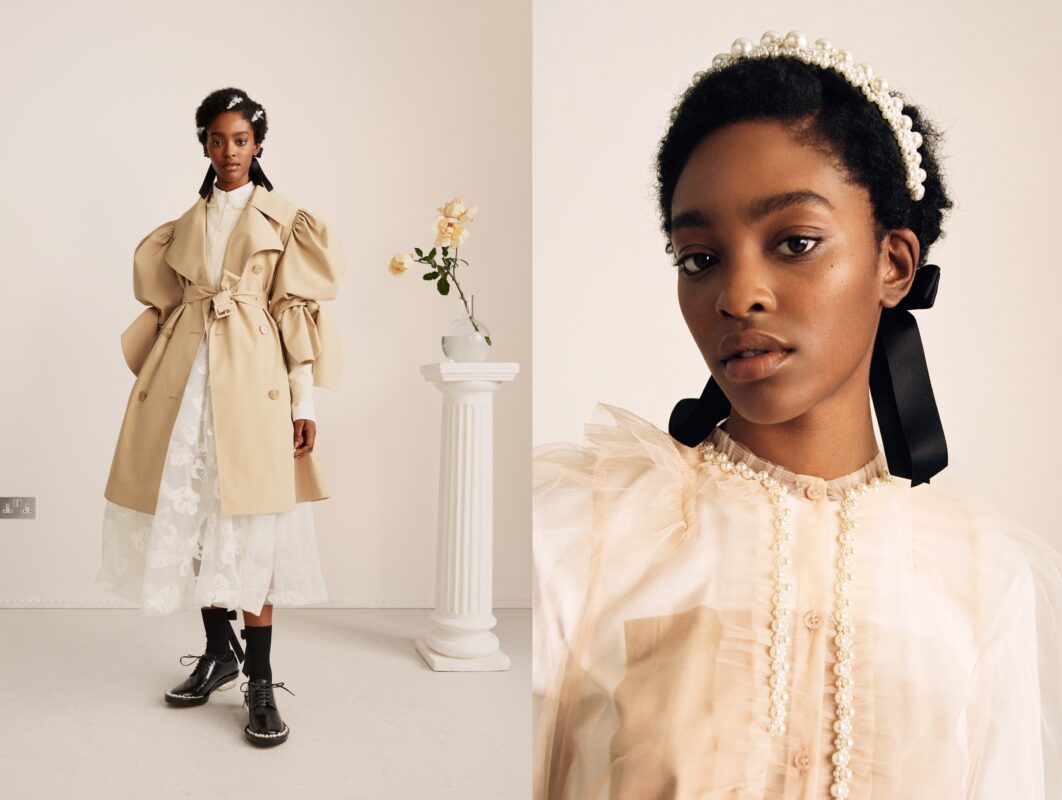
Look closely at the construction and the achievement becomes clear. The dress is built from layers of fine, crisp tulle — a fabric Rocha has made her signature since her Central Saint Martins MA collection — gathered into a full, midi-length skirt that holds its shape with a deliberate, almost architectural volume. The bodice is fitted, often with a sweetheart or square neckline, and finished with the details that separate her work from generic "romantic" dressing: scattered faux pearls, delicate embroidery, occasionally a ribbon tie or a puff at the shoulder.
The palette stays disciplined — black, ivory, soft pink, a muted red — because Rocha understands that tulle at this scale needs restraint elsewhere. It is a dress that reads as costume without tipping into pastiche, and that balance is precisely the achievement. Volume is engineered rather than incidental, which is why it flatters across ages and body types. The midi length does the rest of the work: worn with boots and a knit it reads daytime; with heels and bare shoulders it becomes something else entirely.
A Democratic Gesture, Executed Precisely
Culturally, the collaboration arrived at a moment when the boundaries between luxury and high street were being renegotiated with unusual energy. Rocha, a London-based designer of Irish and Chinese heritage, had long been the darling of a certain editorial and artistic milieu — her shows a fixture of London Fashion Week, her clothes worn by the likes of Sarah Jessica Parker and a rotating cast of It girls. The H&M project extended that language outward without diluting it. It was, in effect, a democratic gesture from a designer whose work had previously been priced for a narrower congregation.
That the piece sold out almost instantly — and that resale listings still command multiples of its original price — tells you something about the enduring appetite for Rocha's particular brand of femininity. It also explains why the dress remains a reference point whenever her name resurfaces in the news cycle, as it reliably does.
The Hinge in the Career
What keeps the piece relevant is the way it anticipates so much of what Rocha has done since. Her recent collections — the much-lauded Spring 2027 outing, the ongoing Adidas Originals partnership, her guest designership at Pitti Uomo — have only deepened her commitment to volume, texture and a kind of tender theatricality. The ballet costumes she created, widely celebrated for their instinctive understanding of movement and fabric, share the same DNA as this dress: tulle as a material of both fragility and structure, pearls as punctuation rather than ornament.
Seen in that lineage, the H&M piece looks less like a one-off commercial experiment and more like a hinge in her career — the moment her vocabulary proved it could travel intact from the runway to the rail. For those who missed it the first time, it remains the most direct route into her singular imagination.
In an era of relentless trend acceleration, that is the real argument for the dress. It has aged into something close to a modern collectible, proof that romance — properly constructed, rigorously edited — never really goes out of season. Rocha's philosophy has always insisted that ceremony belongs in the everyday, that a little theatricality is not an indulgence but a form of care. The tulle midi simply made that conviction available to anyone who queued for it.