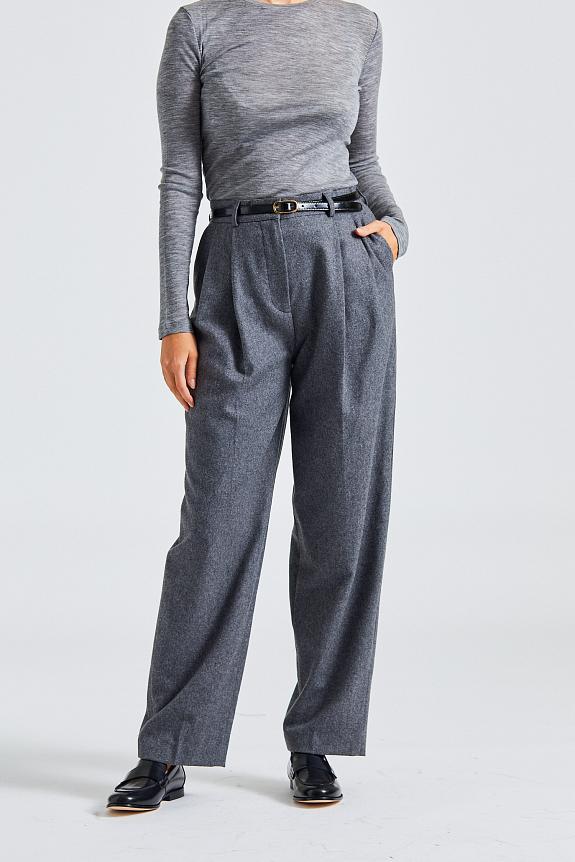
When TOTEME unveiled its Fall/Winter 2026 collection, it wasn’t merely presenting new clothes—it was formalizing a decade-long philosophy. The Swedish label, helmed by Elin Kling and Karl Lindman, has long been the benchmark for a particular strain of Scandinavian restraint. But with the debut of menswear this season, the brand has sharpened its vision into something more architectural, more definitive. At the heart of this evolution sits one garment that captures the entire ethos: the TOTEME FW26 tailored wool trousers. They don’t just redefine modern Swedish tailoring—they reset the standard for what dressing with permanence means in an era of relentless churn.
Cut With Controlled Intention
These trousers are a study in deliberate precision. Cut from a dense, responsibly sourced virgin wool with a pronounced yet soft hand-feel, they drape with a weight that signals seriousness without veering into stiffness. The silhouette is neither aggressively slim nor recklessly wide. Instead, TOTEME has engineered a gently tapered leg that falls from a high, pleated waist—a continuous line that elongates the body while allowing natural movement.
The rise sits at the true waist rather than the hip, a nod to classical menswear that feels entirely contemporary. Inside, the details reward close inspection: an internal waistband facing in contrasting twill, horn buttons, and a meticulously pressed crease running from hip to hem. This is finish work visible only to the wearer—which, for TOTEME, is exactly the point.
Material Intelligence
What elevates these trousers beyond utility is their fabric logic. The wool blend incorporates a traceable percentage of recycled fiber, reflecting TOTEME’s ongoing commitment to circularity. Meanwhile, the fabric’s natural breathability and recovery make them a year-round proposition in most climates.
The FW26 palette leans into what the brand calls “Swedish winter light”—a spectrum of oat, ink, graphite, and a deep forest green that reads almost black in low light. These are not colors that shout; they are colors that endure, designed for a decade rather than a season. Construction details borrowed from bespoke tailoring include a half-lined front and a curtained back, allowing the trousers to move *with* the body rather than against it. An extended closure tab and side adjusters offer a precise fit without the bulk of a belt.
The Cultural Moment
TOTEME’s menswear launch arrives at a pivotal inflection point. The pendulum has swung decisively away from logo-heavy statement dressing toward a more considered, investment-driven approach. The editors who once chased viral trends now speak of “forever wardrobes.” TOTEME’s FW26 runway—staged in a stark, light-filled Stockholm space with models walking at a deliberate pace—felt less like a fashion show than a manifesto.
The tailored wool trousers anchor the collection, the foundational piece around which fluid silk shirts, structured overcoats, and hand-knitted turtlenecks revolve. For women, they join a broader conversation about borrowing from the boys—the androgynous cut offering a refreshing counterpoint to the hypersexualized dressing of recent seasons. For men, they serve as an entry point into a system of dressing that prioritizes integrity over novelty.
Who Wears TOTEME
She is the creative director who wears the same black trousers for five years and calls them her uniform. He is the architect who understands that a garment, like a building, is only as good as its proportions. They are people who have moved past the noise of trends, seeking clothing that aligns with their values—sustainability, longevity, and an aesthetic that whispers rather than shouts.
With Cameron Diaz wearing TOTEME to press days and Kaia Gerber in the brand’s slinkier offerings on red carpets, the label has proven it can straddle accessible luxury and high fashion. But it is in these tailored wool trousers that the brand’s true thesis emerges: dressing well is not about spectacle but about self-possession. In a world of shrinking attention spans, TOTEME has created a garment that demands nothing yet offers everything—a quiet, confident assertion that true style, like true architecture, is built to last.