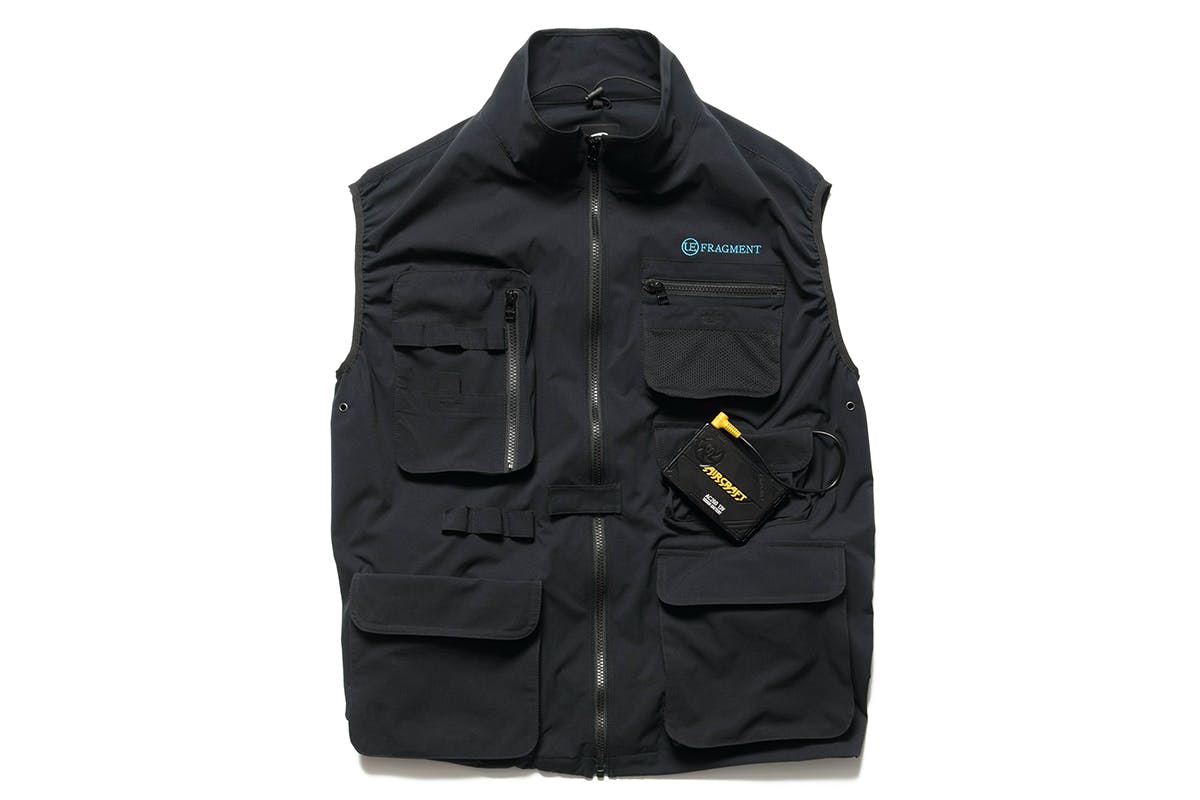
Every summer, streetwear asks its wearers to suffer beautifully. The codes of the culture — layered tech-fleece, boxy overshirts, heavyweight cotton — were built for climate-controlled galleries and temperate Tokyo springs, not for a planet that keeps rewriting its own heat records. Most brands respond to the problem with lighter cotton and call it a season. The uniform experiment x fragment design Fan-Cooled Vest responds with engineering. Depending on your disposition, it is either the least romantic garment in contemporary fashion or the most honest one. Either way, it hums.
The vest is the product of a long-running dialogue between uniform experiment, the experimental menswear label founded by Hiroshi Fujiwara and SOPH's Hiroshi Kiyonaga in 2008, and fragment design, Fujiwara's own consultancy and the most quietly influential studio in modern streetwear. Where uniform experiment takes the vocabulary of the uniform — the suit, the oxford shirt, the workwear shell — and subjects it to rigorous refinement, fragment supplies the lightning-bolt instinct for collaboration and cultural shorthand. Together the two have produced Nike sneakers, slope-ready holiday capsules, and Mastermind Japan link-ups. The fan-cooled vest is the partnership at its most utilitarian.
A Chimney You Can Wear
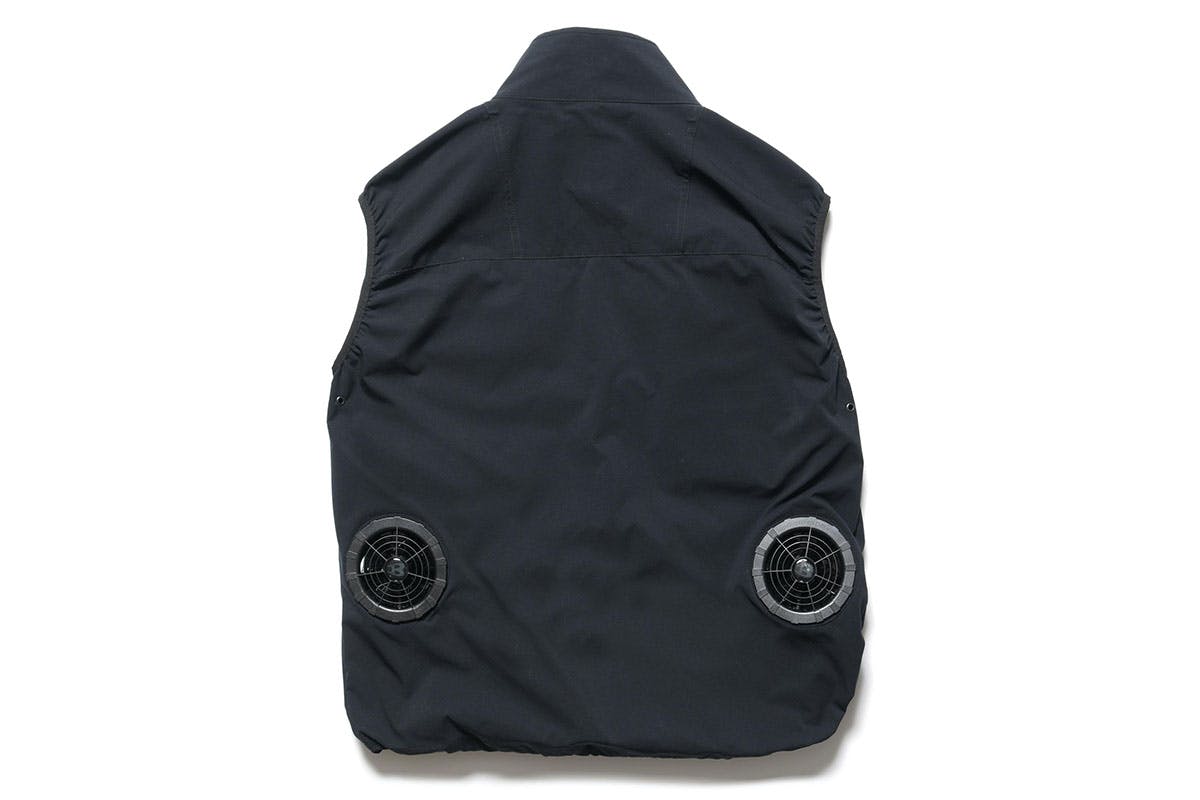
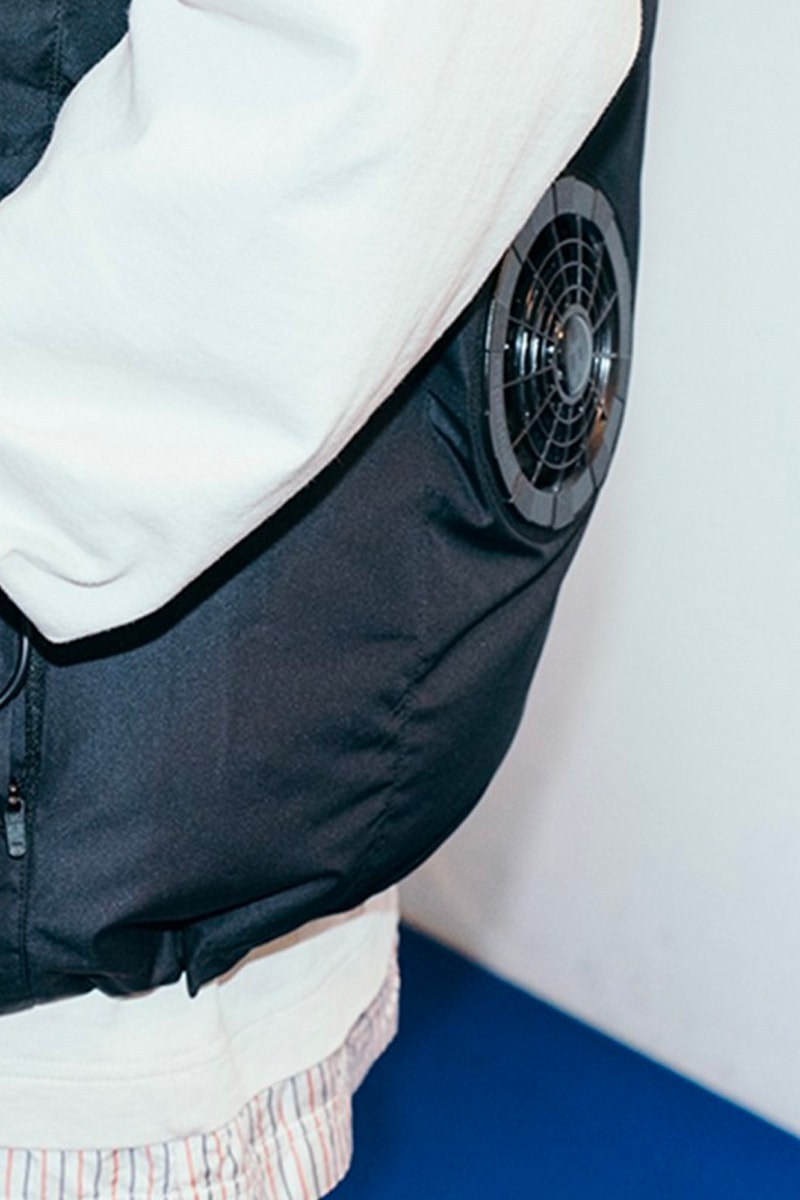
The construction is straightforward in the way that good tools are straightforward. Two compact fan units are mounted at the lower back, drawing outside air in and pushing it across the wearer's torso before venting it through the collar and armholes — a chimney effect that turns the vest into a personal microclimate. The shell is a lightweight, weather-resistant textile with taped seams and a stand collar, cut boxy and slightly cropped in the uniform experiment house silhouette. Hidden zip pockets, a two-way front closure, and adjustable hem drawcords keep the detailing disciplined. Nothing about it announces its technology loudly; the fans are visible only if you know where to look. This is the Kiyonaga principle at work — a garment should read as clothing first and equipment second.
The Case Against Looking Like a Golf Cart
That restraint matters, because cooling wearables have historically skewed toward the aesthetic of a golf cart or a construction site — function worn like a warning label. The BURTLE collaboration uniform experiment released previously proved the label could integrate built-in fans into a genuinely desirable waterproof parka. The fragment version pushes the idea further into the everyday. Worn over a tee in August or under an overshirt in the shoulder season, it slots into a wardrobe rather than replacing one. You don't build outfits around it. You build them through it.
The Uniform, Renegotiated
The cultural context here is not incidental. As French school districts abandon their uniform experiments after researchers found limited effects on behaviour and learning, the word "uniform" is being renegotiated in real time — less a tool of discipline than a platform for problem-solving. uniform experiment has always operated on that premise. A vest with built-in fans is its logical endpoint: the uniform as adaptive system, tailored to the conditions its wearer actually inhabits rather than the ones fashion pretends exist.
Who It's For
The commuter crossing a shadeless district at noon. The festival-goer who refuses to dress like a tourist. The collector who already owns the fragment Air Jordan and wants the piece that admits summer is a design constraint. It is for anyone who has quietly accepted that looking good and staying cool should not be mutually exclusive — and who understands that the most advanced thing a garment can do in 2024 is simply work.
In a season when most brands respond to heat with little more than lighter cotton, the uniform experiment x fragment design Fan-Cooled Vest makes a more serious proposition: that technical function, executed with editorial discipline, is not the opposite of style but its most current form. Heatwave streetwear has a new baseline, and it hums.