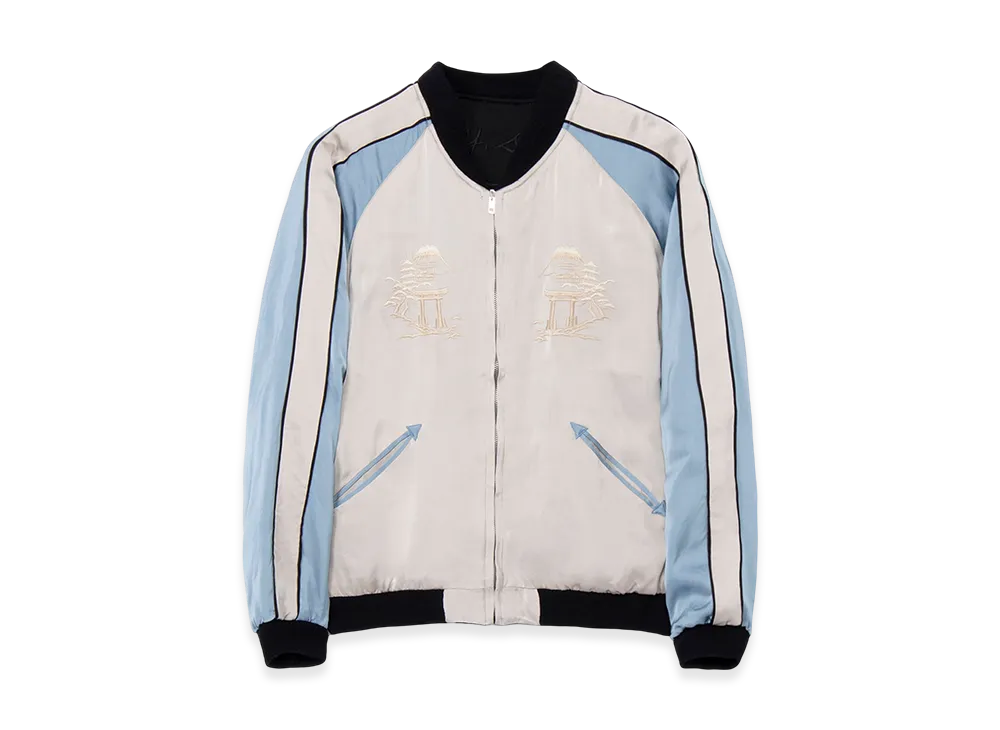
The souvenir jacket has always carried a certain narrative charge—a garment born of postwar Japan, adopted by occupying servicemen who commissioned local artisans to embroider silk and rayon with eagles, tigers, and maps of distant homelands. That lineage of cross-cultural exchange, of craft pressed into service as personal memory, finds a sharp contemporary expression in the Y's x TALOR TOYO Sukajan "Black/Light Blue," a collaboration that places Yohji Yamamoto's exacting tailoring sensibility in dialogue with the embroidery workshops of Toyo, the Japanese label whose sukajan and Yokosuka-jacket heritage has made it a reference point for collectors and designers alike.
The product itself is a study in controlled contrast. A black ground—the color of discipline, of the nocturnal Tokyo that has long shaped Yohji's visual language—is punctuated by pale, light-blue embroidery that reads almost like frost across the back panel and sleeves. The palette is deliberately restrained; this is not the garish, high-saturation souvenir jacket of tourist memory but something quieter and more considered.
The Craft Behind the Contrast
The embroidery, executed through Toyo's established craft channels, retains the density and hand-character that define serious sukajan production: the raised sheen of the thread, the slight irregularity that signals human work rather than machine repetition. Against this, Y's contributes the cut—a silhouette that carries the asymmetry and elongated proportion associated with the house, allowing the jacket to drape rather than sit stiffly. The result is a piece that feels simultaneously archival and forward, a garment that respects its source material while refusing to treat it as costume.
A Garment at a Loaded Intersection
Culturally, the sukajan sits at an unusually loaded intersection. It is at once a symbol of American military presence in Japan, a product of Japanese artisanal skill, and, in the decades since, a staple of subcultural style—worn by rock musicians, adopted by streetwear, reinterpreted endlessly. Yohji Yamamoto's engagement with it is not incidental. His work has long circled themes of East-West exchange, of garments that move between worlds, and the sukajan's embroidered surfaces echo the way his collections have used text, imagery, and textile narrative. Partnering with Toyo, a name synonymous with the preservation of this craft, lends the collaboration credibility that a purely fashion-driven reinterpretation would lack. This is not appropriation but conversation—a Japanese designer and a Japanese craft house returning to a garment that was, from its origins, a hybrid object.
Who It's For—and Why It Matters Now
The Y's x TALOR TOYO Sukajan "Black/Light Blue" is aimed at a wearer who understands that a jacket can be both a statement and a document. It will appeal to the Yohji loyalist who wants an entry point into his universe that is more accessible than a full tailored look, and to the vintage and craft enthusiast who recognizes Toyo's name as a guarantee of embroidery quality. It is also, crucially, a piece for the collector who values the souvenir jacket as an evolving form rather than a fixed relic. The black-and-light-blue colorway is versatile enough to wear over a plain tee or layered under a coat, and the proportions—assuming the house's characteristic ease—should accommodate movement without losing shape.
Why it matters now is partly a matter of timing. The sukajan has been in a slow resurgence, its embroidered surfaces appearing on runways and in editorial spreads as designers look for garments with built-in narrative. At the same moment, the fashion conversation has turned toward craft provenance—who made this, where, and with what skill—and collaborations that pair a designer's vision with a specialist's hand carry particular weight.
The Y's and Toyo partnership answers that appetite precisely. It is a reminder that the most interesting garments often sit at the meeting point of two disciplines, each lending the other something it could not achieve alone. In a market crowded with logo-driven collaborations, this one offers something rarer: a genuine exchange of craft, history, and intent, stitched into a single jacket.
