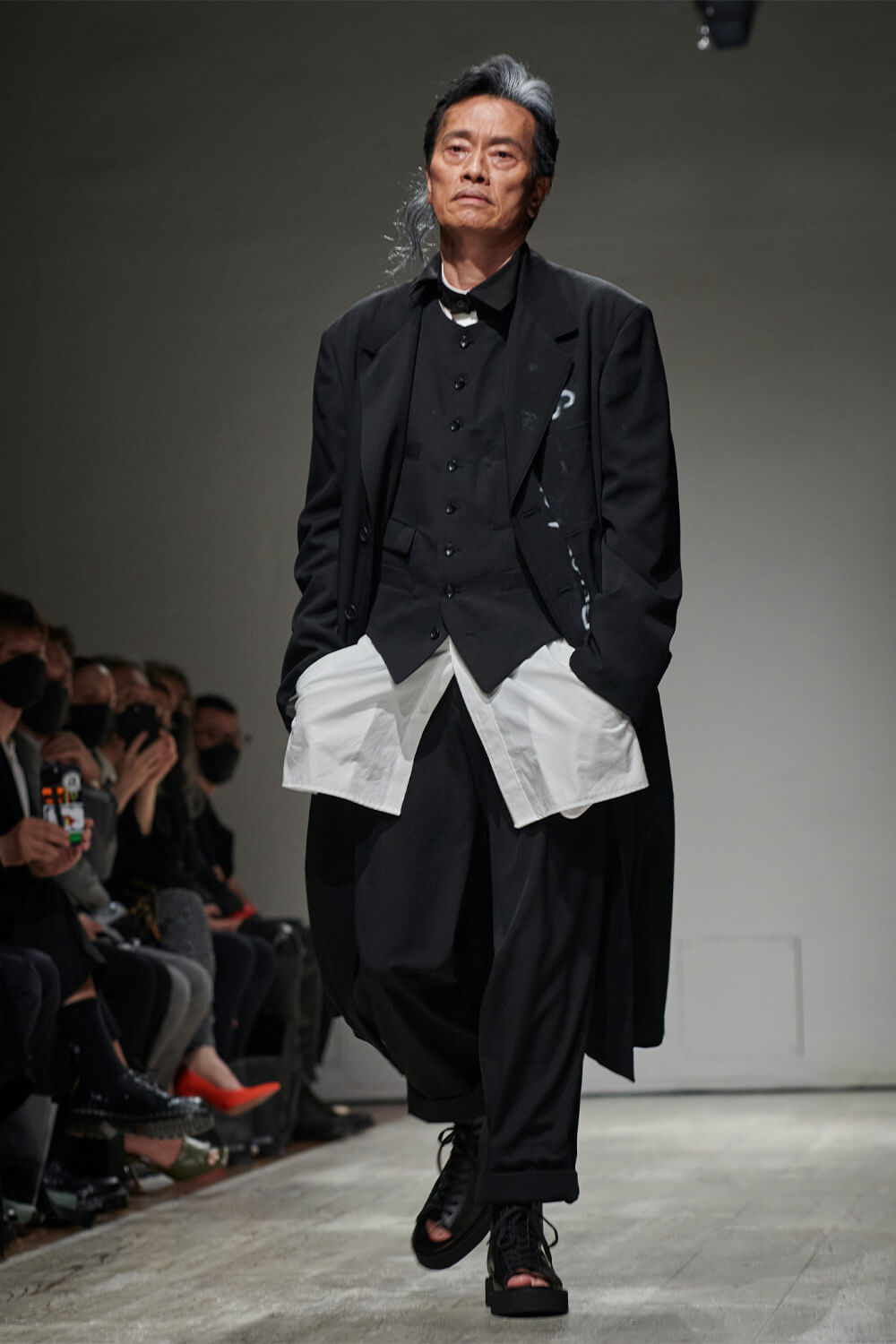
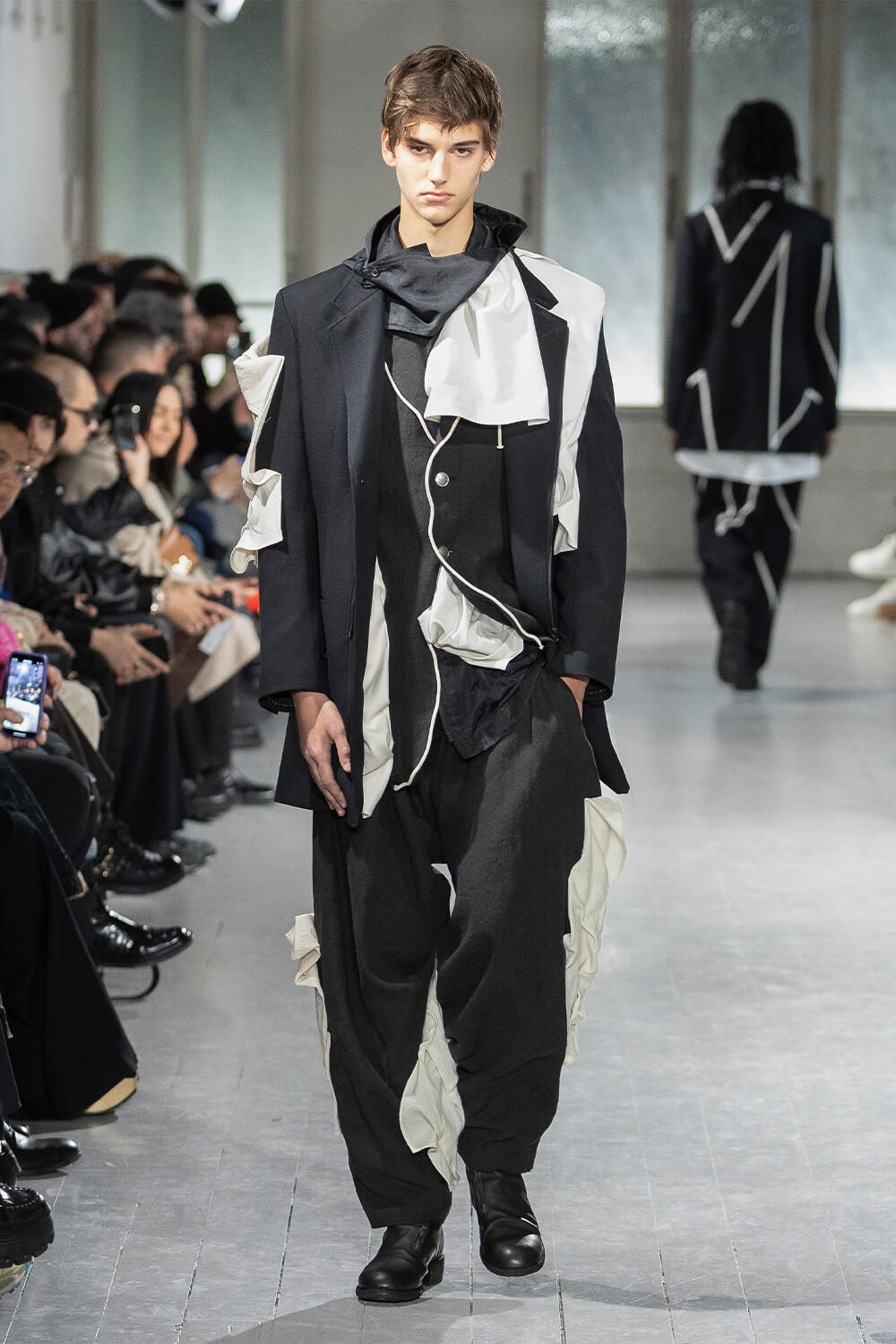
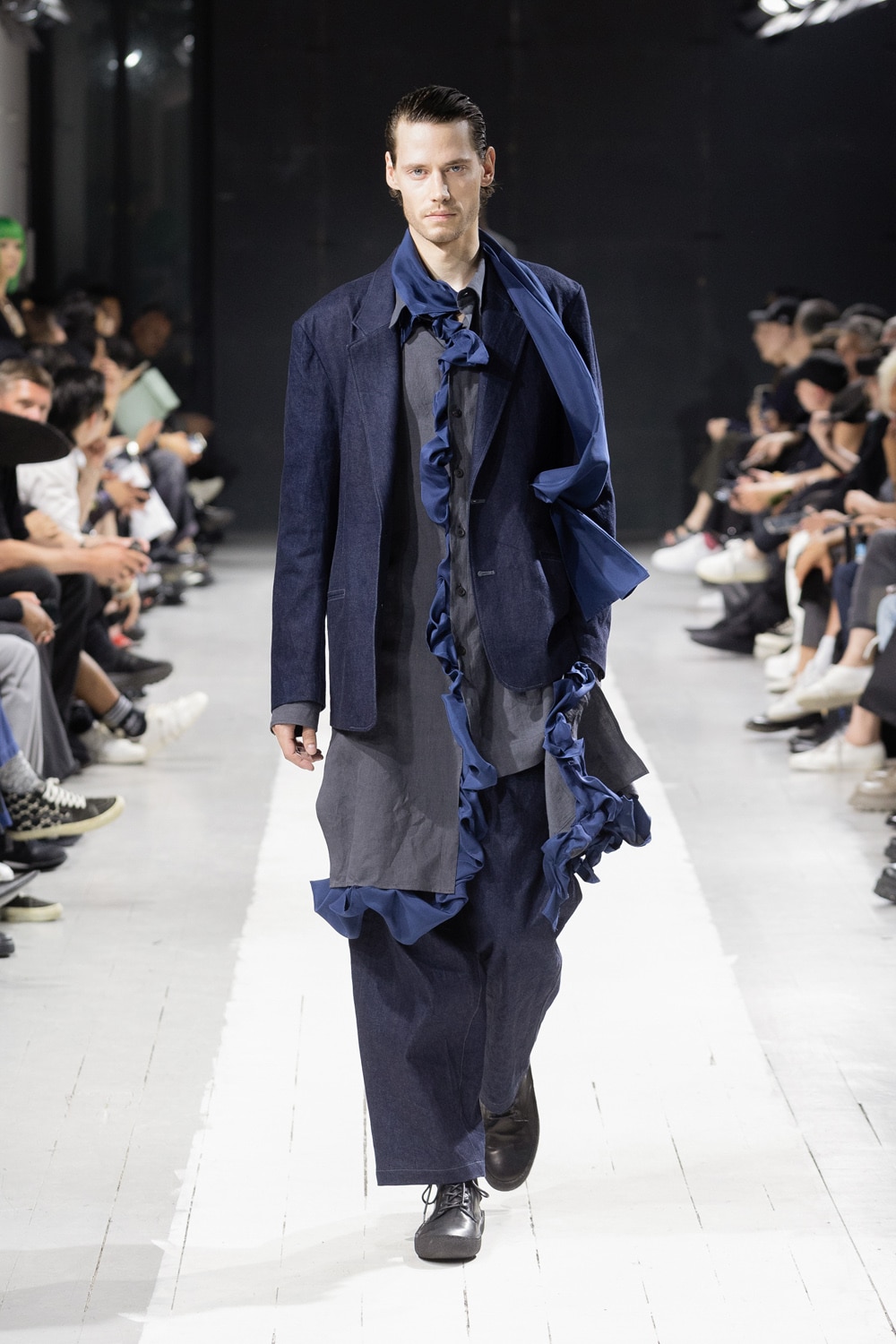
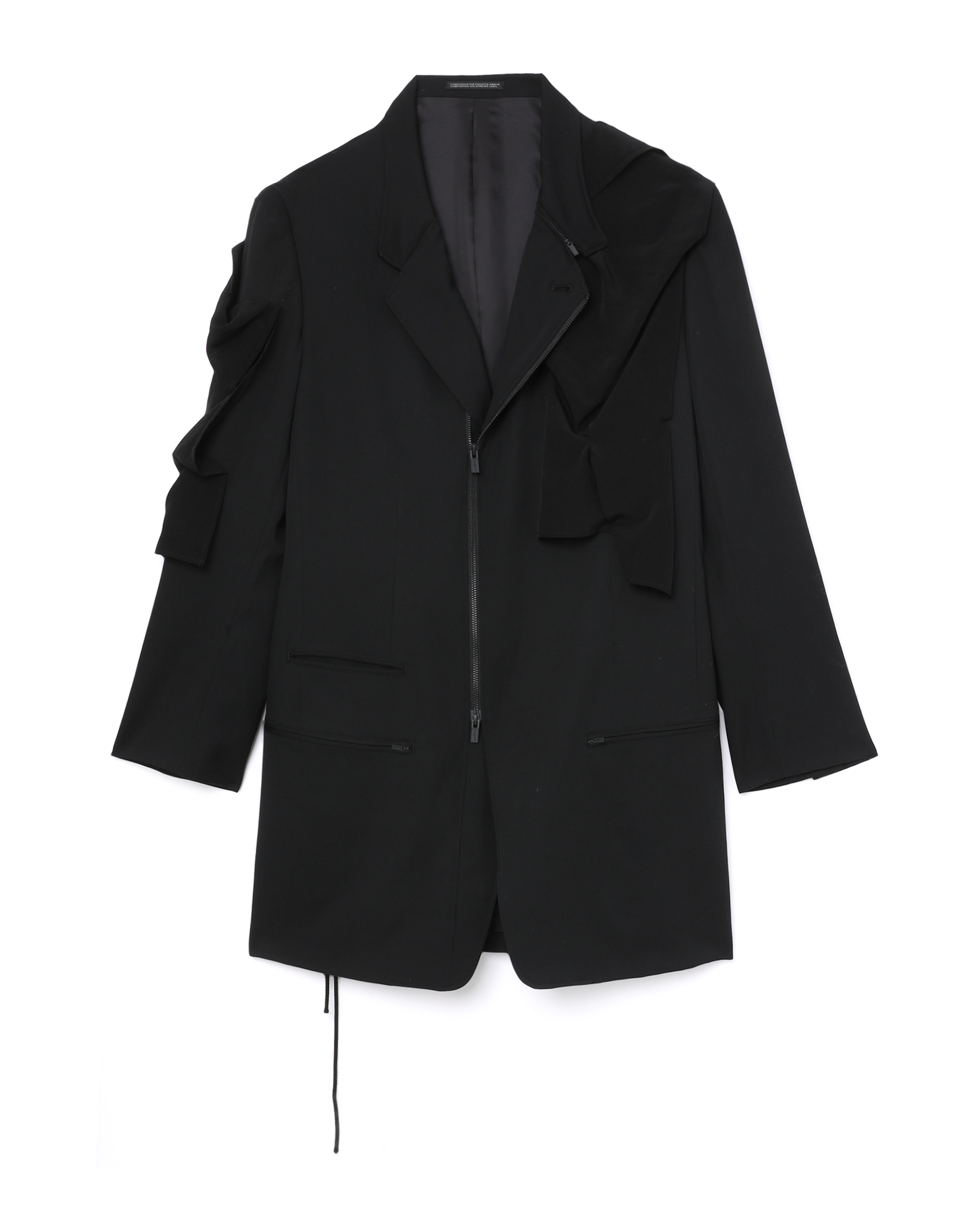
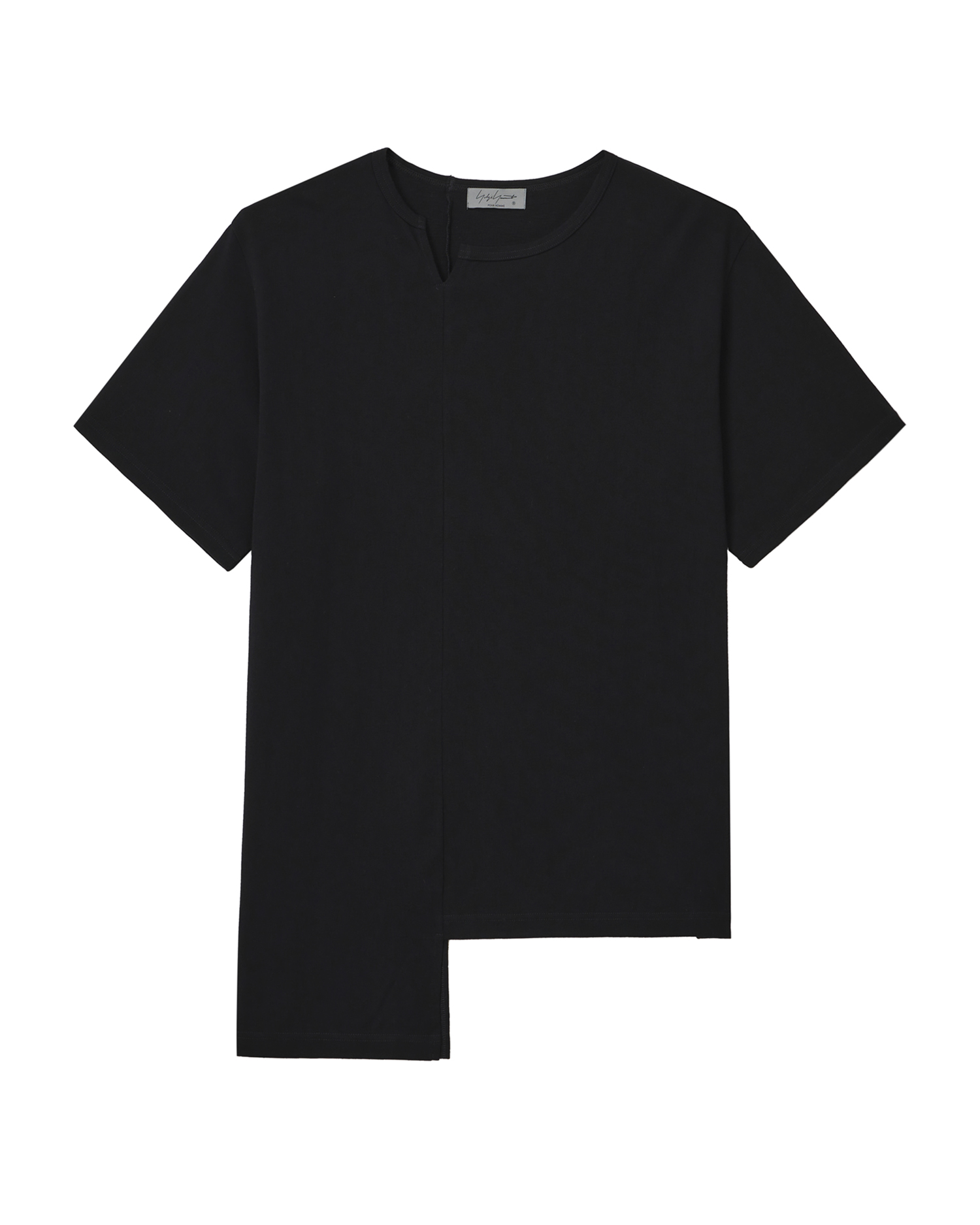
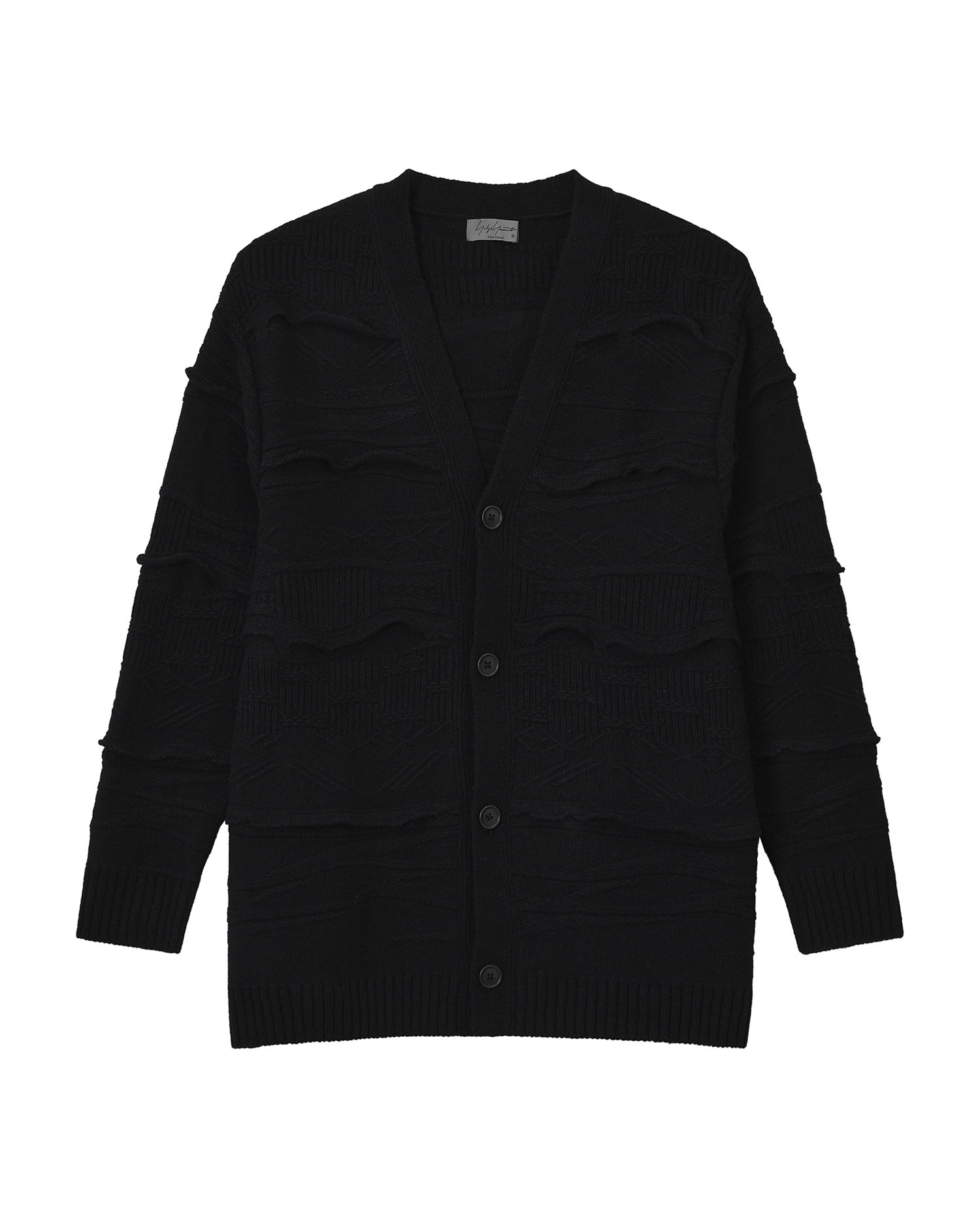
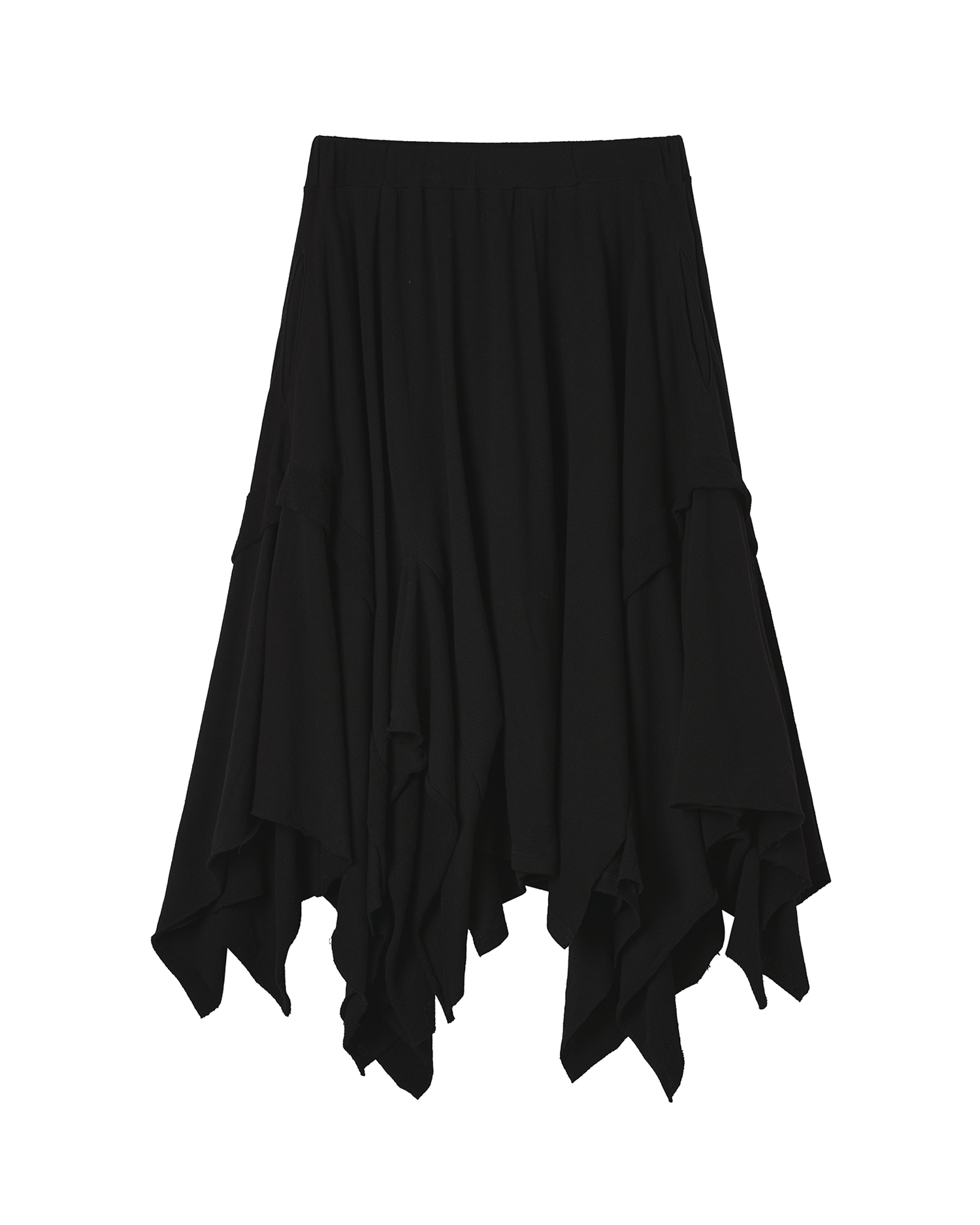
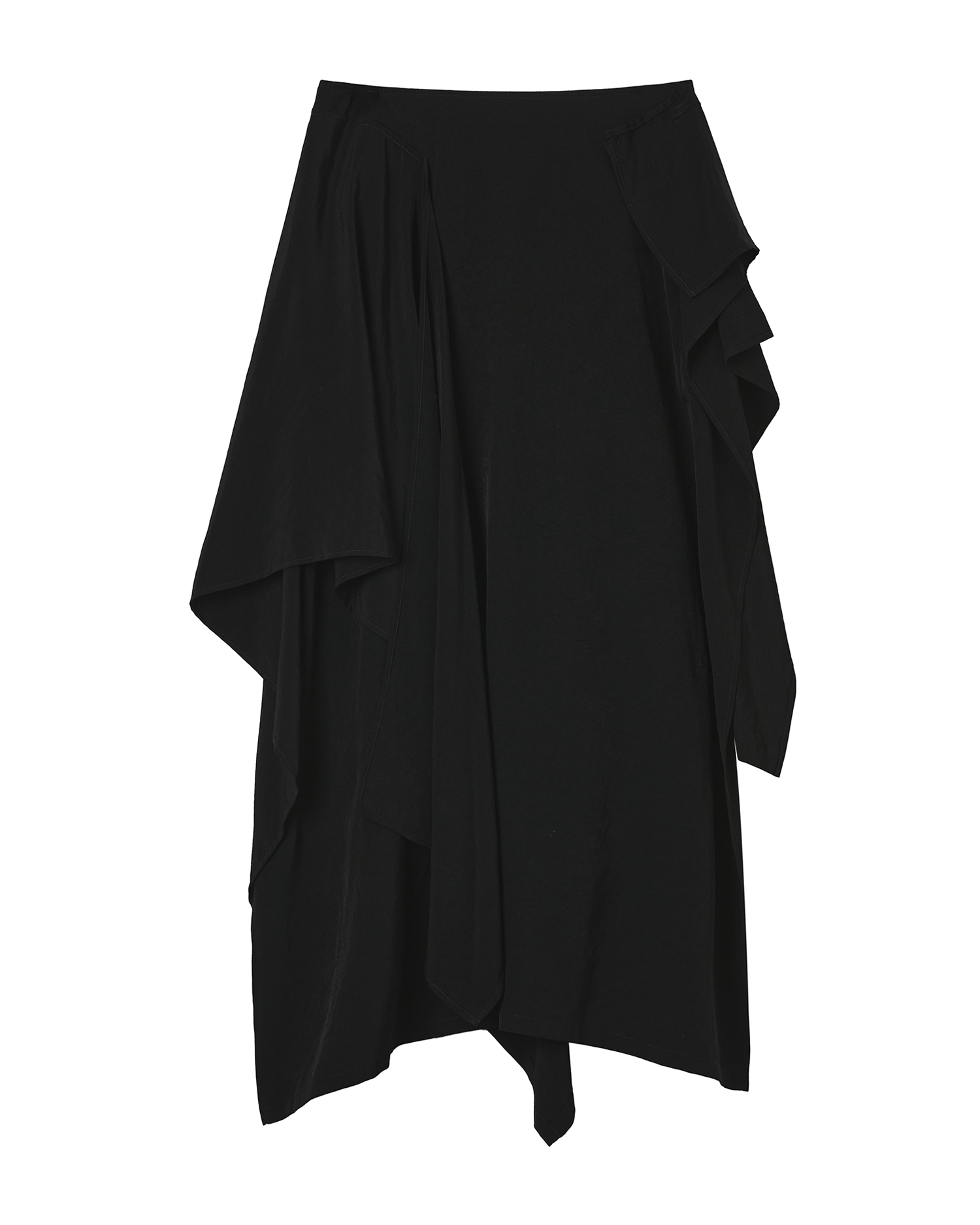
Yohji Yamamoto has spent four decades treating the suit as a site of quiet rebellion. Not the rebellion of loud graphics or shoulders inflated into armor, but the subtler insurrection of asking why tailoring should restrict the body at all. With the YOHJI YAMAMOTO COSTUME D'HOMME "cut motion + motion sewing" suit, that question gets its most technically precise answer yet. The collection drew immediate attention from Hypebeast and reinforced the house's menswear momentum noted by FashionNetwork in its Paris coverage—a suit engineered around movement rather than posture, fabric cut to follow the body in flux instead of freezing it in place.
The name is the thesis. Everything else follows from it.
Cut for the Body You Actually Have
"Cut motion" refers to pattern-cutting calibrated to the trajectories a wearer's body actually traces—reaching, turning, sitting, walking—rather than the static mannequin silhouette that governs conventional tailoring. It's a small distinction with enormous consequences. Most suits are drafted for a body at rest, standing straight, arms at sides. Yamamoto drafts for the body mid-gesture.
The result reads impeccably still but behaves like something alive. Jackets drape with his signature elongated ease; trousers carry volume without collapsing into shapelessness. Nothing is padded into a false ideal. Everything is proportioned to the person inside it.
Seams That Give Instead of Fight
"Motion sewing" extends that logic to construction: seams and stitch lines placed so the garment's architecture flexes with the wearer rather than against them. This is where the suit separates itself from the raft of "comfort tailoring" currently crowding the market. The flexibility isn't achieved through stretch fabrics or relaxed fits. It's built into the geometry of the garment itself—the way a shoulder seam rolls, the way a sleeve sets, the way a trouser leg breaks and recovers mid-stride.
The materials honor the method. Yamamoto's ateliers have long favored wool gabardine, tropical wool, and dry-handed suitings—fabrics with enough natural memory to hold a line yet enough give to answer the body's motion. The palette stays within the house's disciplined register: deep blacks, ink navies, charcoal, the occasional washed grey, rendered matte and light-absorbing rather than glossy. These are clothes that don't announce themselves from across a room. They reveal themselves in motion—in the way a lapel settles when its wearer turns.
The Radical Consistency of a Perpetual Revolutionary
Culturally, this places the suit within a lineage that recent coverage has been busy mapping. AnOther Magazine's "Perpetual Revolution: The Paradox of Yohji Yamamoto" and L'OFFICIEL HOMME's career survey both circle the same idea: Yamamoto has spent his career refusing fashion's demand for novelty while remaining permanently radical. GQ's recent reconsideration of Carolyn Bessette-Kennedy as "Yohji Yamamoto's great interpreter" reminds us that his tailoring has always transcended gender and era—she wore his pieces with a minimalism that now looks prophetic.
Meanwhile, the expansion of THE SHOP YOHJI YAMAMOTO, the house's official web store, means this philosophy is more accessible globally than at any point in the brand's history. And his continued presence on the Paris menswear calendar, side by side with Dries Van Noten, affirms that his dialogue with tradition remains vital rather than nostalgic.
Who It's For
Not the executive chasing armor, nor the peacock chasing attention. It's for the person who understands that authority and comfort are not opposites—the architect, the creative director, the musician, the anyone who spends a day in motion and refuses to be corseted by convention. It suits all genders and none exclusively; like so much of YOHJI YAMAMOTO HOMME, it is really a proposition about freedom wearing the costume of formality.
Why does it matter now? Because menswear is once again obsessed with tailoring, and much of that revival mistakes stiffness for seriousness. The "cut motion + motion sewing" suit quietly refutes that equation. It argues that the most rigorous tailoring is the kind you forget you're wearing—cut not to display the tailor's hand, but to disappear into the wearer's life.
In a moment saturated with logomania and algorithmic trend cycles, a suit designed around the human body's actual movement is almost subversive. Yamamoto, as ever, is not chasing the moment. He is cutting around it, seam by seam, letting the cloth do what it has always done best in his hands: move.