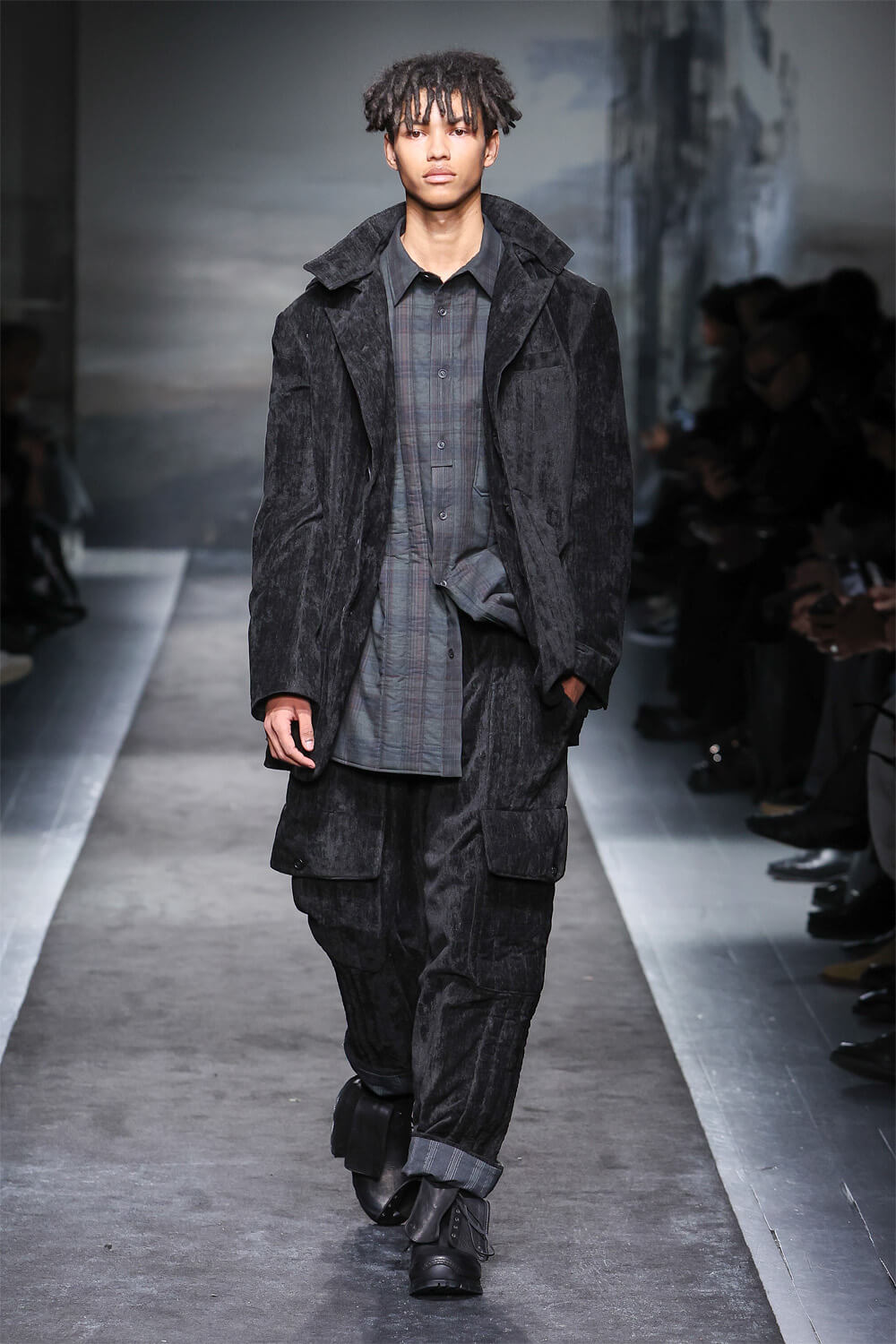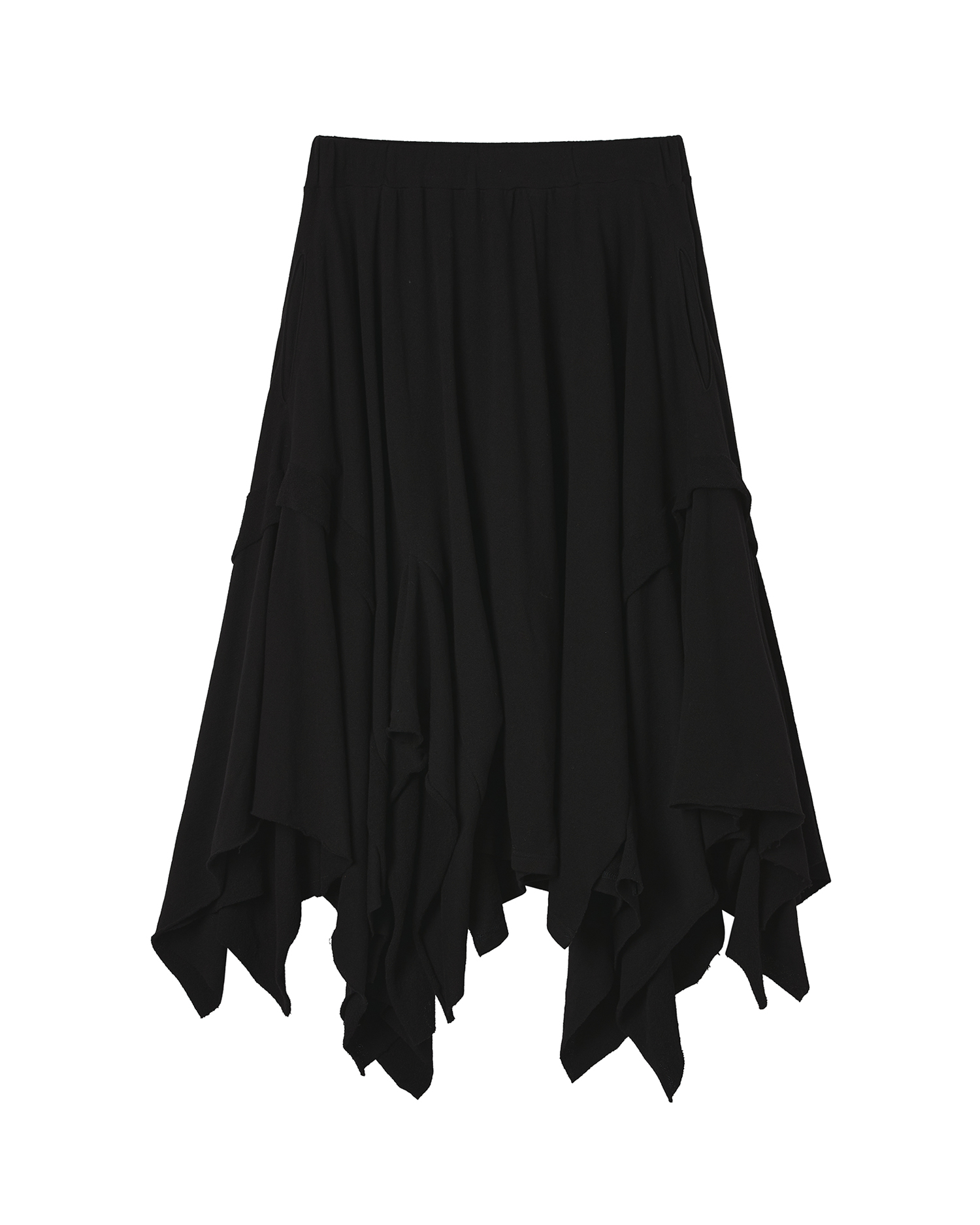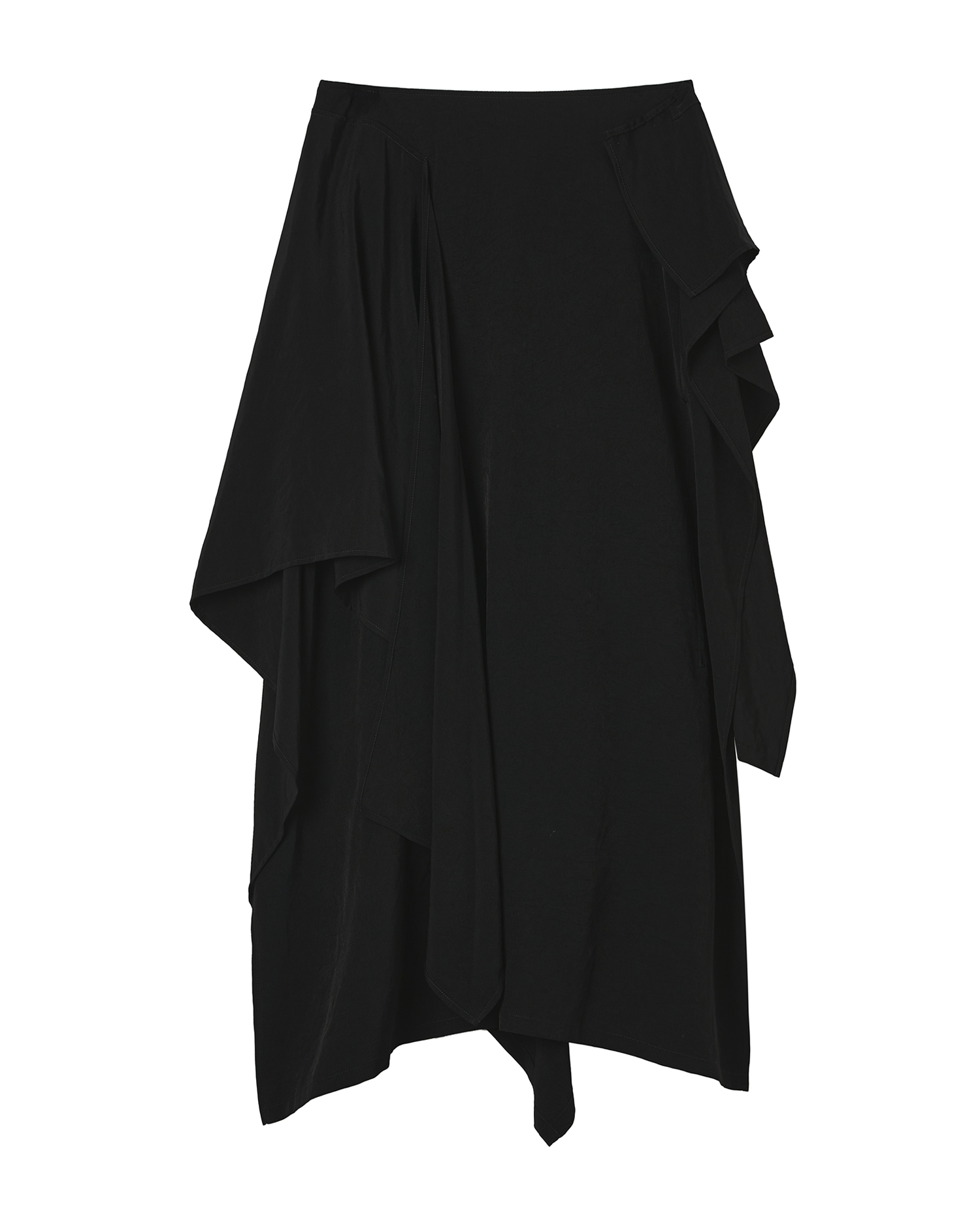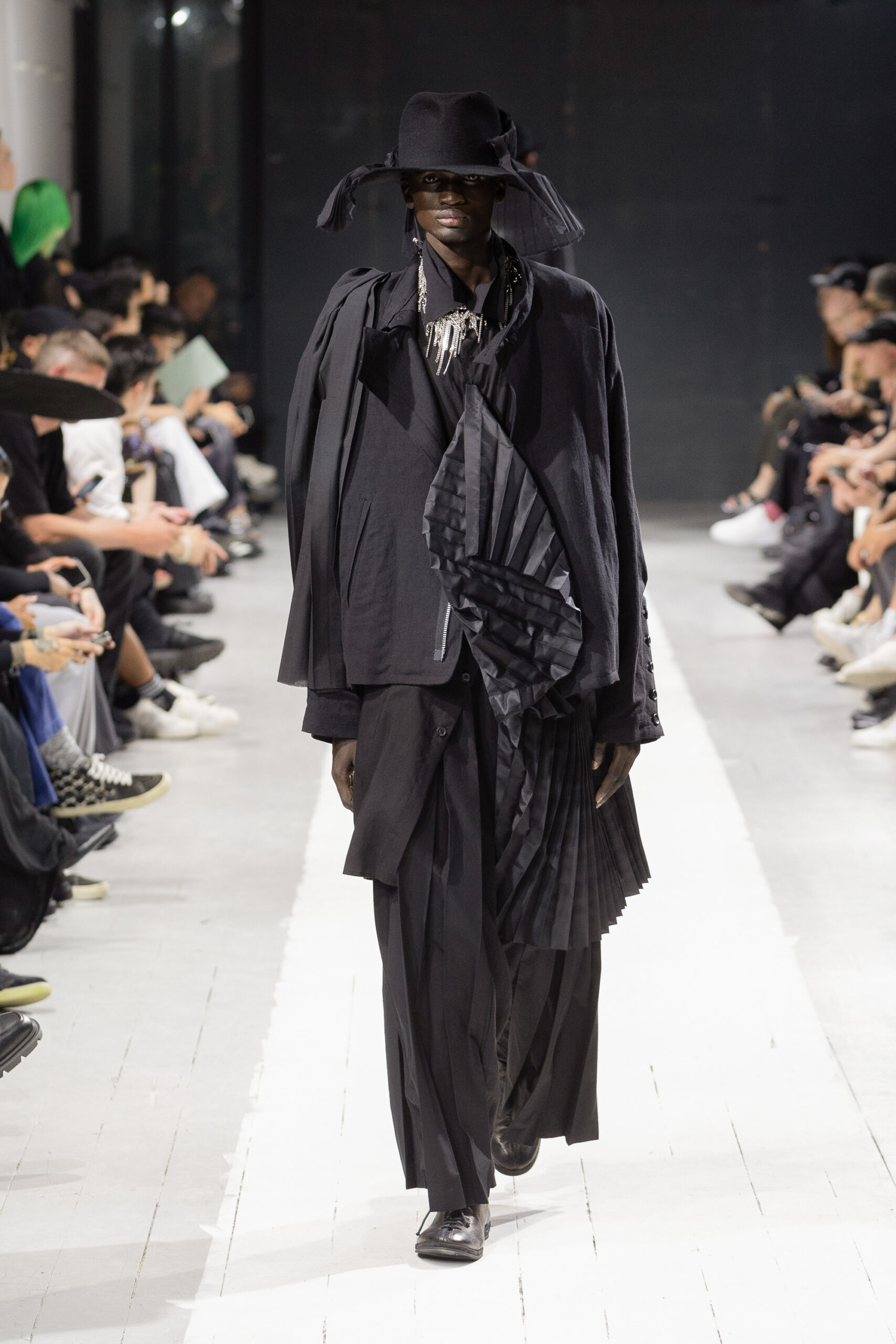
At the center of Yohji Yamamoto Homme's latest Paris menswear showing—a highlight of a Thursday schedule the industry watched closely alongside Dries Van Noten—stood a suit that quietly dismantles everything a suit is supposed to be. The YOHJI YAMAMOTO HOMME Cut Motion + Motion Sewing Suit is not an exercise in nostalgia or a reverent rereading of Savile Row. It is a garment built around a single, radical proposition: that tailoring should serve the moving body rather than the static mirror.
Where conventional suiting locks the shoulders into a rigid architecture and treats the torso as a fixed volume, this piece is engineered for motion from the first stitch, its construction anticipating the wearer in mid-stride rather than standing still. The effect is less a reworking of the suit than a quiet rebellion against its stillness.
The Pattern Follows the Body, Not the Mirror
The design details reveal the philosophy in material form. The Cut Motion principle governs the pattern itself—panels are cut and reoriented so that fabric follows the body's natural arcs of movement, releasing tension at the joints and allowing the jacket to swing, drape, and settle without resistance.
The Motion Sewing technique extends this logic into the seams: rather than pressing the garment into a fixed silhouette, the stitching is conceived to accommodate shifting volume, so the suit breathes and adapts as the wearer walks, turns, or sits. The result is a paradoxical formality—a suit that reads as authoritative and composed at rest, yet behaves with the fluidity of something far less structured the moment it is worn. The palette, as ever with Yamamoto, leans toward the sober and the profound: deep blacks, softened charcoal, the kind of shadowed neutrals that let cut and movement carry the entire conversation.
A Career of Interrogating the Garment
The cultural context here is inseparable from the designer himself. Across four decades, Yamamoto has been fashion's great interrogator of the garment—an AnOther Magazine reflection recently framed his career as a "perpetual revolution," and that paradox is precisely what this suit embodies. He is at once a traditionalist and a saboteur, a couturier who has spent his life pulling tailoring apart to understand what holds it together.
The Cut Motion + Motion Sewing Suit is a distillation of that lifelong inquiry, arriving at a moment when the broader culture has rediscovered his influence: GQ's recent examination of Carolyn Bessette-Kennedy as his great interpreter, L'OFFICIEL HOMME's charting of his career, and the expansion of THE SHOP YOHJI YAMAMOTO all confirm a designer whose relevance keeps renewing itself. This is not revivalism; it is the ongoing work of an original.
For the Man Who Moves
Who is this suit for? Not the man who wants his tailoring to announce his status from across a room, but the one who understands that true authority is felt in how a garment moves with its wearer. It suits the architect, the artist, the collector of considered things—someone who values the intelligence of construction over the loudness of a logo, and who recognizes that the most sophisticated statement a suit can make is the freedom it grants the body inside it. It is for those who have outgrown the stiff theater of conventional formality and want something that thinks alongside them.
Why It Matters Now
Why does it matter now? Because the suit, as a category, is being renegotiated everywhere—and Yamamoto got there first, and remains furthest ahead. In an era obsessed with comfort but starved of rigor, this piece proves the two need not be enemies.
The YOHJI YAMAMOTO HOMME Cut Motion + Motion Sewing Suit is a living argument that tailoring can be both exacting and liberating, that the most disciplined garment in a wardrobe can also be the freest. It is not merely a runway highlight; it is a quiet manifesto, stitched into every seam, on behalf of the moving man.
That, in the end, is the Yamamoto philosophy in its purest form: a lifetime spent proving that discipline and freedom are not opposites but collaborators. The suit simply makes the argument wearable—and then dares you to move.