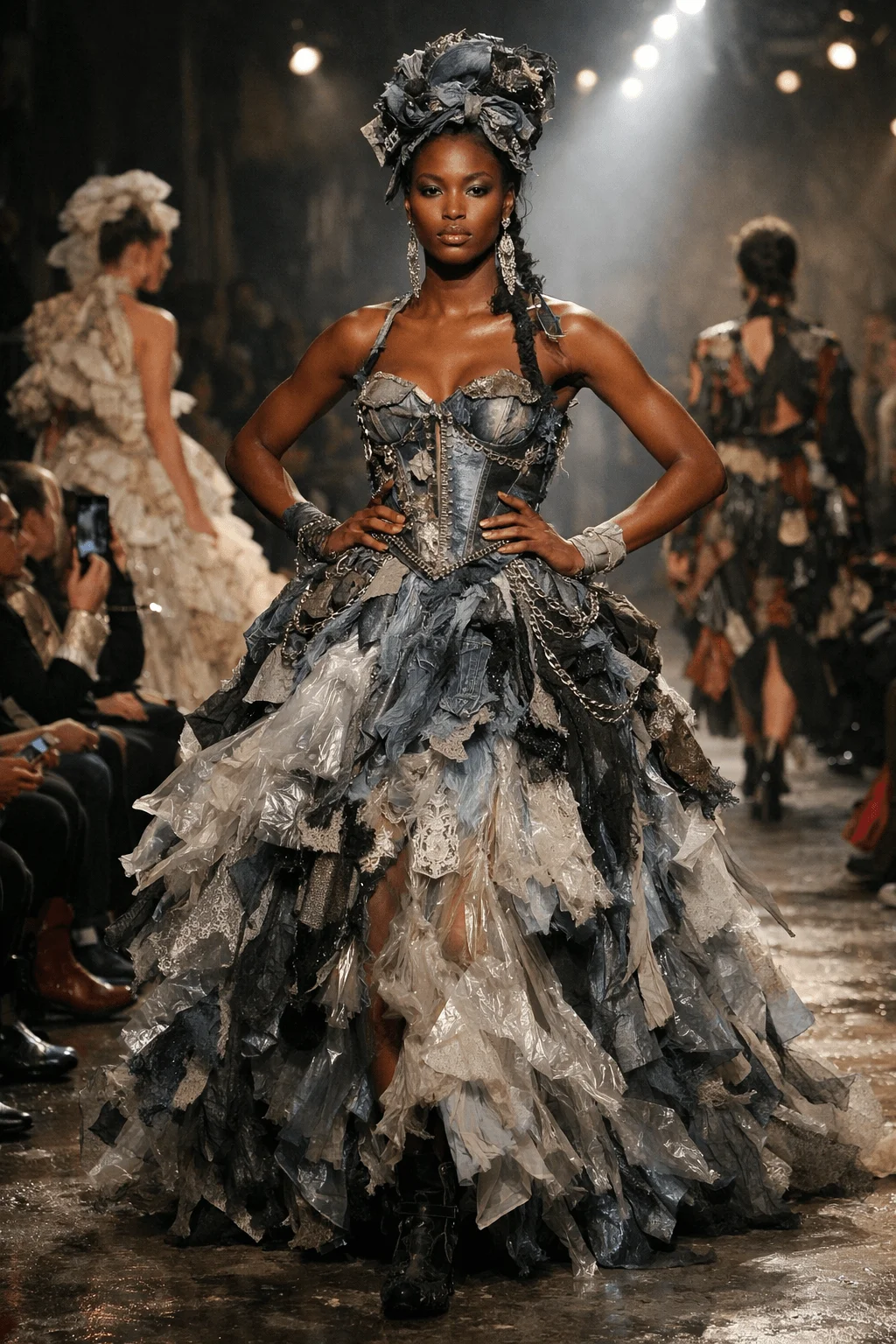
For decades, the maison houses of Paris have traded in a singular, unspoken currency: scarcity. The hand-stitched beading, the limited-edition fabric runs, the sheer impossibility of replication—these were the markers of true haute couture. Yet in an era where luxury conglomerates churn out logo-laden goods at breakneck speed, scarcity has been cheapened into mere volume control. The thrill of the chase is gone, replaced by the dull thud of another drop landing in your feed.
Enter 1/OFF Paris, a brand that has not only reclaimed scarcity but has redefined its very source. By treating discarded textiles, deadstock leathers, and unsold luxury remnants as its primary raw materials, 1/OFF Paris is quietly staging a revolution—one that posits upcycling not as a compromise, but as the most sophisticated form of high fashion available today. The brand’s reported 400% growth, as highlighted in Forbes, is not merely a commercial milestone; it is a cultural signal that the old guard’s eco-apathetic stance is finally cracking under the weight of an impatient, discerning consumer.
The Alchemy of the Found Object
The genius of 1/OFF Paris lies in its philosophical inversion of waste. Traditional luxury begins with pristine materials, often sourced from environmentally destructive supply chains, and then imposes design upon them. The Parisian label, however, begins with the found object—a bolt of vintage silk, a roll of archival wool, a set of military-grade canvas offcuts—and treats it with the same reverence a couturier would afford to a bespoke weave. This is not “trashion” in the throwaway sense; this is alchemy.
There’s something deeply romantic about this process. Imagine the hands that touched that fabric before it reached yours—the ateliers, the warehouses, the quiet decades of storage. Each piece carries that history forward, not as a burden but as a badge of honor. And here’s the kicker: each garment is produced in a single, numbered run, ensuring that the wearer possesses something genuinely irreplaceable. In a market where “limited edition” has become a marketing slogan, 1/OFF Paris delivers on the promise with absolute literalness: when the fabric is gone, the design ceases to exist. This is scarcity born of ethics, not of artificial withholding, and it carries a weight that mass-produced luxury can never replicate.
The Beauty of a Garment With a Past
What makes this approach so potent is its challenge to the very notion of desirability. For years, the fashion industry has conditioned us to covet the new—the pristine, the untouched. But there is an emerging aesthetic consciousness that finds more allure in a garment with a past. A 1/OFF Paris piece carries within its seams the memory of its previous life, whether it’s the faded patina of a 1980s couture remnant or the sturdy weave of a heritage workwear fabric.
This is the antithesis of the sterile, influencer-approved minimalism that has dominated recent seasons. Instead, it offers a tactile, narrative-rich alternative, where the “flaws” of recycled material—a subtle discoloration, a unique grain, an irregular weave—are elevated to the status of signature details. You won’t find these pieces hanging in identical rows on a shop floor. You’ll find them as singular objects, meant to be examined up close, appreciated for their quirks, and worn with the knowledge that no one else on earth has the same one. In this context, upcycling becomes not a lesser form of creation but a superior one, demanding a level of creative problem-solving and technical skill that off-the-shelf fabric simply cannot provide.
The New Economics of Desire
Furthermore, 1/OFF Paris’s meteoric rise speaks to a fundamental shift in how we evaluate luxury’s true cost. The Forbes report of 400% growth is a direct rebuke to the industry’s long-held belief that sustainability and high-end desirability are mutually exclusive. The brand has effectively tapped into a zeitgeist where the consumer is no longer satisfied with a story of heritage alone; they demand a story of accountability.
By sourcing materials from luxury houses’ own surplus—the very waste that the industry would prefer to bury—1/OFF Paris exposes the dirty secret of overproduction while simultaneously offering a chic, wearable redemption. It is a masterclass in turning a liability into an asset, and the market is responding with fervor. The customer is not buying a piece of clothing; they are buying a piece of a solution, wrapped in the unmistakable quality of Parisian craftsmanship.
This is a generational shift, too. The new luxury consumer has done the math, and they’ve realized that the most exclusive item in the room isn’t the one with the biggest logo—it’s the one that can’t be reproduced. When you wear 1/OFF Paris, you’re not just making a style statement; you’re signaling that you understand the true cost of fashion, and you’re willing to pay for something better than the status quo.
The Future Is Already Here
In the end, the question is no longer whether waste can become high fashion, but whether high fashion can survive without embracing waste. As the industry watches its younger, more agile competitors like 1/OFF Paris flourish, the archaic model of seasonal, disposable luxury appears increasingly brittle. The brand has proven that the most progressive design ethos is not found in a lab creating lab-grown leather, but in the simple, radical act of looking at what we already have and seeing infinite potential.
It is a return to the core of couture’s original ethos: the transformative power of the hand, the value of the unique, and the beauty of an object that cannot be replicated. And in a world drowning in copies, that is the most luxurious proposition of all. The ateliers of Paris built their reputation on the impossible—on garments that could never be made twice. 1/OFF Paris has simply remembered what the rest of the industry forgot: that the truest luxury is the one that exists only once.