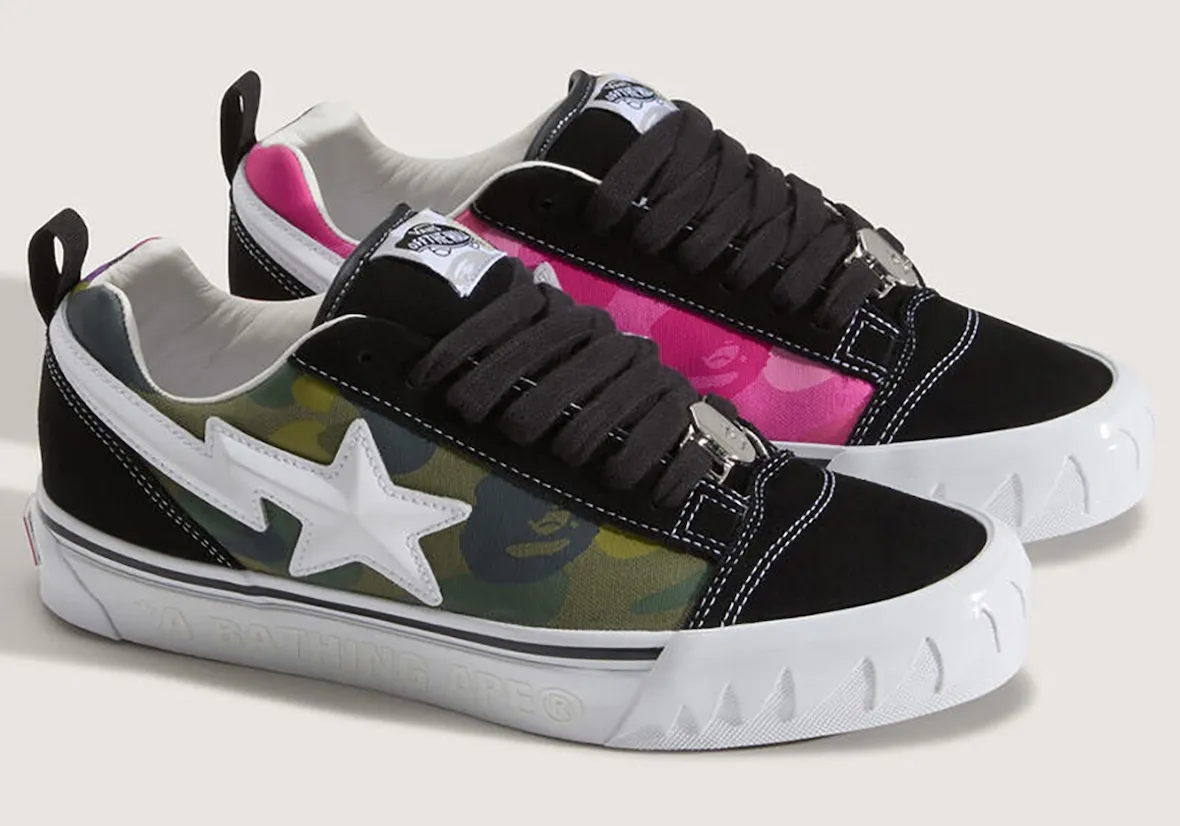
Some collaborations feel transactional — two logos sharing a box, a press release, and little else. Others feel inevitable. The BAPE x Vans Premium Knu Skool belongs firmly in the second category. Both brands built their reputations far from the luxury establishment — one in the backstreets of Ura-Harajuku, the other in the concrete bowls of Southern California — and their convergence here reads less like a marketing exercise than a conversation between two institutions that shaped how generations dress, skate, and signal belonging.
This is a shoe built layer by layer, and it rewards the kind of close reading that serious collectors bring to the table.
The Silhouette: Why the Knu Skool, and Why Now
The Knu Skool is a deliberate choice. Vans' puffed-up, early-2000s reinterpretation of the classic Old Skool has enjoyed a quiet renaissance among those who understand that skate footwear's most interesting moments often live in its exaggerated forms. The bulbous tongue, the fat laces, the chunky sidestripe — it all reads as unapologetically Y2K, which makes it a natural vessel for BAPE's aesthetic vocabulary.
Crucially, the collaboration doesn't smooth over the Knu Skool's inherent chunkiness. It leans in. Where a lesser project might have tried to tame the silhouette, this one treats its proportions as an asset — volume meeting volume.
Construction: Camo Canvas, Suede, and Shark Teeth
What distinguishes this release is its construction philosophy. The upper is assembled as a layer-by-layer build, combining camo canvas with suede overlays in a way that gives the shoe genuine dimensional depth. BAPE's signature camouflage — that endlessly referenced pattern that has become one of streetwear's most recognizable visual codes — is rendered here on textile rather than simply printed flat, allowing the texture to shift and catch light as the wearer moves.
Suede panels reinforce the toe box, eyestay, and heel, providing both structural integrity and a tactile contrast that elevates the shoe beyond novelty. Then there's the shark-teeth rubber detailing along the midsole and outsole — the collaboration's most overt gesture, a direct citation of BAPE's iconic Shark Hoodie motif translated into vulcanized rubber. It's a detail that could have felt gimmicky in less careful hands. Here, it reads as a natural extension of the shoe's aggressive, layered character.
The Bigger Picture: BAPE's Wider Momentum
The cultural context matters enormously. A BATHING APE® has spent the past several seasons demonstrating that its influence extends well beyond nostalgia. Recent moves — a Van Gogh Museum capsule featuring BAPE STA footwear and BE@RBRICK figures, a Kazuki Kuraishi SS26 performance collection pushing into technical all-weather territory, a San Francisco flagship opening with Marshawn Lynch, collaborations with aespa, HIDDEN.NY, and a forthcoming Mickey & Friends drop — paint a picture of a brand actively expanding its footprint rather than resting on archival laurels.
The Vans partnership sits comfortably within this strategy: a collaboration rooted in mutual respect between two institutions that shaped how generations dress, skate, and signal belonging.
Who It's For
Certainly the BAPE loyalist who has followed the brand from its Nigo-era origins through its current global expansion. But equally, it speaks to the Vans collector who understands that the Knu Skool's resurgence is not merely trend-driven but rooted in a genuine reappraisal of early-2000s skate design. And it will resonate with anyone who appreciates footwear that rewards a second look — shoes whose details reveal themselves gradually rather than announcing everything at once.
Why does it matter now? Because streetwear collaborations have reached a saturation point where genuine craft is the differentiator. The BAPE x Vans Premium Knu Skool does not rely solely on the power of two logos occupying the same space. It earns its place through material selection, considered layering, and a willingness to let each brand's signature elements coexist rather than compete.
In a market flooded with co-branded product, that restraint and intention are increasingly rare — and increasingly valuable.

