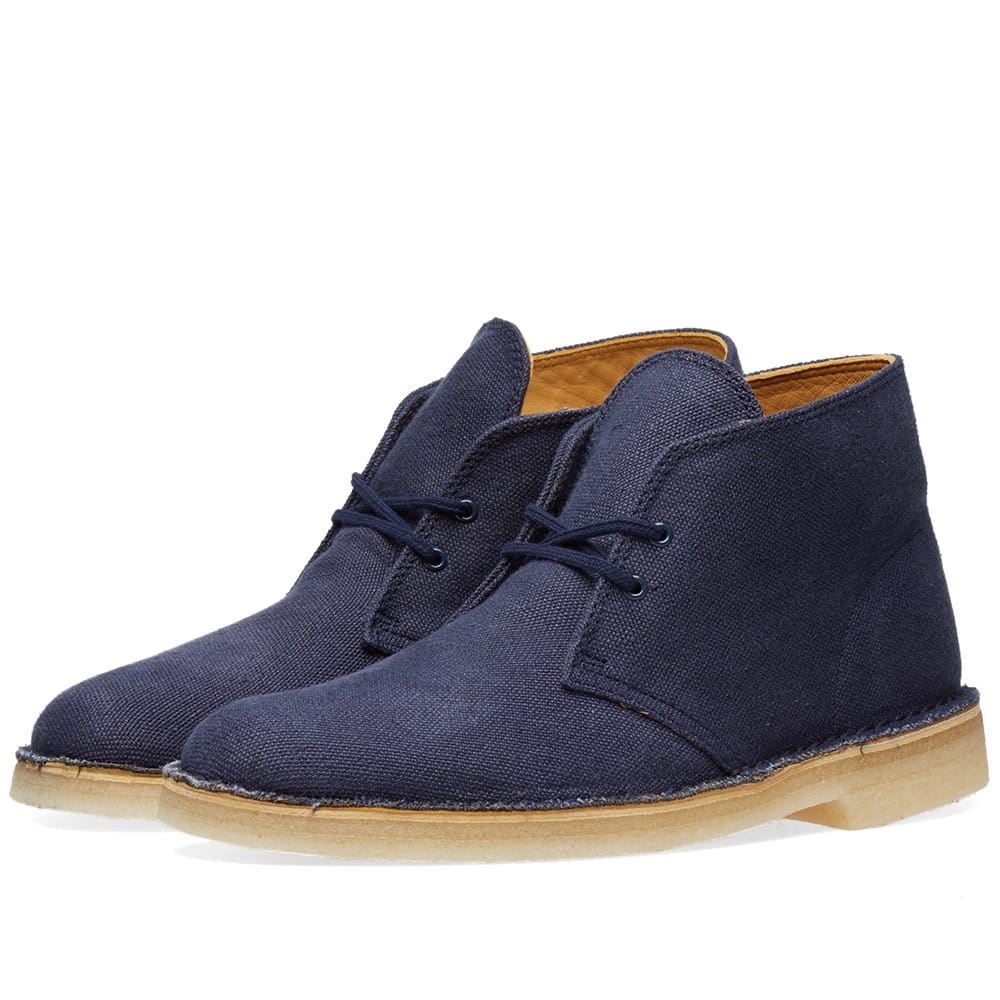
Fashion has spent the last few years shouting. Logo-heavy drops, algorithmic hype cycles, collaborations engineered to break the internet before anyone has actually tried the product on. Into that noise steps the A.P.C. x Clarks Originals Desert Boot — a nearly sixty-year-old English silhouette filtered through the precise, unhurried eye of a Parisian label that has spent decades refining the art of doing less. It arrives less like a product launch than a quiet correction.
There is nothing loud here. No exaggerated proportions, no hardware, no designer signature stamped across the heel. Just a boot that knows exactly what it is — and trusts you to know it too.
The Silhouette That Needed No Reinvention
The Desert Boot requires little introduction. Clarks introduced it in 1950, designed by Nathan Clark in Burma and inspired by the crepe-soled chukkas he observed among off-duty officers in Cairo. Its arc since — from British army surplus to mod essential to global staple — is one of the more remarkable in footwear history.
What A.P.C. founder Jean Touitou has done is not reinvent that legacy but recalibrate it. The suede upper is rendered in muted, earthy tones consistent with the label's palette: soft sand, deep olive, restrained navy. The signature crepe sole remains untouched, a slab of natural rubber that grounds the shoe in its own history. Where other collaborators might have reached for hardware or inflated the proportions, A.P.C. has largely stepped back, letting the boot's original architecture carry the weight.
The Charms, and the Confidence Behind Them
The one conspicuous gesture — and the detail generating the most conversation — is the inclusion of removable shoe charms. Small, understated, and unmistakably A.P.C. in their restraint, they attach to the laces and offer a playful counterpoint to the boot's otherwise austere composition.
It is a curious move for a brand whose reputation rests on refusing decoration, and yet it lands with precision. The charms function as a kind of signature — a way of marking the collaboration without compromising the object itself. Remove them, and the boot stands entirely on its own. That is the trick: the flourish is optional. The design does not depend on it.
A Tight Edit, Not a Market Flood
The collaboration extends beyond the Desert Boot to include the Clarks Originals Weaver, a lower-cut cousin with a similar crepe sole and an equally pared-back treatment. Together, the two styles form a small, coherent capsule — the kind of tight edit that has become A.P.C.'s specialty. This is not a collaboration designed to flood the market. It is a collaboration designed to reward those who already understand both brands.
The timing is worth noting. A.P.C. has spent the past several seasons in a state of renewed visibility, from its high-profile Gap collaboration — which brought the label's understated sensibility to a mass American audience — to a growing appreciation among younger consumers for its foundational denim and outerwear. The Clarks partnership fits neatly into this moment. It reaffirms A.P.C.'s position as a translator: a brand capable of taking something familiar and making it feel considered again.
Who It's For
It is for the person who has grown weary of footwear that announces itself. It is for the reader of *The Casual* who understands that a crepe sole and a clean suede line can say more than a monogram. It is for the Parisian minimalist and the English heritage purist alike — two sensibilities that share more than either might admit. The shoe bridges them without strain.
Why it matters now is simpler still. In a season defined by noise, the A.P.C. x Clarks Originals Desert Boot chooses quiet. It is a reminder that collaboration, at its best, is not about addition but about alignment — two houses, one silhouette, and the confidence to let the object speak for itself.
The charms, in the end, are almost a joke: a small, removable wink from a brand that has never needed them. Which is precisely why they work — and precisely why the boot underneath them will outlast the moment that produced it.