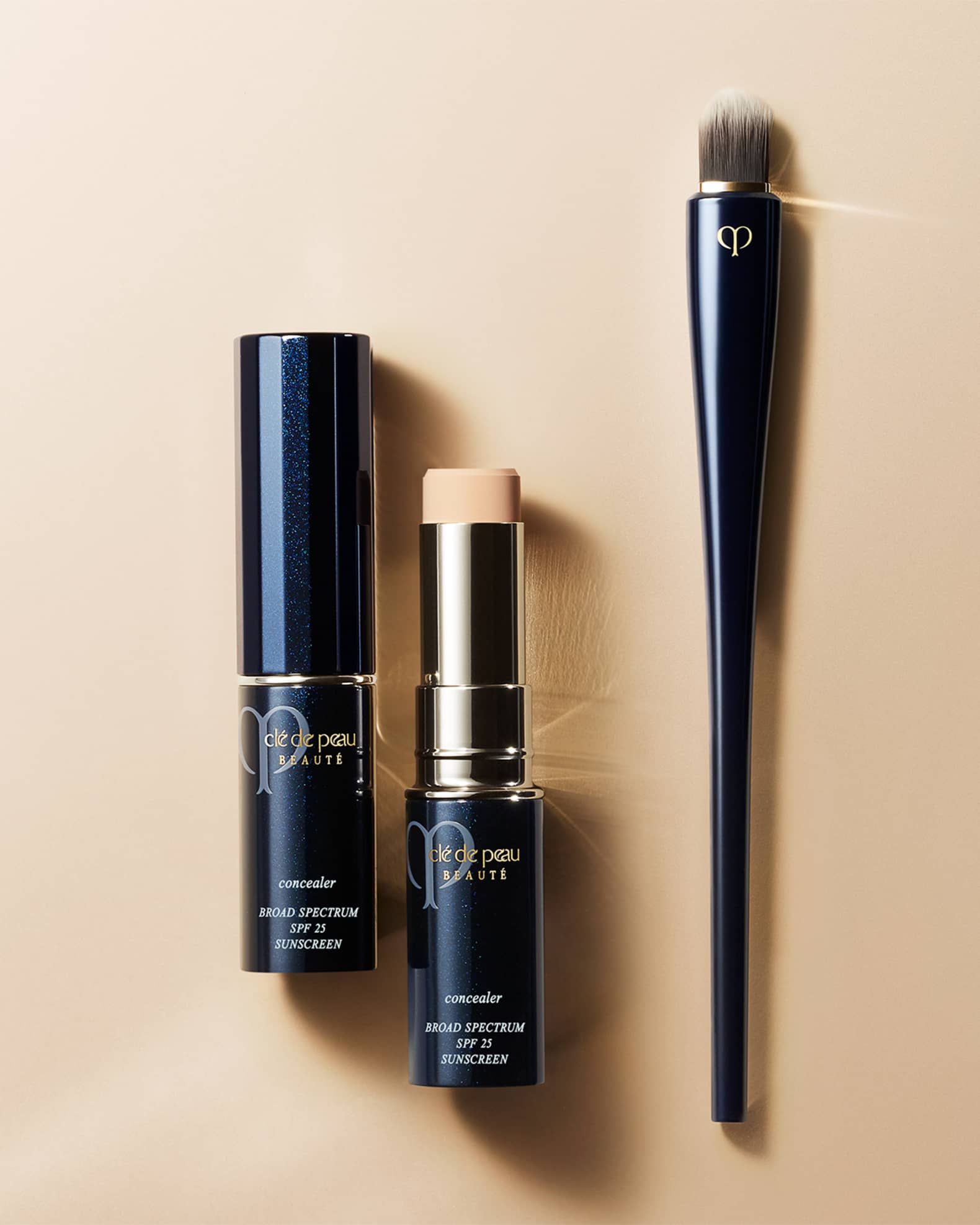
Some concealers hide blemishes. A rare few quietly rewrite the architecture of a face. Clé de Peau Beauté's The Concealer SPF 25 belongs firmly to the latter category — a small, weighty tube of pigment and skincare that has spent the past year as one of the most talked-about objects in luxury beauty. Its ascent wasn't the work of a single campaign but of a convergence: Nicole Kidman's much-publicized partnership with the house, a viral moment in which the actress's luminous, seemingly filtered complexion was attributed to a mere sweep of concealer, and a broader cultural hunger for makeup that behaves less like a mask and more like a second skin.
The product itself is a study in restraint. The packaging is characteristically Clé de Peau: a slender, beveled stick in deep navy and gold, weighted enough to feel like an heirloom rather than a commodity. The formula is where the real engineering lives.
The Formula: Soft-Focus, Not Blanket Coverage
A creamy, emollient texture glides over the under-eye and discoloration without settling into fine lines — the perennial failure point of lesser concealers — thanks to a blend of light-diffusing powders that soften the appearance of shadows rather than simply blanketing them. The finish is the phrase that has followed it across every review: airbrushed. Not matte, not dewy, but a blurred, soft-focus effect that mimics the way skin looks under flattering light.
And unlike the vast majority of concealers on the market, it carries SPF 25 — a quiet act of pragmatism from a house that has always positioned sun protection as inseparable from beauty. It's the kind of detail you notice on the label and then, months later, in the mirror.
Why the Concealer Became the Status Object
Culturally, the product arrives at a moment when the concealer has been elevated from utilitarian staple to status object. The "no-makeup makeup" era, accelerated by the clean-girl aesthetic and the rise of skin-first routines, has made the concealer the single most scrutinized item in a woman's kit — the one product that must perform invisibly.
Clé de Peau Beauté, a house under the Shiseido umbrella with a decades-long reputation for marrying French luxury codes with Japanese formulation science, understood this instinctively. The brand's recent activity reflects a wider renaissance: a collaboration with Oscar de la Renta, a Restorative Cream Supreme experience hosted by Tatler Malaysia, a traveling "Around the World" campaign through Hainan and Osaka, and even a polo team bearing its name.
But it is the concealer — a modest tube, not a jar of La Crème — that has done the most democratic work, bringing the house's ethos to a generation that discovered it through a red-carpet close-up rather than a department-store counter.
Who It's For — and Why It Endures
Ostensibly, anyone who has ever looked in the mirror at 7 a.m. and wished for eight hours of sleep. More precisely, it is for the woman who has graduated beyond concealers that crease, cake, or oxidize, and who is willing to pay for a formula that treats the under-eye as an extension of her skincare regimen.
It suits mature skin particularly well — the emollient base resists the dryness that makes fine lines more visible — which is why it has found devotees among women well past their thirties, a demographic the beauty industry has historically underserved with base products. Yet its viral audience skews younger, drawn by the promise of a filter in a stick.
Why does it matter now? Because the luxury concealer market has become crowded with imitators claiming the same airbrushed language, and few deliver.
The Clé de Peau Philosophy, Distilled
Clé de Peau Beauté's The Concealer SPF 25 endures because it does two things simultaneously and without compromise: it conceals, and it cares for the skin beneath. That is the house's founding logic in miniature — the belief that radiance is not applied but cultivated, and that the best luxury is the kind you forget you're wearing.
In an era of exhausted, over-scheduled faces, that dual promise is not a luxury. It is the whole point.



.jpg)
.jpg)