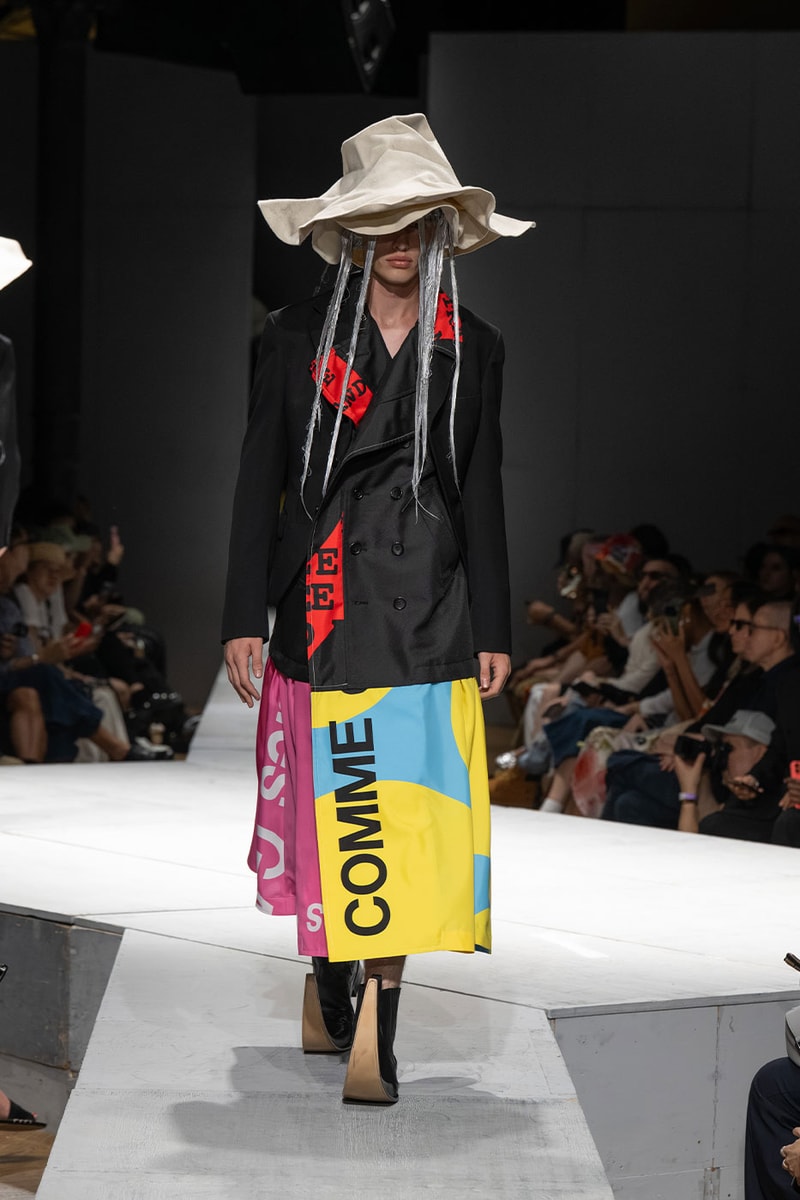
There are fashion shows that present clothes, and there are fashion shows that present a thesis. Comme des Garçons Homme Plus Spring 2027, staged under the title “If The War Were To End,” belongs firmly to the latter category — a dual-act meditation on what Rei Kawakubo imagines might follow the wreckage, and the most talked-about menswear proposition of the season.
Where recent Homme Plus outings circled the void — the “black hole” that critics from HERO Magazine to AnOther have used to describe Kawakubo’s fascination with darkness and dissolution — this collection dares to ask the question that comes after: what does beauty look like when the fighting stops? The answer, as ever with Kawakubo, arrives through construction rather than decoration.
Two Acts, One Argument
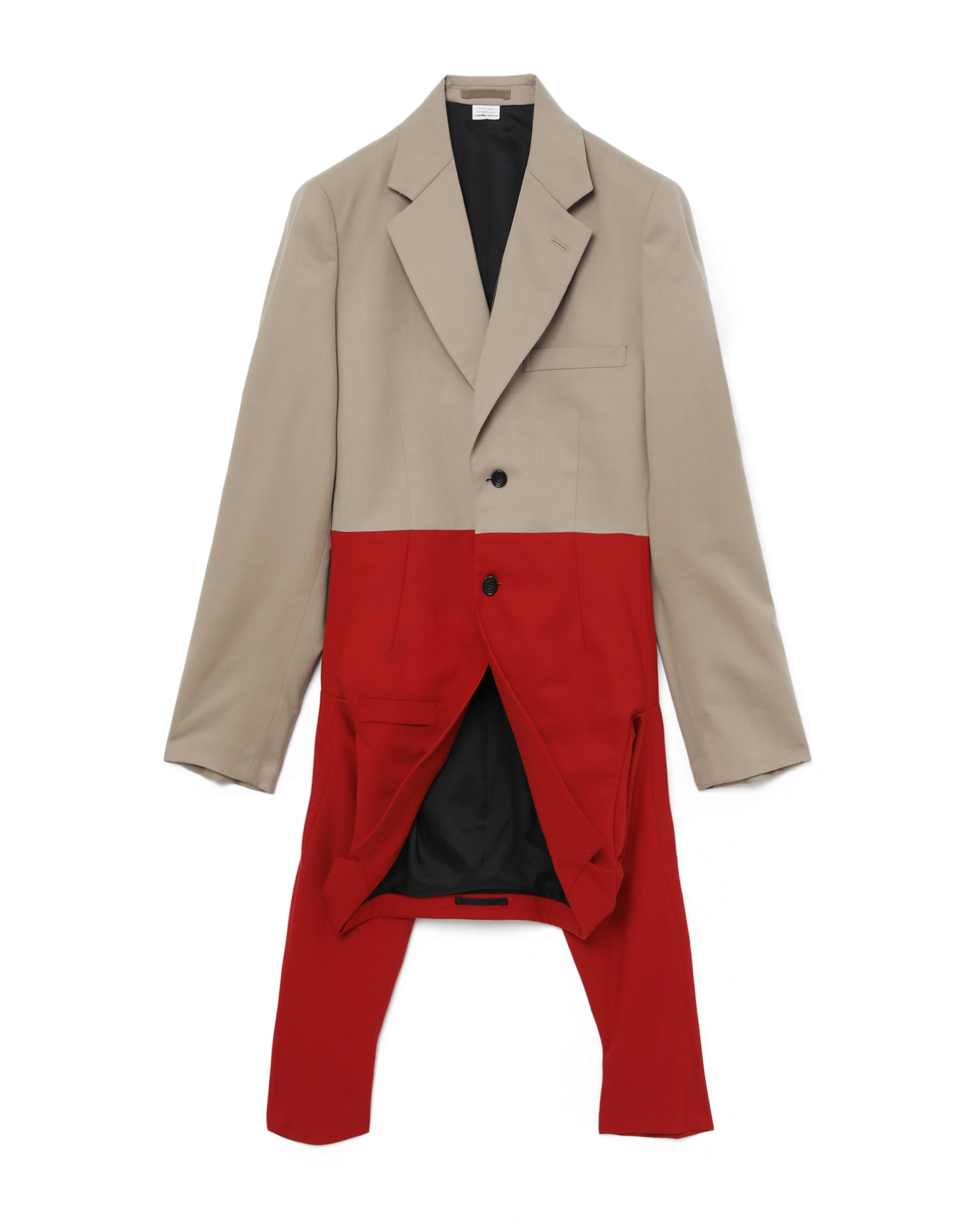
The show unfolded in two distinct movements, a structure that gave the collection its “dual-act” reputation across the trade press. The first act carried the weight of aftermath — deconstructed tailoring in which lapels seemed to peel away from the body, seams exposed as if a garment had been taken apart and reconsidered, and the kind of asymmetric, purposefully off-kilter silhouettes that have defined Homme Plus since its founding in 1984.
The second act moved toward something approaching lightness: layered, voluminous forms in paler tones, fabrications that seemed to breathe, and the sense — rare in a Kawakubo collection — of emergence rather than retreat. WWD called it a “peace treatise”; AnOther framed it as beauty found after the black hole. Both readings hold.
The Vocabulary of Unfinished Business
What distinguishes this outing is how legible the emotion is without ever becoming literal. Kawakubo does not illustrate war, and she does not illustrate peace. Instead she works in the vocabulary she has spent four decades refining: unfinished edges, displaced buttons, garments that wrap and fold rather than close, tailoring that respects the shoulder while refusing its conventions.
The materials do the argumentative work — crisp shirting cottons pressed into unexpected shapes, technical nylons and fluid rayons layered against one another so that structure and softness exist in the same garment. This is “fearless tailoring” in the truest sense: clothing that trusts the wearer to carry its ambiguity.
A Brand Mining Its History, Asserting Its Present
The cultural context matters here. Homme Plus has always been the cerebral wing of the Comme des Garçons universe — the line where Kawakubo interrogates masculinity rather than merely dressing it. That the house chose this moment to stage a collection about endings and aftermath is not incidental.
The revival of the GUERRILLA STORE in Fukuoka with archive pieces, the resurrection of the cult magazine Six, and a run of high-profile collaborations — the New Balance 1226, the Air Max TL 2.5, the anticipated Air Jordan 11 — all point to a brand simultaneously mining its history and asserting its present-tense relevance. Spring 2027 sits at the center of that gravity.
Who It’s For
Not the customer seeking a suit that disappears into a boardroom. Comme des Garçons Homme Plus Spring 2027 is for the man who treats dressing as an intellectual act — the collector, the archivist, the wearer who understands that a Kawakubo garment is an object with a point of view. It rewards a body comfortable with volume, with asymmetry, with the occasional provocation of a hem that doesn’t behave. In practical terms, the strongest pieces are likely the reconfigured jackets and the layered outerwear, garments designed to be worn in combination rather than isolation.
Why it matters now is simpler than the critical discourse suggests. Menswear has spent several seasons in a mood of retrenchment — quiet luxury, safe silhouettes, heritage revisited. Kawakubo’s answer is a collection that insists clothing can still carry philosophical weight, that a show can be an argument, and that beauty is worth pursuing precisely because it arrives after difficulty.
“If The War Were To End” is not a slogan. It is a proposition: that the most radical thing a designer can do in 2027 is imagine what comes next — and cut a jacket that proves it.