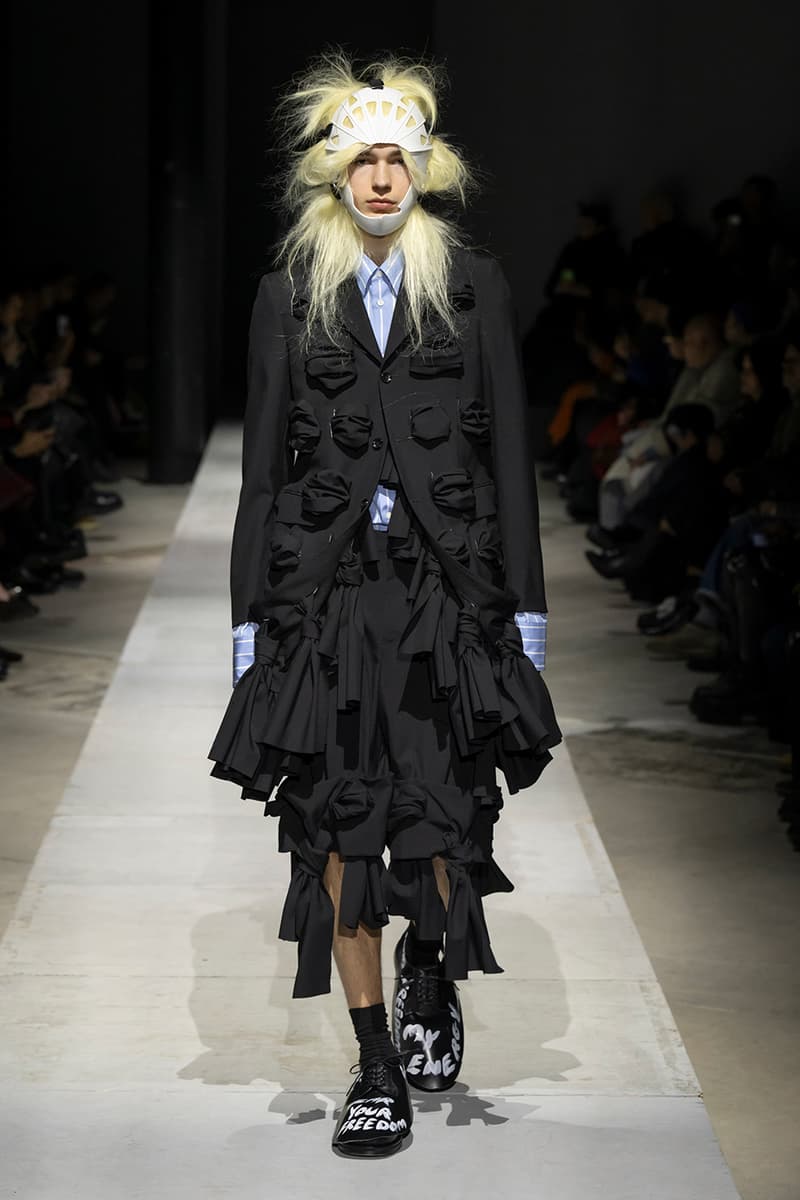
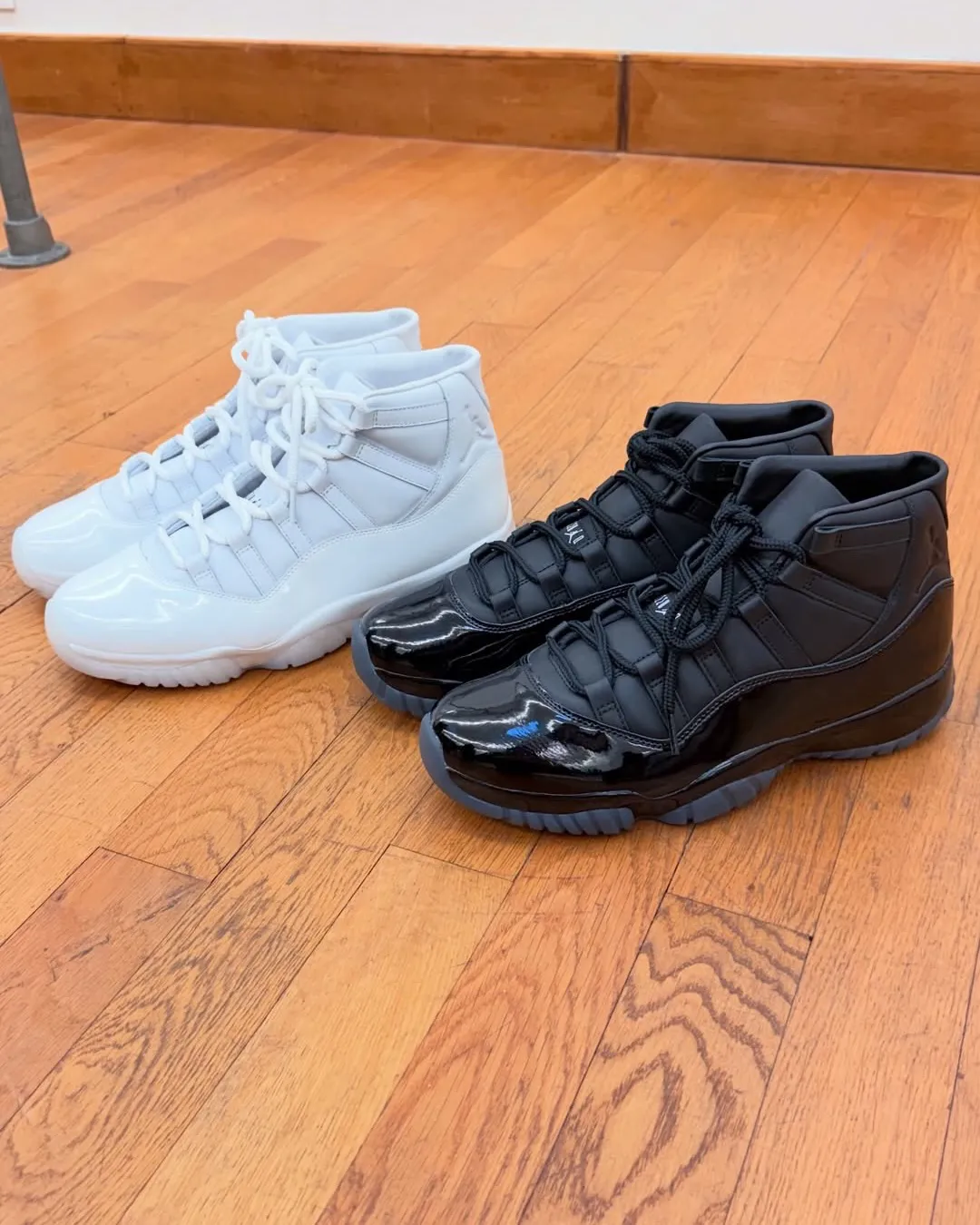
The Comme des Garçons Homme Plus x Air Jordan 11 arrives as one of the more quietly radical footwear propositions of the season — not a sneaker dressed up in designer logos, but a basketball icon systematically rebuilt as formalwear. Rei Kawakubo's Homme Plus line has spent decades dismantling the grammar of menswear, and here she turns her attention to one of the most recognizable silhouettes in sneaker history, stripping it of its athletic associations and reconstructing it in the language of the dress shoe.
Nothing about the shoe announces itself as a collaboration in the way we've come to expect. There's no oversized co-branding, no graphic chaos, no self-congratulatory remix energy. Instead, the transformation happens at the level of material and proportion — the kind of move that rewards a second look rather than a first impression.
The Mudguard Is the Whole Story
The most striking element is the patent leather mudguard, the glossy band that has defined the Air Jordan 11 since Tinker Hatfield first sketched it in 1995. Where the original used that shine to evoke cleats and speed, the Comme des Garçons version leans into its most formal reading: a patent leather cap toe, the kind of finish traditionally reserved for evening shoes and opera pumps.
It's a small shift with enormous consequences. The same glossy band that once signaled athletic performance now reads as a quiet nod to black-tie tradition. The eye doesn't know whether to register the shoe as sport or ceremony, and that ambiguity is exactly where the design lives.
Materials That Force a Second Read
The ballistic mesh upper, the defining texture of the original, is rendered in sober, monochromatic tones that read closer to a fine wool gabardine than to performance textile. The silhouette retains its low-profile geometry, but the proportions have been subtly rebalanced — the collar lowered, the toe box refined — so that what remains feels less like a sneaker and more like a derby that happens to float on an Air unit.
Materials carry the transformation. Premium leathers replace the synthetic overlays of the mass-market release, and the finish is matte where the original was glossy, glossy where the original was matte — an inversion that forces the eye to re-read the shoe from scratch. The Jumpman insignia, historically the loudest signifier on the model, is either minimized or absent entirely, replaced by the restrained branding that has defined Comme des Garçons Homme Plus since its founding in 1987.
The result is a shoe that can be worn with tailored trousers and a blazer without irony, which is precisely the point.
A Cultural Moment for Porous Boundaries
Culturally, the release lands in a moment when the boundaries between athletic footwear and formal dress have become genuinely porous. The Spring 2027 collections in Paris made clear that Kawakubo is still interrogating the codes of status and formality — reviews from Vogue, WWD, and Dazed framed the season around royalty, fairytales, and the dismantling of inherited hierarchies.
A sneaker remade as a dress shoe is a small but precise expression of that same instinct: taking a garment associated with play and performance and asking what happens when it is asked to behave like something serious. It is also, notably, one of the few collaborations in recent memory that treats the Air Jordan 11 as a design object rather than a canvas for graphics.
Not a Trophy — a Wardrobe Piece
This is not a shoe for the collector who wants a trophy. It is for the person who wears tailoring regularly, who understands that the most interesting thing about a sneaker is often what it refuses to be, and who has grown tired of the loud, logo-forward collaborations that dominate the market.
The Comme des Garçons Homme Plus x Air Jordan 11 matters because it demonstrates that a mass-market icon can be reworked with genuine rigor — not decorated, but reconsidered. In an era when every brand wants a sneaker, Kawakubo has produced something rarer: a dress shoe that remembers it used to be a basketball shoe, and chooses to forget.