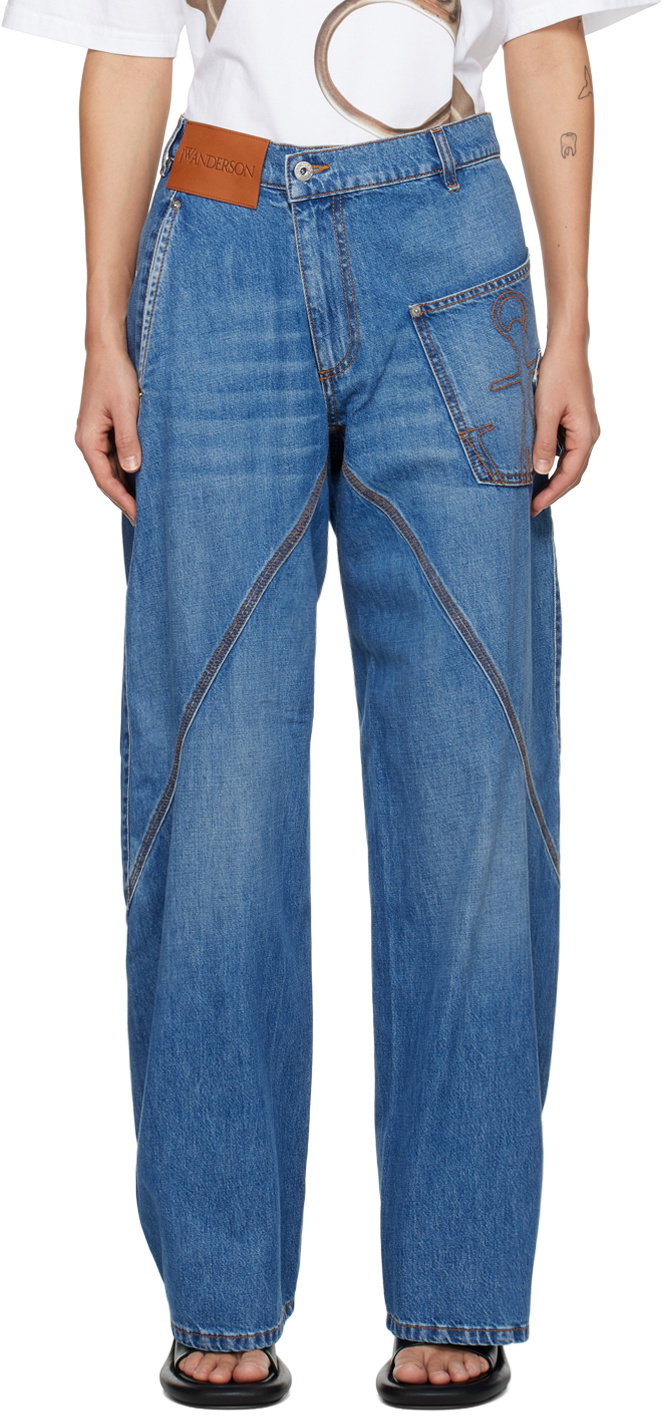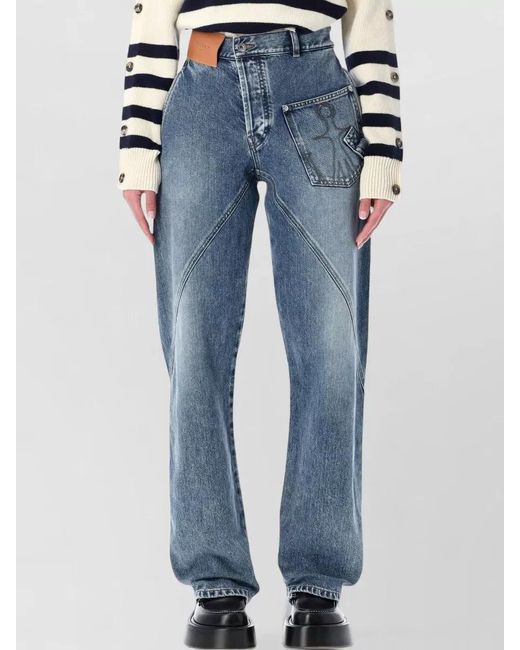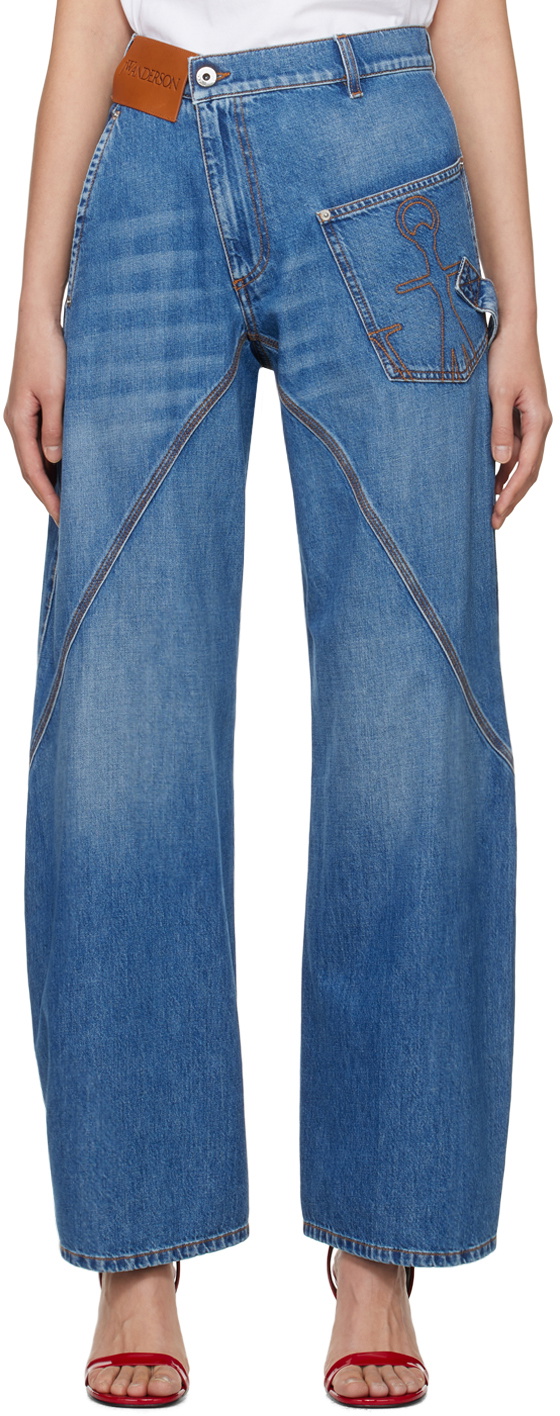
Few garments carry as much democratic weight as a pair of jeans, and fewer still have been interrogated so relentlessly by designers convinced they can say something new with them. JW Anderson’s Spring 2027 Twisted Denim makes a persuasive case that they can. Rather than embellishing denim with logos or distressing it into oblivion, Jonathan Anderson has turned to the one element most designers treat as mere infrastructure: the seam.
In this collection, seams are not hidden inside the leg or pressed flat along the outseam — they spiral, torque and wrap around the body, dragging the fabric into sculptural relief. The result is a pair of jeans that reads as familiar from across the room and quietly radical up close.
The Twist Is in the Construction
The construction is where the design earns its name. Panels of denim are cut and rotated before being rejoined, so the traditional straight grain is disrupted and the leg takes on a gentle, deliberate twist. Seam lines travel diagonally across the thigh and calf, creating volume where denim normally lies flat and drawing the silhouette into something closer to drapery than workwear.
Anderson has long treated clothing as a study in proportion — his runways are full of inflated sleeves, skewed shirting and asymmetrical knits — and here that instinct is applied to the most ordinary canvas available. It is a technical feat executed with restraint: from the front, these could pass for classic five-pocket jeans. From the side, they are unmistakably something else.
Denim That Refuses to Soften
The fabric itself remains honest. This is substantial, rigid-feeling denim in the indigo and washed-black registers that anchor any wardrobe, chosen precisely because its stiffness holds the twisted geometry in place. Softening it too much would collapse the effect; the cloth needs to resist the body slightly for the sculpture to survive a full day of wear.
That tension — between the utilitarian and the architectural — is the entire point. Anderson has spoken of his Spring 2027 collection as being about what you already have, and Twisted Denim embodies that philosophy: it takes a garment you own and reimagines it rather than replacing it with something alien.
A House in Expansion Mode
Culturally, the timing is sharp. The house has spent the past year expanding its footprint far beyond the runway — a SoHo flagship at 138 Wooster Street, a London pop-up exhibition with artist Cerith Wyn Evans during Frieze Week 2026, a second Wedgwood collaboration drawing on Greek ceramics and British landscapes, and even a public denial of Zara collaboration rumors that only intensified interest in what the brand does next.
Underneath all of it is Jonathan Anderson’s insistence that fashion and art are continuous rather than adjacent pursuits, a conviction reinforced by his habit of curating exhibitions inside his own stores. Twisted Denim is that thesis translated into cotton: a commercial product that behaves like an art object without asking the wearer to perform.
Who It’s For
Not the collector who treats denim as a trophy, and not the minimalist who wants a jean to disappear. It suits the person who understands that the most interesting clothes are often the ones you almost recognize — the wearer who pairs a twisted leg with a plain white tee and lets the seam do the talking. The accompanying campaign, which explores couples’ style, reinforces the idea that these jeans are meant to be lived in and shared rather than preserved.
What makes Twisted Denim matter now is its refusal of spectacle. In a moment when luxury denim is often distinguished by price tag alone, Anderson has returned to craft as the differentiator — a seam, rotated a few degrees, doing more conceptual work than any logo could.
It is denim as wearable art, and it argues that the everyday uniform still has room to surprise. More than that, it returns to the brand’s central philosophy: that the familiar is never finished, only waiting to be twisted into something new.