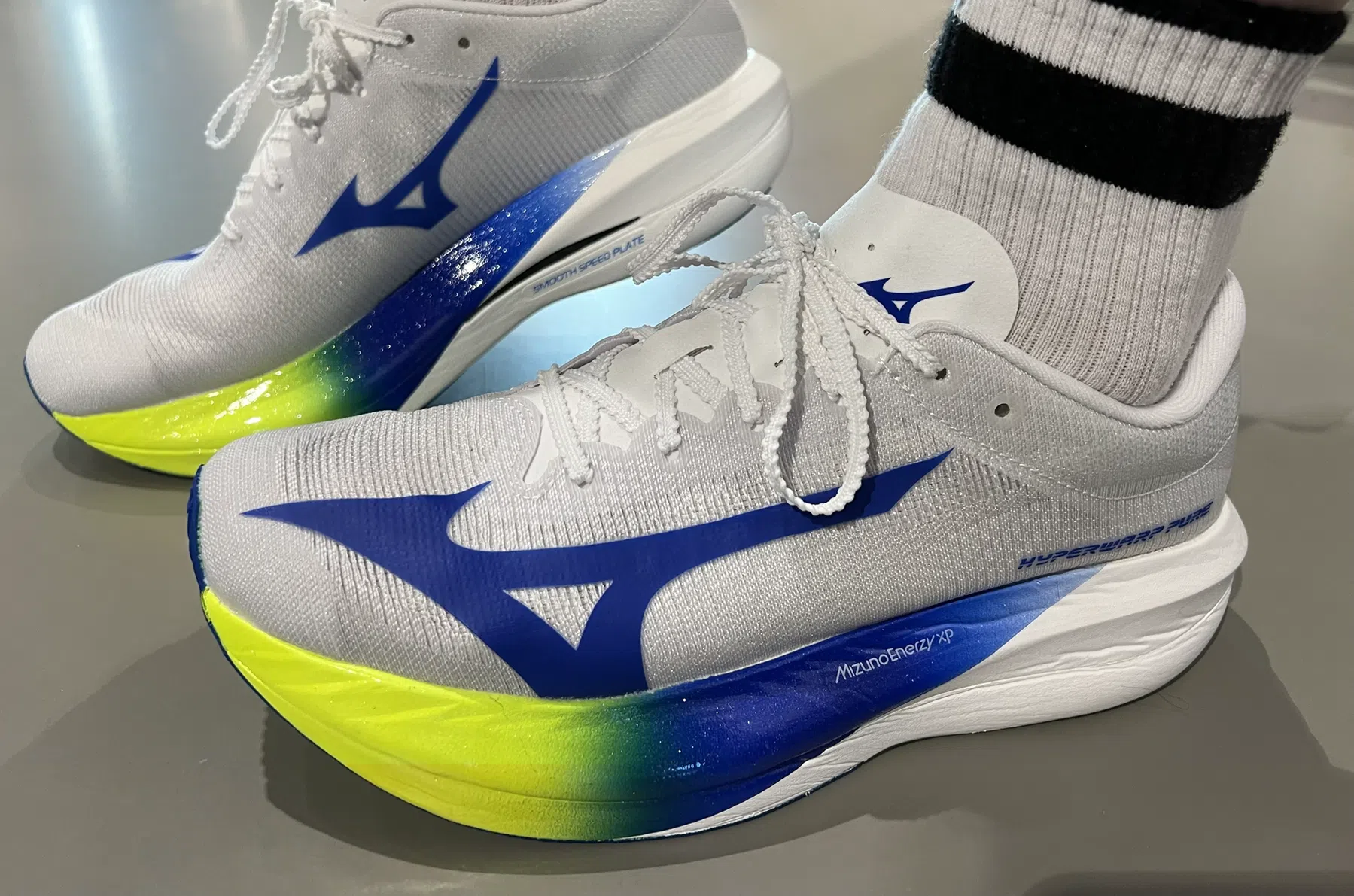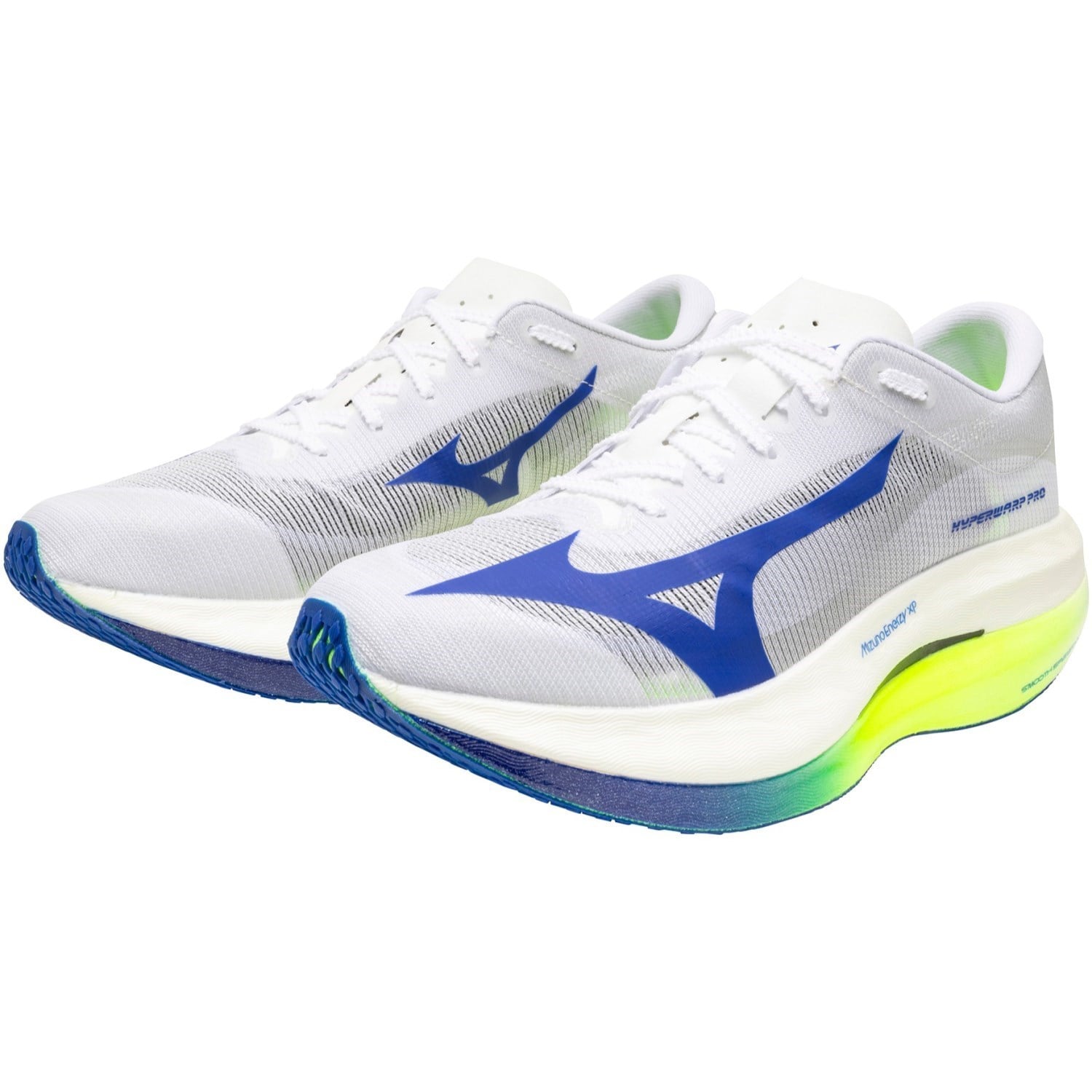
For years, the running shoe arms race has been measured in grams, and for a brief moment, Adidas seemed to have won it. Its sub-2 racer broke the 100-gram barrier and settled the debate — until a company from Osaka quietly picked the argument back up. The Mizuno Hyperwarp 96 weighs exactly 96 grams. Lighter than the Adidas Pro Evo 3. Lighter than any supershoe currently in production. Light enough that you'd shake the box before believing there was a shoe inside.
The number isn't marketing poetry. It's a specification, and it arrives with the kind of restraint that has always defined Mizuno's approach to sport. Where rival supershoes stack thick, compliant foams and carbon plates that add structural mass, the Hyperwarp 96 is built around a machined midsole that strips away every gram not strictly required for propulsion. The result reads as surgical: less footwear, more extension of the athlete's own biomechanics — an instrument for the final miles of a marathon, when every additional gram becomes a tax on dwindling reserves.
A Brand No Longer Content to Be the Connoisseur's Secret
Mizuno has long occupied a peculiar position in global sport. Respected by purists, beloved by golfers for its forged irons, quietly influential in running circles where the Wave Rider and Wave Rebellion lines earned loyal followings. That low-key reputation is shifting. Golf Digest's swing robot flagged the Pro S-1 irons for breaking their own category's rules — a compliment, in certain circles. And The Worldfolio has documented the brand's expanding global footprint, framed as Japanese craftsmanship fused with performance innovation. The Hyperwarp 96 is the loudest statement yet in that arc: proof that the same obsessive metallurgy and precision manufacturing applied to a forged blade iron can be turned toward the pursuit of absolute lightness.
The Price of Marginal Gains
At ¥88,000 — roughly $554 in Japan — the Hyperwarp 96 is not for the casual jogger or the weekend 5K enthusiast. It's aimed squarely at elite marathoners, sub-3-hour chasers, and the growing cohort of performance-obsessed amateurs willing to pay for marginal gains. That positioning is deliberate. Supershoes have become the Formula 1 of running retail: low-volume, high-visibility, and disproportionately influential on how everyday runners perceive a brand. Mizuno knows the Hyperwarp 96 will sell in modest quantities. Its real function is halo-building — proving the company can out-engineer anyone when the stakes are measured in grams.
Craftsmanship as a Competitive Edge
There is something deeply Japanese about the project. Mizuno's identity is rooted in patient, iterative refinement — the kind that produced the MP-64 irons golf traditionalists still speak of reverently, and that now informs the brand's expansion into lifestyle design without sacrificing technical credibility. The Hyperwarp 96 embodies that duality: a shoe so extreme it borders on conceptual art, yet so functional it will appear on start lines from Tokyo to Boston. It is not a compromise between racing and training, or between tradition and innovation. It is a single-minded answer to a single-minded question.
The Final Frontier Is Mass
Why does it matter now? Because the supershoe wars have reached the point where weight is the last differentiator standing. Foam chemistry has plateaued. Plate geometry has been exhaustively optimized. What remains is mass. By undercutting Adidas and claiming the title of world's lightest supershoe, Mizuno has shifted the conversation — and signaled that the next generation of racing footwear will be judged not by how much technology can be crammed into a shoe, but by how much can be removed without losing speed.
The Hyperwarp 96 is, for the moment, the answer. It is also an invitation to every rival brand to try again. And it returns Mizuno to a philosophy it has never really abandoned: that the most advanced technology is the kind you barely feel.