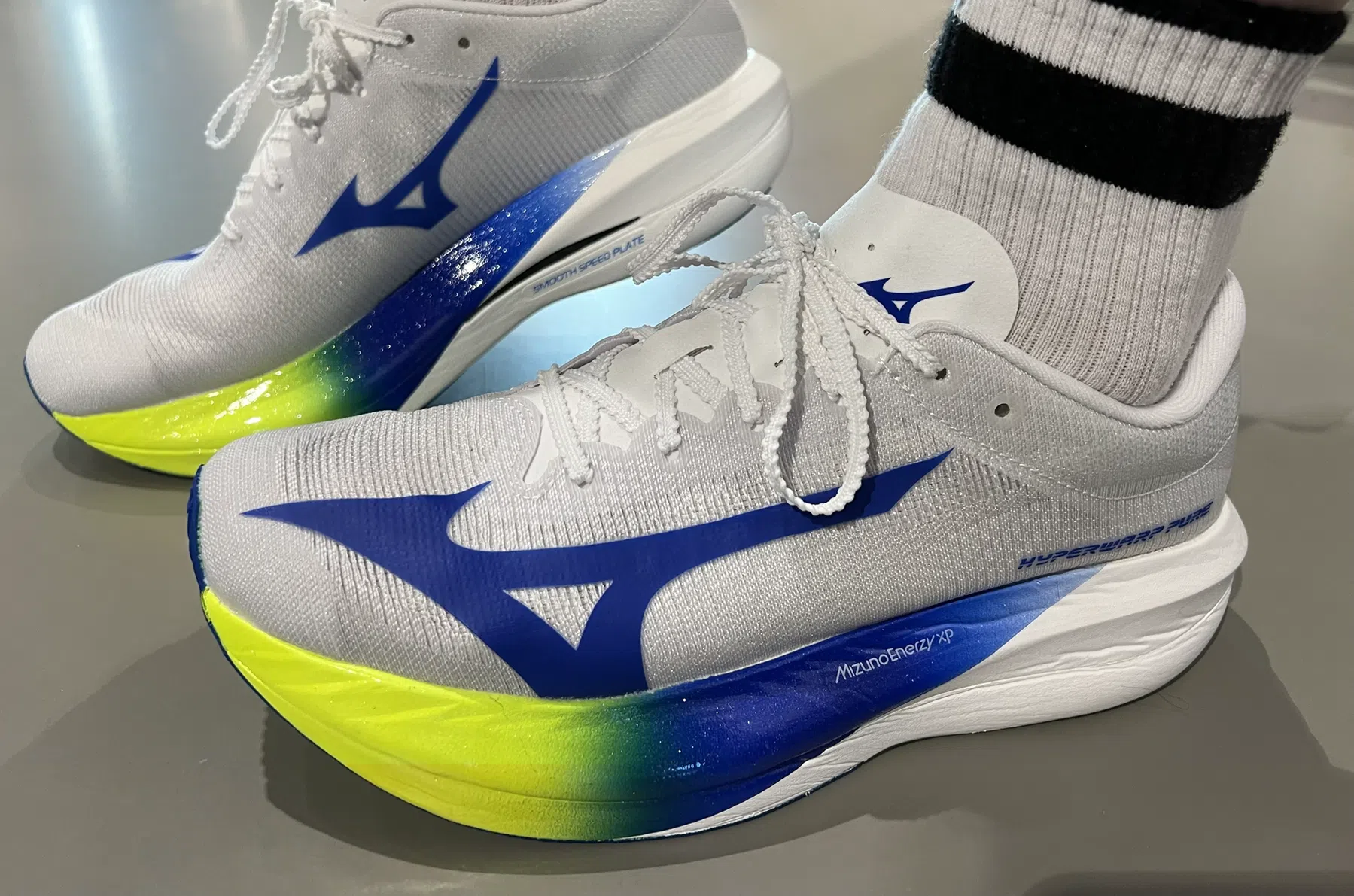
Mizuno has never been a brand that shouts. For over a century, the Japanese house has built its reputation on quiet precision — forging irons in Hiroshima, refining Wave plate geometry in running labs, and letting the work speak in hushed tones. So when Mizuno does something loud, the industry listens.
The Mizuno Hyperwarp 96 is loud. At 96 grams in a men's sample size, it is the lightest supershoe ever brought to market — lighter, remarkably, than Adidas' sub-2 marathon prototype, the shoe that carried a human being under the two-hour barrier. That a mainstream Japanese manufacturer, not a skunkworks project, has claimed this record is the story of the season.
A Number That Demands Context
Most carbon-plated racing shoes sit between 180 and 220 grams. The Adidas Pro Evo 3, widely considered the benchmark of featherweight racing, weighs roughly 138 grams. The Hyperwarp 96 undercuts it by more than forty grams — a gap that, at this end of the spectrum, is not incremental but categorical.
Mizuno calls the construction "machined," a deliberate word choice that evokes the brand's metalworking heritage as much as any footwear process. The upper is a gossamer monofilament mesh, the midsole a highly compressed supercritical foam, and the plate a sculpted carbon element pared to its structural minimum. Every gram was negotiated, not assumed.
Racing's Last Frontier
What makes the Hyperwarp 96 culturally significant is the timing. Marathon world records have fallen repeatedly in the past three years, and the shoe has become the central instrument of that progress — a piece of equipment as scrutinized as any swimsuit or Formula 1 chassis. World Athletics has tightened stack-height and plate regulations; brands have responded by engineering within the rules while pushing every remaining variable. Weight is the last frontier.
Mizuno's achievement is not simply a materials triumph but a regulatory one: the shoe is expected to sit within competition-legal parameters, meaning the 96-gram figure is not a laboratory curiosity but a race-day proposition. At ¥88,000 — roughly $554 — in Japan, it is also an unmistakably premium statement, priced for the athlete who has already optimized everything else.
A Brand Finally Claiming Its Moment
The shoe arrives, notably, alongside a broader Mizuno moment. The Mizuno Pro S-1 irons have been generating buzz for bending the conventions of their category, with swing-robot testing suggesting performance that defies the usual trade-offs. The Sky Prime has drawn praise from running specialists for its ride. The Wave Rider 30 continues to anchor the brand's daily-training line. Even the company's off-road experiments — a trail runner recast as a streetwear object, a prototype mattress studied for sleep performance — signal a house unafraid to apply its engineering culture beyond the obvious categories.
The Hyperwarp 96 is the sharpest expression of that culture: a product that exists not to sell in volume but to prove a point.
Who is this shoe for? Not the weekend 10K runner, and not the casual consumer drawn to a striking silhouette. The Hyperwarp 96 is for the competitive marathoner chasing a personal best, the elite amateur who treats equipment as a marginal-gains discipline, and the collector who understands that the lightest racing shoe ever made is a piece of sporting history regardless of what happens on race day. It is also, quietly, for anyone who has watched Mizuno operate for decades and wondered when the brand would finally claim the spotlight it has long deserved.
That moment is now. The Hyperwarp 96 is not a marketing exercise or a concept car with a lanyard. It is a functioning, priced, competition-intended racing shoe that has taken the single most contested record in running footwear — the weight floor — and moved it somewhere no one expected. In a sport increasingly defined by what technology permits, Mizuno has answered with a number: ninety-six grams, and the quiet confidence of a brand that has been preparing for this its entire life.