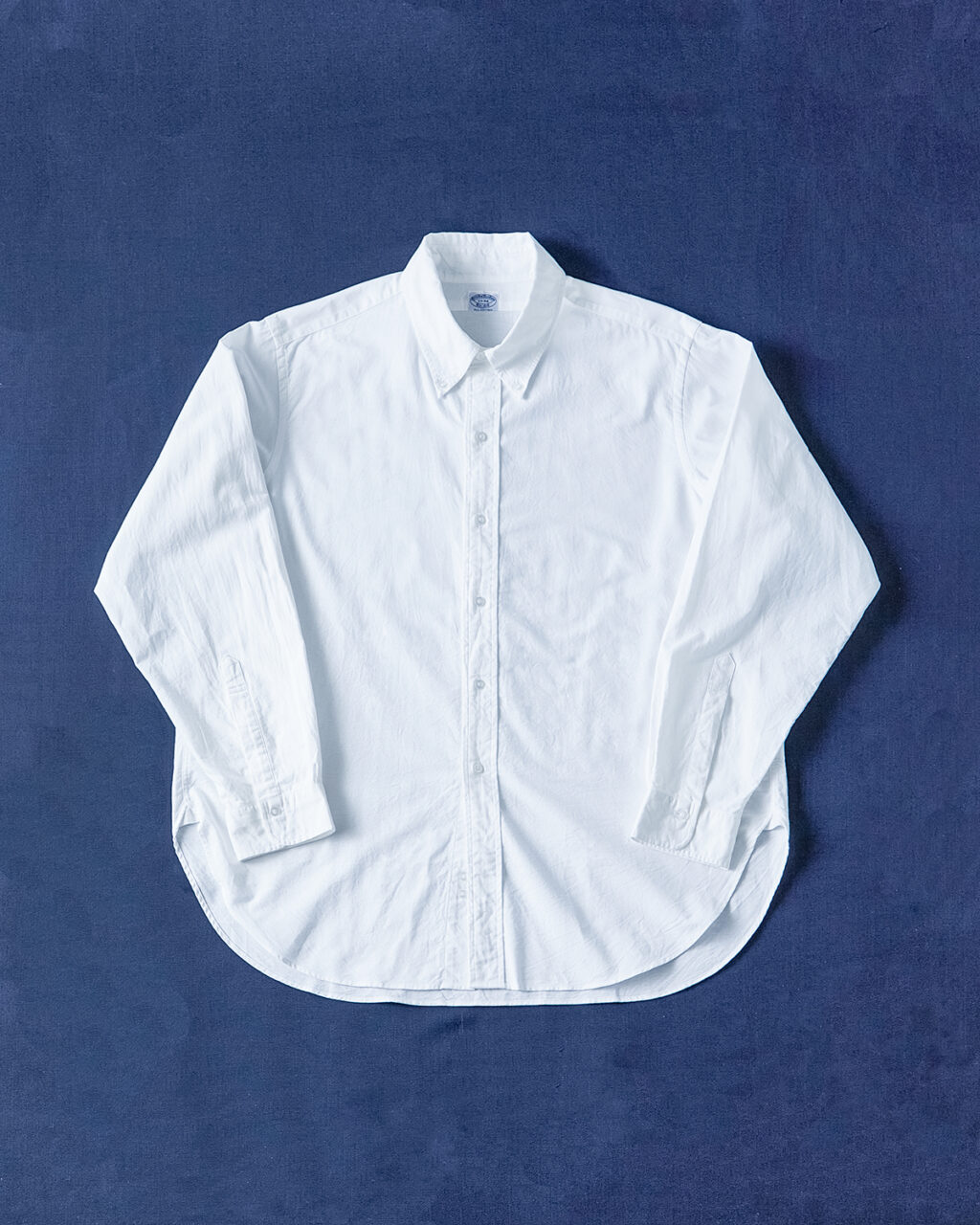
Few garments carry as much ideological weight as the American oxford button-down. Born on Ivy League campuses and codified by Brooks Brothers in the early twentieth century, it has spent decades as the uniform of the establishment—and, paradoxically, the uniform of those quietly subverting it. That tension between propriety and quiet rebellion is exactly the territory Daisuke Obana has staked out across two decades at the helm of N.HOOLYWOOD. His latest collaboration, a special-order button-down shirt produced with Brooks Brothers, isn't a nostalgic exercise but a forensic one: an archival American classic taken apart, studied, and reassembled with the vintage-inflected precision that has become Obana's signature.
The shirt begins where all great oxfords begin—with the cloth. Here it's a substantial, dry-handed cotton oxford with the faint slub and irregular surface that speaks to loom-state authenticity rather than the slick, mercerized finish of contemporary fast fashion. Obana has long been preoccupied with the patina of age, the way garments record their own history, and this fabric is chosen to do exactly that. It will crease, soften, and yellow at the collar over years of wear, becoming less a product than a document.
The Architecture of an Archive
The construction follows suit. A soft-roll button-down collar with a generous, unhurried curve. A box-pleated back yoke for ease of movement. A single-needle side seam that nods to the manufacturing standards of mid-century American shirtmaking. The fit, crucially, is neither the billowing sack of a genuine 1960s original nor the shrunk-to-nothing silhouette of a modern slim cut—it's a considered, contemporary proportion that reads as relaxed without tipping into costume.
Where Authenticity Lives
What distinguishes this from a standard-issue reissue is the detailing, which is where Obana's vintage obsession becomes legible. The shirt features reconstructed, period-correct touches: a slightly shortened placket, mother-of-pearl buttons with an uneven, natural luster, and a collar band cut to sit with just enough lift to frame the face rather than flatten against the neck. There's an intentional asymmetry in the cuff and a subtle irregularity in the stitch density—the kind of imperfection that only emerges when a designer has spent years handling genuine archive pieces and understands that authenticity lives in the deviations, not the specifications. It's the same instinct that has driven his broader practice, from the N.HOOLYWOOD COMPILE x KEEN footwear experiments to the TPES x Teva collaborations, all of which pare familiar objects down to their essential logic and rebuild them with a craftsman's restraint.
A Cultural Exchange in Reverse
The cultural context here is impossible to ignore, and it's arguably the point. Brooks Brothers is the American academy's clothier of record; N.HOOLYWOOD is the Tokyo label that has spent its existence translating and refracting American vernacular—military, workwear, Ivy—through a Japanese lens of precision and reverence. The collaboration is therefore a kind of cultural exchange in reverse: an American icon reinterpreted by the very designer who has made a career of studying it from the outside in. It arrives at a moment when the broader fashion conversation has turned decisively back toward Ivy style reinvented—a theme that dominated N.HOOLYWOOD's recent Spring 2027 showing, where the codes of campus dressing were stripped and re-cut for a new generation. This shirt is that thesis in miniature.
The Case for Buying Once
It's a garment for the man who understands that the oxford is not a blank canvas but a loaded one—who wants the history without the stiffness, the provenance without the pomade. It pairs as naturally with wide-wale corduroys and a chore coat as it does under a soft-shouldered blazer, and it will only improve as it ages.
In an era of disposable trend cycles, the N.HOOLYWOOD x Brooks Brothers special-order button-down makes the case for the opposite: buy once, wear hard, let the cloth tell the story. It is archive American style, made new again—and it is the rare collaboration that earns its place in the wardrobe rather than merely in the feed.