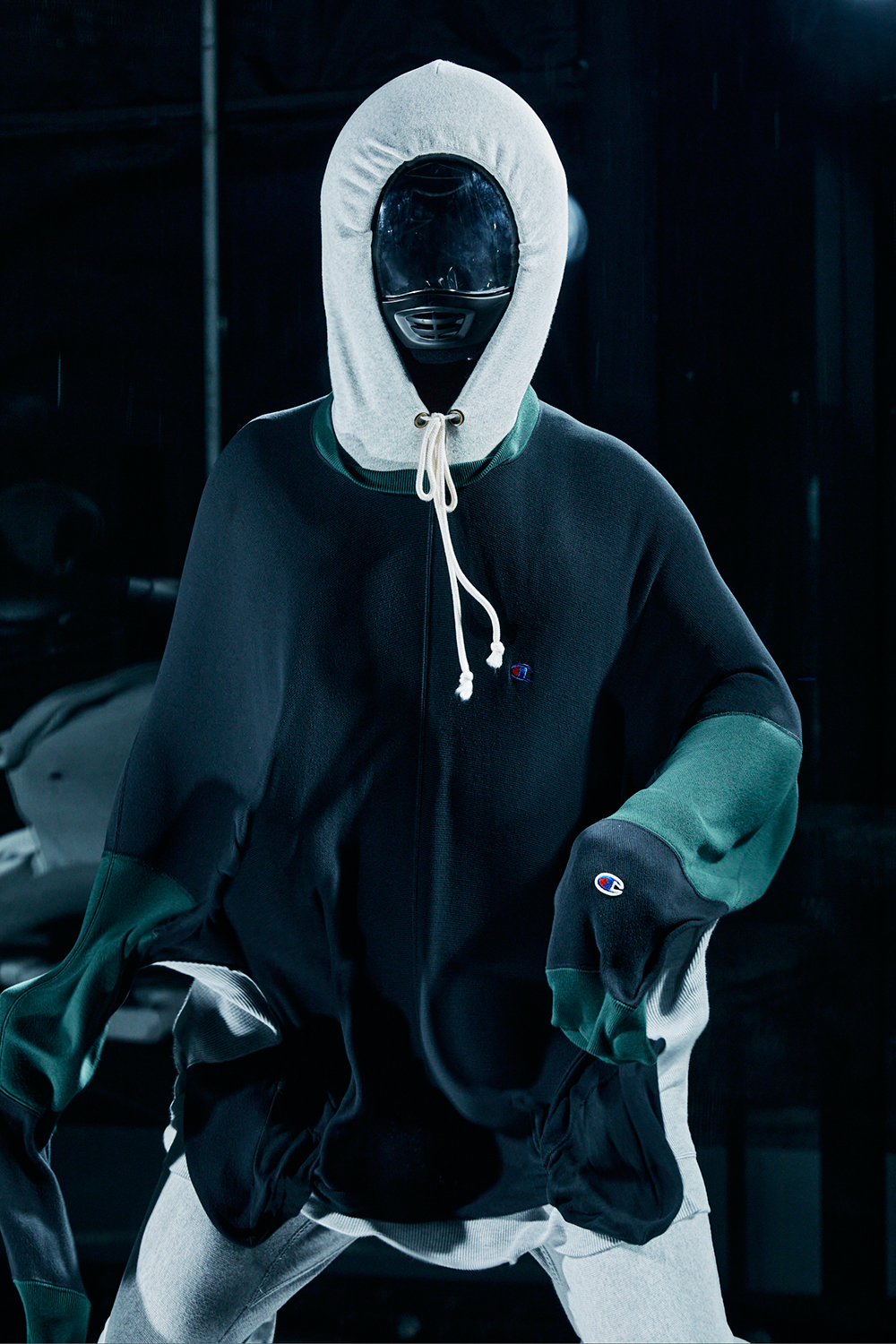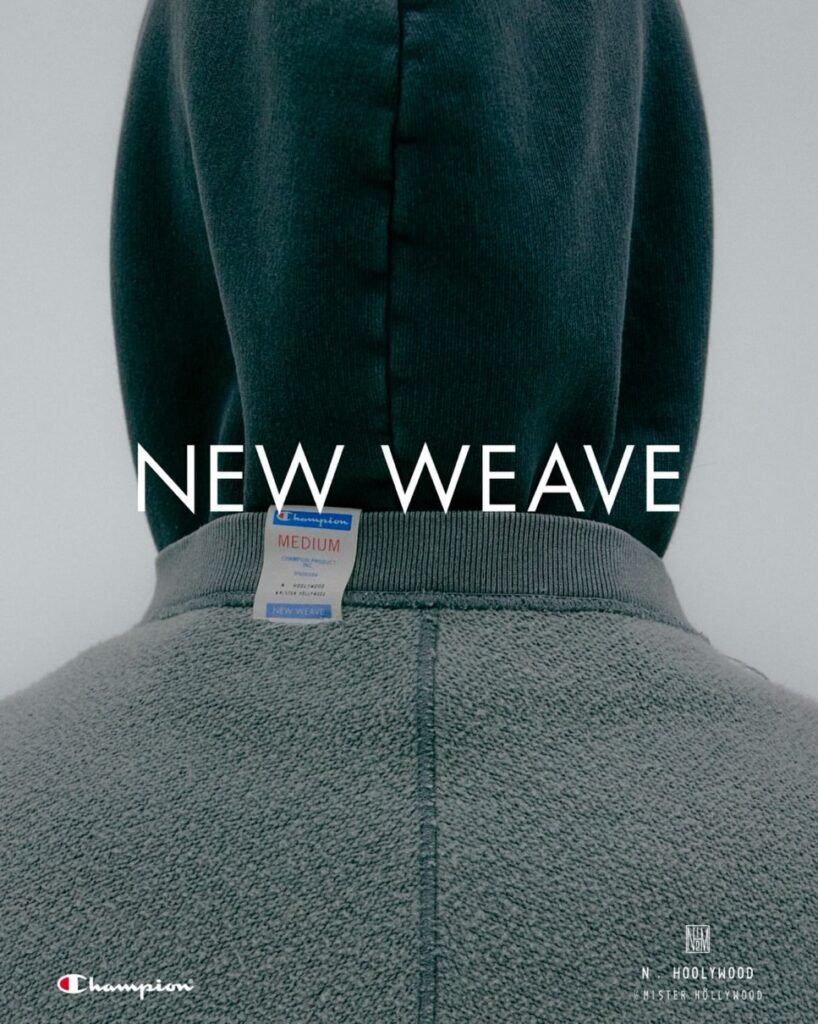
The N.HOOLYWOOD x Champion "NEW WEAVE" Reverse Weave capsule arrives as the ninth chapter in one of fashion's most quietly rigorous partnerships — a collaboration that has spent nearly a decade treating the humble American sweatshirt not as merchandise but as material for ongoing formal inquiry. Where lesser collaborations chase novelty, designer Daisuke Obana returns each season to the same garment, the Champion Reverse Weave, and asks the same question with renewed severity: what remains of a classic once you strip away everything that made it familiar?
This iteration's answer lies in the weave itself. The capsule reconstructs the Reverse Weave's signature tube-knit architecture with fresh woven detailing — a deliberate intervention into the very structure that has defined Champion's heavyweight fleece since the 1930s.
An Intervention Into the Structure Itself
The original Reverse Weave was engineered to resist shrinkage by running its grain horizontally against the vertical pull of the body, a piece of mid-century American industrial ingenuity that turned a utilitarian athletic garment into a cultural artifact. Obana's approach honors that engineering while subtly destabilizing it, introducing woven panels and textural shifts that read as almost imperceptible from across a room and unmistakable in the hand. This is the N.HOOLYWOOD signature: a designer who trained under the exacting eye of a costume house before building a label that treats vintage American sportswear as a scholarly text, annotating rather than rewriting.
Material Honesty, Not Spectacle
The materials matter here precisely because they refuse spectacle. Heavyweight cotton fleece, garment-dyed to muted, lived-in tones, retains the heft that made Reverse Weave a staple of collegiate locker rooms and, later, of hip-hop's earliest style language. The woven detailing introduces a slight tension against the fleece's brushed interior — a tactile conversation between two traditions of textile construction. Ribbed cuffs and hem anchor the silhouette in its athletic lineage, while the fit has been quietly recut toward the considered proportions that define Obana's output. The N.HOOLYWOOD label appears alongside Champion's iconic "C" with characteristic discretion, a co-signature rather than a billboard.
A Parallel Curriculum Across Categories
Culturally, the capsule lands at a moment when the entire fashion apparatus is re-examining its relationship to American heritage. The headlines tell the story: N.HOOLYWOOD's Spring 2027 collection was received as an "Ivy Style Reinvented," while the label's ongoing Brooks Brothers partnership has reconstructed the Oxford shirt through vintage detail, and its KEEN and DESCENTE ALLTERRAIN 81 projects apply the same forensic logic to footwear and technical outerwear. Obana is, in effect, running a parallel curriculum across categories — and the NEW WEAVE capsule is the course in American athletic minimalism. Against a broader market saturated with logo-heavy nostalgia, the decision to rebuild the Reverse Weave through weave rather than graphics feels almost contrarian. It trusts the garment to speak.
For the Collector, Not the Billboard
Who is this for? It rewards the collector who already owns the archival pieces and wants the conversation continued rather than repeated; the design-literate buyer who understands that a sweatshirt can be a thesis; and anyone who has grown weary of collaborations that mistake volume for value. It is not for those seeking a statement. It is for those who understand that in Obana's world, the statement is the seam.
Why it matters now is simple: heritage collaborations have become fashion's default mode, and most amount to little more than a logo swap. The ninth NEW WEAVE capsule demonstrates what happens when a designer treats an American icon with the patience of a restorer rather than the appetite of a merchandiser. Champion's Reverse Weave has survived nearly a century because it was built correctly the first time. N.HOOLYWOOD's achievement — season after season, now nine times over — is proving that "correctly" was never the end of the story.