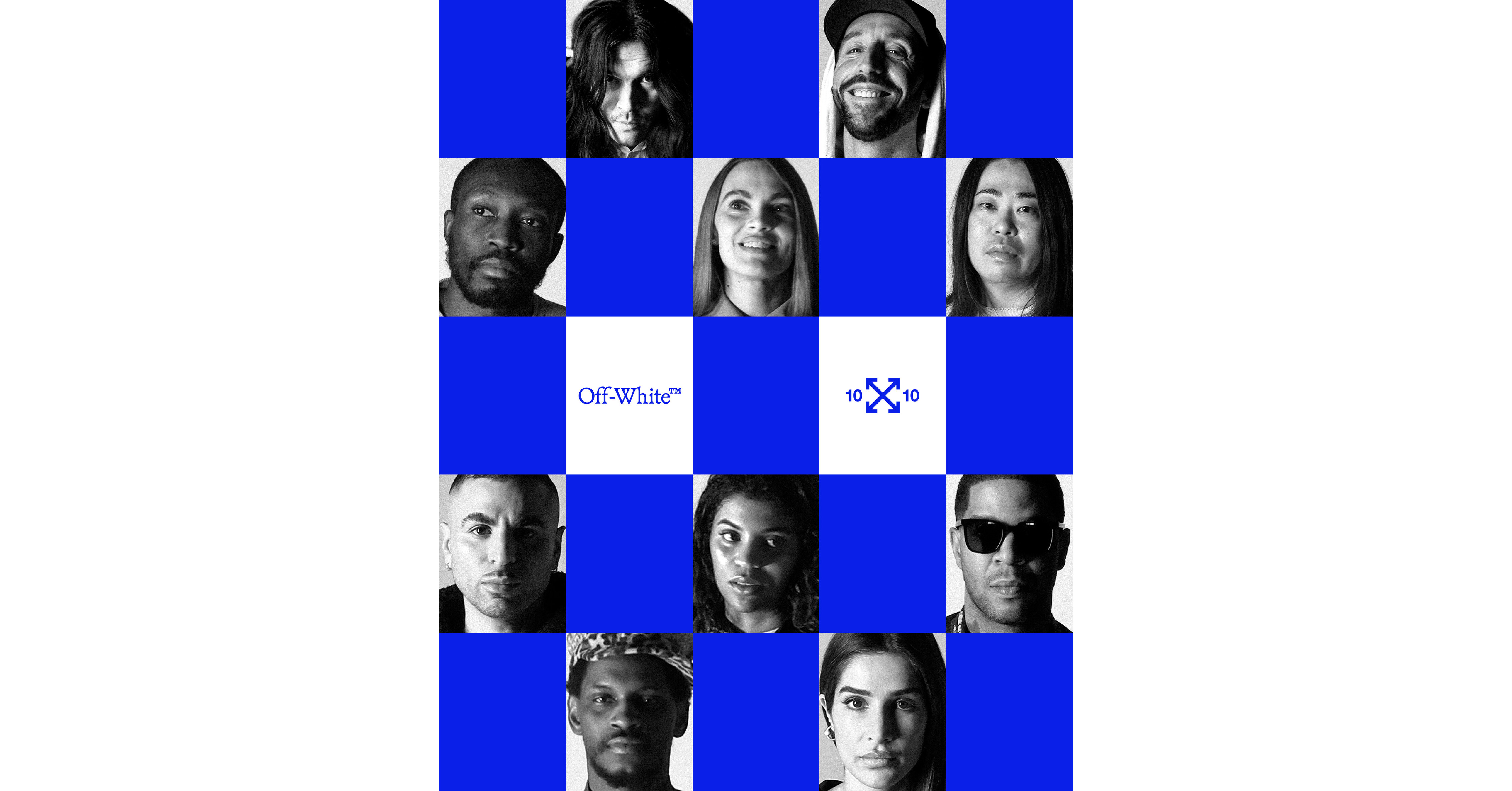
Inside a space the brand has christened the Imaginary Palace, Off-White™ has staged its most self-aware gesture yet. 10x10: Icons Reimagined is not a conventional collection drop, nor a seasonal campaign in the ordinary sense. It is an exercise in controlled reinvention: ten trailblazing global creatives, each handed one of ten archetypal Off-White™ silhouettes, invited to fracture, rework and re-author the house's visual grammar. The result functions simultaneously as archive, manifesto and provocation — a brand looking squarely at its own mythology and asking what, exactly, survives interpretation.
The premise is deceptively simple. Ten icons — the garments and accessories that have come to define the Off-White™ vocabulary over the past decade — are redistributed to ten distinct voices. Each contributor is given license to reshape their assigned piece, and the resulting objects are exhibited and released under a single conceptual umbrella. The cast assembled for the campaign speaks to the breadth of the brand's cultural reach: Kid Cudi and A$AP Nast are among the figures tapped to front the project, lending it a credibility that no amount of advertising spend could manufacture. These are not models in the traditional sense; they are participants in a shared cultural conversation, and their presence signals that 10x10 is intended as a dialogue rather than a decree.
Ten Icons, Ten Authors
What distinguishes this undertaking is its refusal of nostalgia. Reinterpretation, in the wrong hands, becomes mere reproduction — a hollow reissue dressed up as homage. Off-White™ avoids that trap by treating its own icons as raw material rather than sacred relics. The pieces carry the hallmarks that built the house: the industrial typography, the quotation marks that turned punctuation into a global signature, the diagonal stripes and the self-referential branding that once felt like an inside joke and now reads as institutional shorthand. Yet under the guidance of ten outside creatives, those codes are bent, questioned and occasionally dismantled. The Imaginary Palace setting reinforces the conceit — a fictional architecture built to house fictionalized versions of very real garments.
The Imaginary Palace
The Milan staging is the project's quietest provocation. A palace that doesn't exist, built to hold objects that do — the framing turns the collection into something closer to an exhibition than a drop. It's a knowing wink at fashion's appetite for mythmaking, and a reminder that Off-White™ has always understood the power of a setting to shape how a garment is read. Here, the architecture itself becomes part of the argument: icons don't live in vitrines, they live in the imagination, and they change each time someone new steps inside.
A Pincer Movement
This project matters precisely because of its timing. Off-White™ is in the midst of a deliberate expansion of its universe, and 10x10 arrives as the intellectual centerpiece of that moment. Alongside it, the house has introduced L/AB c/o Off-White™, a new label oriented toward access and affordability, brought to retail through an exclusive PACSUN activation in SoHo and rooted in the underground energy of Los Angeles. There is a debut watch collection, aptly titled TIME. There are summer pop-ups in Marbella and sneaker guides and a steady drumbeat of retail theater. Against that backdrop of democratization and category expansion, 10x10 serves a different function entirely: it reaffirms that the brand's founding codes still possess the elasticity to absorb new authorship. Accessibility at one end, reinterpretation at the other — the two strategies are not contradictions but a pincer movement, widening the audience while deepening the mythology.
For the Fluent
The collection is ultimately for the collector who understands Off-White™ as a language rather than a logo. It rewards fluency. Someone who has tracked the house from its earliest industrial-belt days will read the reinterpretations as commentary; someone encountering the brand through its more accessible ventures will read them as introduction. Both readings are valid, and that duality is the point. Ten objects, ten authors, one continuous conversation.
By handing its icons to ten outsiders and displaying the results in a self-invented palace in Milan, Off-White™ makes an argument that few fashion houses are secure enough to make: that an icon is not diminished by reinterpretation but proven by it. The house has always insisted that its vocabulary belongs to the people who wear it — and now, for one project, it belongs to the people who remade it, too.