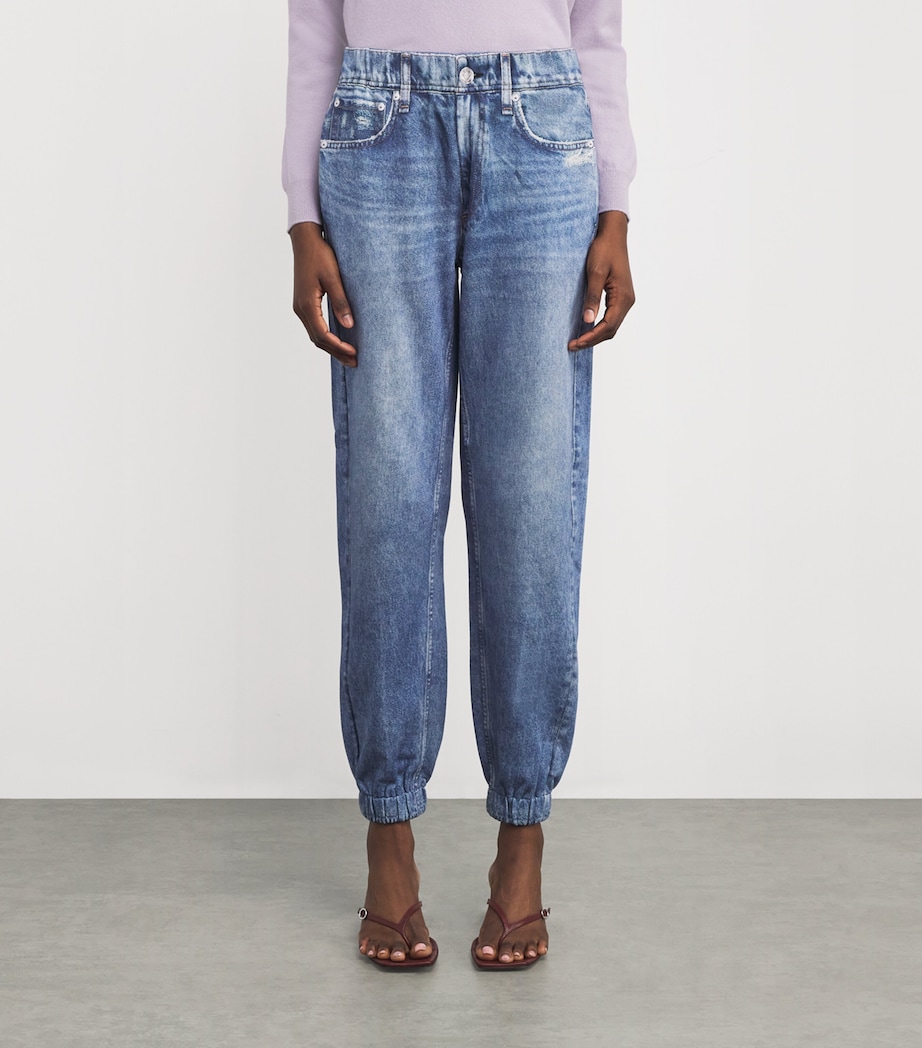
There's a certain kind of garment that earns its keep not through flash but through quiet, daily devotion—the piece you grab without thinking, the one that outlasts trend cycles because it solves a problem nobody else bothered to solve. The Rag & Bone Miramar Sweatpant Jean belongs squarely in that rarefied company. At first glance, it reads as a perfectly ordinary pair of lived-in denim: faded indigo, a convincing whisker at the hip, the faintest suggestion of a worn pocket edge. Look closer—or better, reach out and touch it—and the illusion collapses into something far more subversive. The Miramar isn't denim at all. It's a sweatpant printed with a trompe-l'oeil rendering of five-pocket jeans, and in that single sleight of hand, rag & bone has quietly rewritten the terms of everyday dressing.
The construction is where the magic lives. The Miramar is cut from a soft, brushed knit—the kind of fabric you associate with a Sunday morning rather than a Monday commute—and finished with an elastic waistband and a relaxed, tapered leg that skims rather than grips. The genius is in the print: a high-resolution, photographically detailed treatment of denim that captures not just the color but the texture, the contrast stitching, the subtle shadowing of a real seam. From across a room, it's indistinguishable from a favorite pair of broken-in jeans. Up close, it's something better. The result is a garment that performs the visual language of heritage denim while delivering the physical experience of loungewear—a trompe-l'oeil effect so convincing it's become one of the most talked-about pieces in contemporary casualwear.
The Trick Is in the Texture
What separates the Miramar from a novelty print is the fidelity of its deception. The knit carries a photographic rendering of denim that reproduces the whiskering at the hip, the shadowed edge of a pocket, the faint contrast of stitching—details your eye reads as wear and history. The fabric itself is soft and brushed, built for ease rather than structure, with an elastic waistband and a relaxed, tapered leg. It doesn't grip. It skims. And that's precisely the point: the Miramar lets you wear the look of a broken-in jean without submitting to the break-in itself.
The Culture Caught Up
Context matters here, because the Miramar didn't arrive in a vacuum. It landed at precisely the moment the culture began rejecting the tyranny of stiff, unforgiving denim—the rigid selvedge that demanded a break-in period, the high-rise that punished anyone who dared to sit down. The rise of the "comfy jean" as a category, championed by editors and embraced by a public weary of discomfort-as-style, made room for something this clever. Oprah anointed the Miramar among her favored finds, CNN devoted a feature to decoding the "sweatpant jean" phenomenon, and Condé Nast Traveler singled it out as the ideal travel companion—a piece that packs like knitwear and photographs like denim. The endorsement circuit has been unusually unanimous, and for good reason: the Miramar resolves a tension that has quietly defined the last decade of dressing, the standoff between looking pulled-together and feeling at ease.
Who It's For
The answer is broader than the phrase "sweatpant jean" might suggest. It's for the traveler who wants to clear security and still look composed on arrival. It's for the remote worker who needs to appear on camera from the waist up and refuses to suffer below it. It's for anyone who has ever loved the idea of jeans more than the reality of wearing them—and for a generation of shoppers increasingly suspicious of garments that demand sacrifice, who believe comfort and polish aren't opposing forces but negotiable ones. The Miramar is the negotiation.
Why It Lands Now
Timing and momentum do the rest. rag & bone has spent recent seasons reasserting its authority over the denim category—GQ praised the brand for nailing its comeback jeans, Vogue has tracked its pre-fall and spring collections with renewed attention, and the acquisition of the label by WHP Global and Guess?, Inc. signals a new chapter of investment and reach, underscored by new retail openings and a freshly energized presence in the market. Against that backdrop, the Miramar reads less like a novelty than a thesis statement: proof that a heritage-minded label can still produce genuinely original, category-blurring product that earns headlines and, more importantly, repeat wear. It's the rare viral piece that survives the virality.
Which brings us back to the philosophy underneath the parlor trick. rag & bone has always traded on a certain pragmatic cool—downtown utility with an editorial finish—and the Miramar is that ethos made literal: a garment whose cleverness serves the person wearing it rather than the other way around. It looks like denim. It feels like a Sunday. And in the quiet, daily devotion it's designed to earn, it makes the case that the best design often works by making the complicated feel effortless.