When Nicole Kidman stepped onto the 2024 Met Gala carpet in a whisper of black lace, the fashion world didn’t just pause — it recalibrated. The gown, a Zimmermann Sculpted Air Lace Dress, became an overnight obsession, spawning a million searches and a thousand think pieces. But to understand why this particular piece resonated so violently, you have to understand the house that made it.
Zimmermann was founded in 1991 by sisters Nicky and Simone Zimmermann, who started selling their designs at Sydney’s Paddington Markets before building an empire rooted in a distinctly Australian idea: that getting dressed up should be a pleasure, not a performance. As the brand celebrates its 35th anniversary — a milestone the sisters have recently discussed in interviews reflecting on their enduring philosophy — that founding principle has never felt more relevant. In an era of quiet luxury and stealth-wealth minimalism, Zimmermann has quietly insisted that romance, texture, and unabashed femininity still have a place at the table.
The Architecture of Air
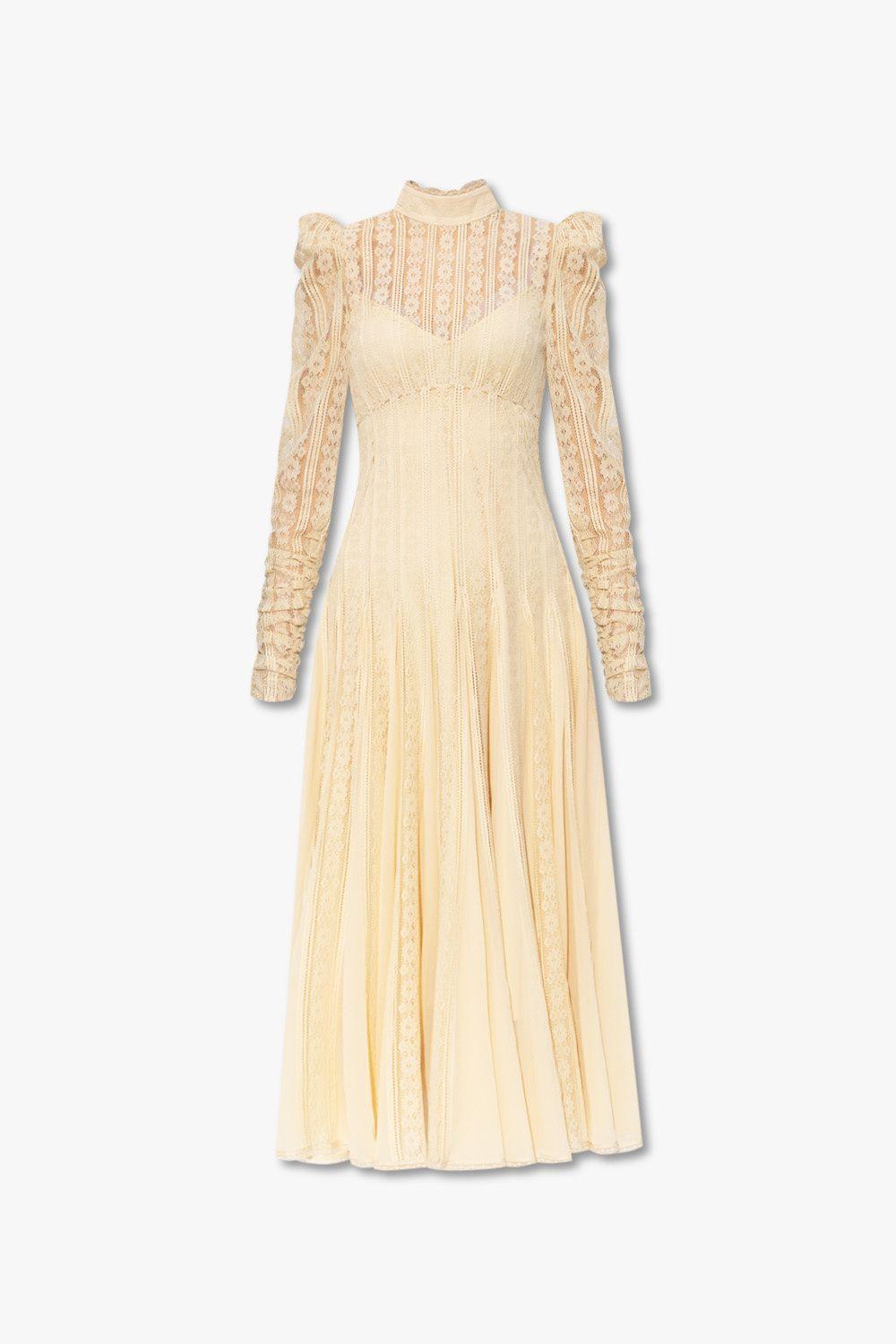
The Sculpted Air Lace Dress is the purest distillation of that argument. Its architecture is deceptively complex: a fitted bodice and corseted waist give way to a fluid, floor-sweeping skirt, all rendered in a gossamer lace that seems to float rather than fall. The “sculpted air” of the name is not marketing hyperbole — it describes a genuine technical achievement, a garment that holds its shape through internal structure while appearing weightless from the outside. The lace itself is a study in restraint and excess simultaneously: dense enough to read as opaque in certain lights, sheer enough to reveal the body’s silhouette in others. It is, in the truest sense, a dress that changes depending on how you look at it.
The Power of Trust
What made Kidman’s moment so electric was the way the dress negotiated the line between exposure and elegance. This was not a naked dress in the vulgar sense — it was a dress that trusted the wearer. The lace did the work of both concealment and revelation, and the effect was less about showing skin than about asserting presence. For a woman of Kidman’s stature, it was a statement of ownership: of her body, her career, and her place in the cultural conversation.
Sheer, But Not Transactional
The cultural context matters here. The Sculpted Air Lace Dress arrived at a moment when the see-through trend had reached saturation — sheer fabrics on every runway, every red carpet, every influencer’s grid. But most of it felt transactional, a bid for attention. Zimmermann’s version felt like something else entirely: a piece of couture-adjacent craft that happened to be sheer. The distinction is everything. This is a dress for someone who doesn’t need to prove anything, which is precisely why it works.
Who It’s For, and Why It Matters Now
Who is it for? Ostensibly, the woman who has already arrived — the one with nothing left to prove and everything to express. But the genius of Zimmermann is that the dress flatters that fantasy for a broader audience than its price point might suggest. It is worn by red-carpet veterans and by brides, by gala attendees and by women who simply want to feel extraordinary at a dinner they’ll remember for years. The Sculpted Air Lace Dress is not a costume; it’s a confidence garment.
Why does it matter now? Because fashion is cyclical, and the pendulum is already swinging back from minimalism toward maximalism, from restraint toward romance. Zimmermann has been quietly making this case for three and a half decades, and the Sculpted Air Lace Dress is the proof of concept. It is a garment that understands the difference between being seen and being remembered — and it chooses the latter. In a culture that rewards the fleeting, that is a radical act.