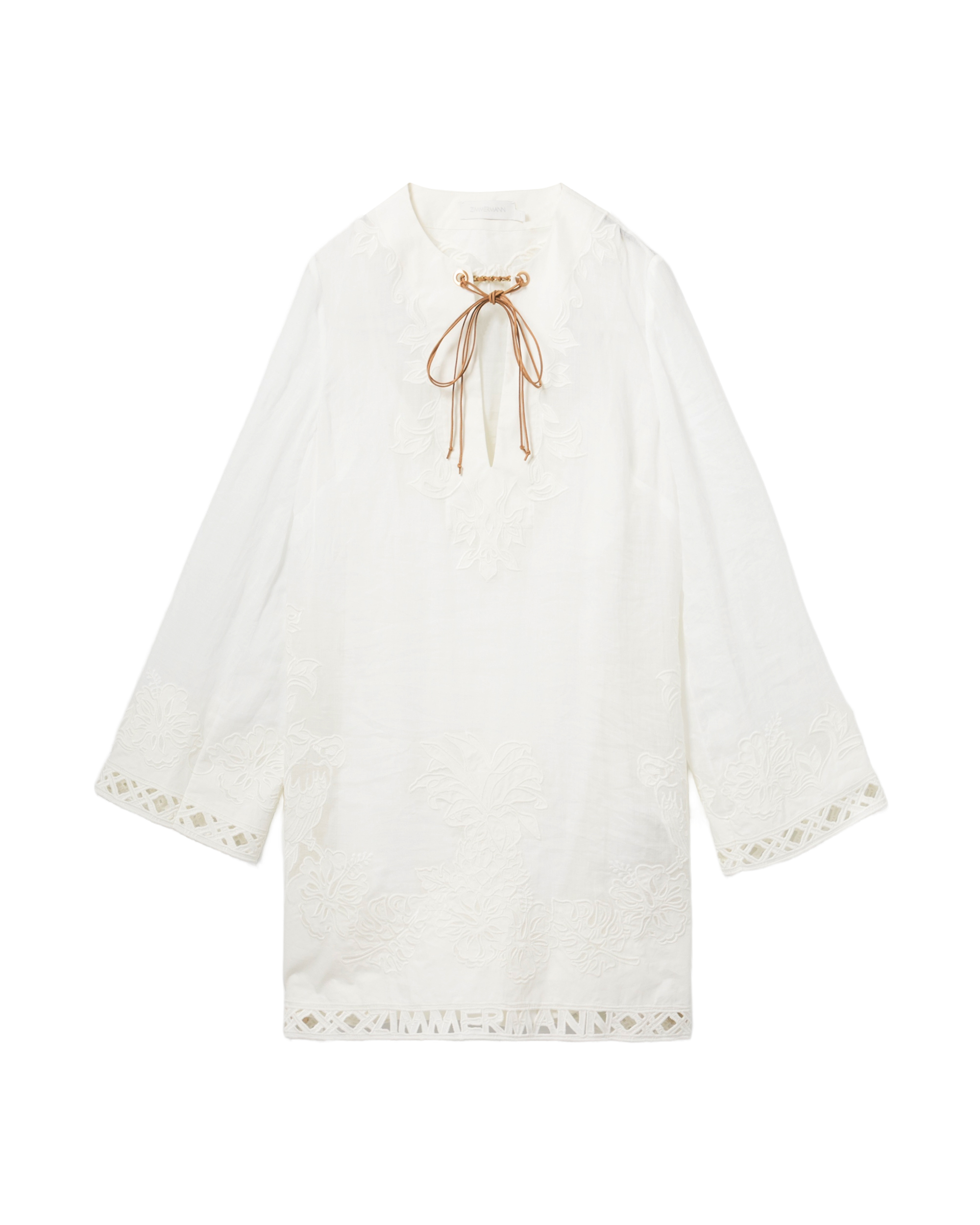
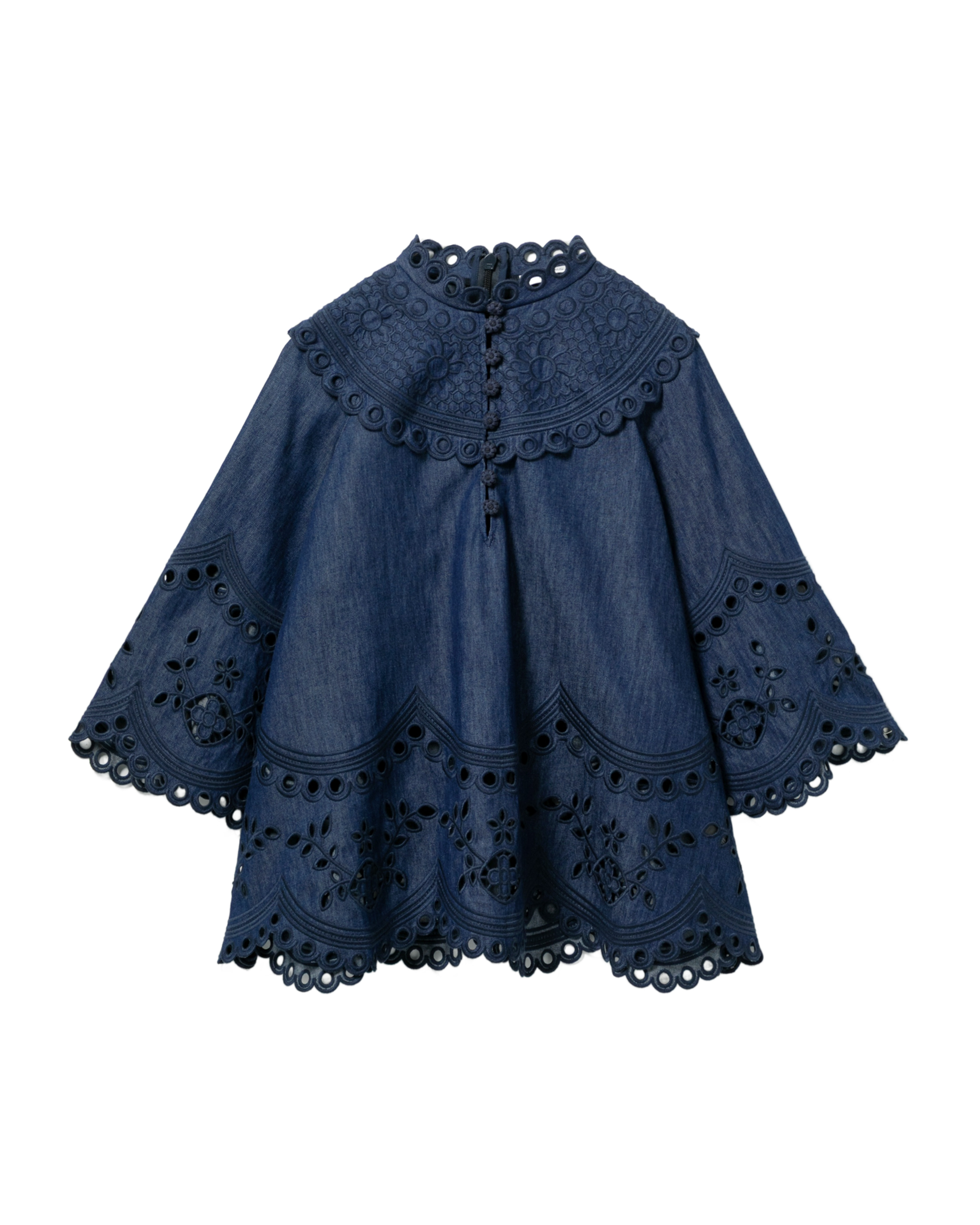
The room itself was the first tell. When Zimmermann chose to unveil its Cruise 2027 Collection before a crowded, camera-ready soirée rather than a conventional runway, it was making an argument about where the brand now belongs—not on the margins of Australian resort wear, but at the center of an international luxury conversation. Katie Holmes, Uma Thurman, and Naomi Watts arrived to see it, and their presence did what no press release could: it ratified the collection as a genuine red-carpet proposition. Holmes, in particular, has become something of a bellwether for the house, and the Who What Wear observation that elegant New York women now treat a well-cut jumpsuit as eveningwear—styled precisely the way Holmes does—captures the cultural shift Zimmermann has both anticipated and accelerated.
What distinguishes Cruise 2027 is its fluency in contradiction. The collection reads as resort wear in its ease—fluid silhouettes, sun-warmed palettes, the sense of garments designed to move through long afternoons—yet it carries the structural rigor of evening dressing. Zimmermann's signature flourishes are all present and accounted for: intricate lace and broderie detailing, sculpted bodices, billowing sleeves that catch light and air, and the kind of precise tailoring that keeps volume from becoming shapelessness. The jumpsuits in particular deserve their reputation; cut with a confidence that flatters rather than constrains, they are the collection's quiet thesis statement—proof that a single garment can hold both the languor of a holiday and the formality of a gala.
The Architecture of Ease
Look closely at the construction and the story sharpens. Zimmermann has long built its name on the intelligent use of linen, silk, and cotton lace, and this collection refines that vocabulary rather than reinventing it—crisp linens that hold a pressed line, silks with enough weight to drape rather than cling, and lace worked with the density of something far more precious. It is a collection that rewards touch as much as sight, and that is precisely the point: the brand is asking to be judged against the houses it now shares a guest list with. The hidden corsetry, the hand-finished hems, the proportions calibrated over decades—these are the details that separate a holiday dress from an evening proposition, and they are the details on which this collection stakes its claim.
A Guest List That Travels
And that guest list is expanding. The soirée arrives alongside CEO Roberto Eggs's publicly articulated strategy for global expansion, reported by WWD—a plan that positions Zimmermann not as a niche Australian export but as a fully international luxury brand with the retail footprint, the celebrity ecosystem, and the editorial gravity to match. The timing is not incidental. A Cruise collection is, by definition, a collection built for travel and for the customers who travel—and Zimmermann is now courting those customers in every market that matters. The front row told the story as clearly as any lookbook: Holmes, Thurman, and Watts are not regional names but global ones, and their presence signals a brand moving at a different altitude.
Who It's For
Who is this collection for? It is for the woman who has outgrown the dichotomy between "resort" and "occasion"—who wants a single wardrobe that moves from a Sydney harbour lunch to a Manhattan evening without a change of register. It is for the customer who recognizes that Zimmermann's real luxury lies in its construction. And it is for a new audience, introduced to the brand through the red-carpet visibility of Holmes, Thurman, and Watts, who will arrive at the collection expecting eveningwear and discover something more versatile. The jumpsuit, the sculpted bodice, the billowing sleeve—each is a piece designed to be worn hard and worn often, not archived after a single season.
Why It Matters Now
Why it matters now is a question of momentum. Luxury's center of gravity has shifted toward houses that can offer both accessibility and genuine craft, and Zimmermann occupies that space with unusual credibility. Cruise 2027 is not a bid for relevance—the brand already has that—but a declaration of arrival. It says, plainly, that a house built on Australian summers now dresses the world's most photographed women, and that it intends to keep doing so.
What remains, after the cameras and the guest list and the strategy documents, is the clothes themselves—and the philosophy they encode. Zimmermann has always understood that ease is not the absence of rigor but its most elegant disguise. A collection that can carry a woman from a long afternoon into a long evening, without asking her to change who she is, is a collection that understands something essential about how modern luxury is actually lived. The soirée was the setting. The collection was the argument. And the argument, this season, is persuasive.